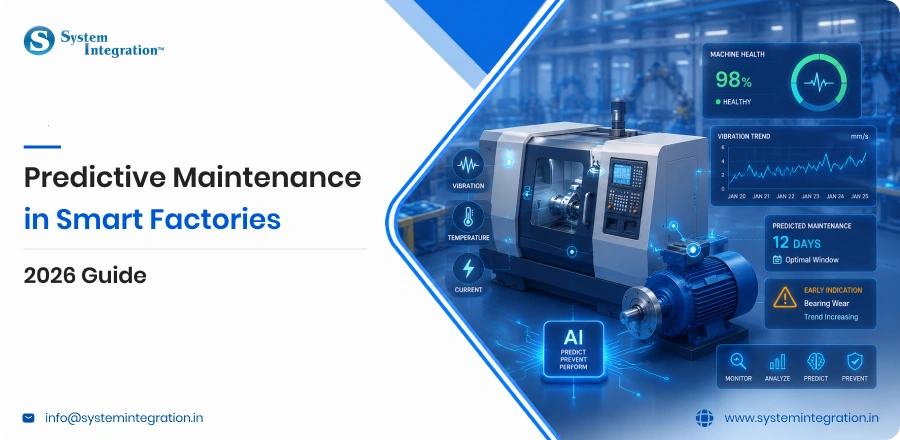
Introduction
Your inaction is affecting your profits with every passing minute on the production line. In 2026, unplanned downtime is predicted as one of the top two threats to manufacturing businesses that disrupt operations, delay delivery and drive up maintenance costs.
Reactive maintenance has become the most expensive option for manufacturers because they experience an average of roughly 25 downtimes each month. A surge in labor costs, complicated supply chains and accelerating automation have sent downtime expenses soaring more than half again from what it used to cost in 2019.
This is exactly the reason that predictive maintenance has now become one of the crucial strategies of smart factories. In this blog, find out how predictive maintenance works, the technologies that support it, steps to implementation, challenges and more.
What Is Predictive Maintenance? (And how it differs from reactive & preventive maintenance)
Predictive maintenance (PdM) is a kind of preventive maintenance based on condition and implementing real-time sensor data, artificial intelligence, and PDM analytics to predict equipment failure in advance to minimize downtime as well as maintenance costs.
| Maintenance Strategy | Approach | Downtime Risk | Maintenance Cost |
|---|---|---|---|
| Reactive Maintenance | Fix equipment after it fails | High | High (unexpected repair) |
| Preventive Maintenance | Maintained on a fixed schedule | Medium | Medium |
| Predictive Maintenance (PdM) | Use data in real-time to maintain only when required | Low | (prevents expensive failures) |
How Predictive Maintenance Works in a Smart Factory
IIoT Sensors: Vibration, Temperature, and More.
IIoT sensors monitor the health of machines by continuously collecting motion, temperature, sound, and the quality of electrical and lubricant fluid that can give an early warning about machine malfunction.
Real time data streaming and Edge computing
While cloud computing addresses some of the challenges faced by traditional industrial setups, it cannot overcome the demands for real-time analysis and instant decision-making; edge computing solves this dilemma by processing sensor data close to the equipment without solely relying on cloud infrastructure, which ensures low-latency responses while enabling seamless factory operation.
Failure Detection using Machine Learning Models
Machine learning algorithms analyze historical and real-time equipment data to identify anomalous patterns, make predictions about potential pieces of equipment that are likely going to fail soon, and suggest maintenance prior to disruptive-to-production rates of unexpected breakdowns.
Remaining Useful Life (RUL) Calculation
RUL or remaining useful life, estimates the operating time left before a defect is expected to fail and assists maintenance teams in scheduling repairs for the ideal moment.
Connect Production data to your existing Software (CMMS, SCADA) or PLCs
Integrate with CMMS, SCADA, and PLC systems to automate maintenance scheduling, monitor equipment performance, trigger alerts & improve operational workflows across the factory.
How Much Downtime Can You Actually Eliminate?
- Reduce unplanned downtime up to 50% through early fault detection and predictive maintenance.
- Reduce maintenance costs by 20-30% by only servicing equipment as needed.
- Increase Equipment Lifetime by Preventing Excessive Wear and Catastrophic Failures.
- Fewer interruptions on production and higher availability of assets translate to better Overall Equipment Effectiveness (OEE).
- Maximize production and profits by reducing unplanned outages & keeping the ball rolling.
Key Technologies powering predictive Maintenance in 2026
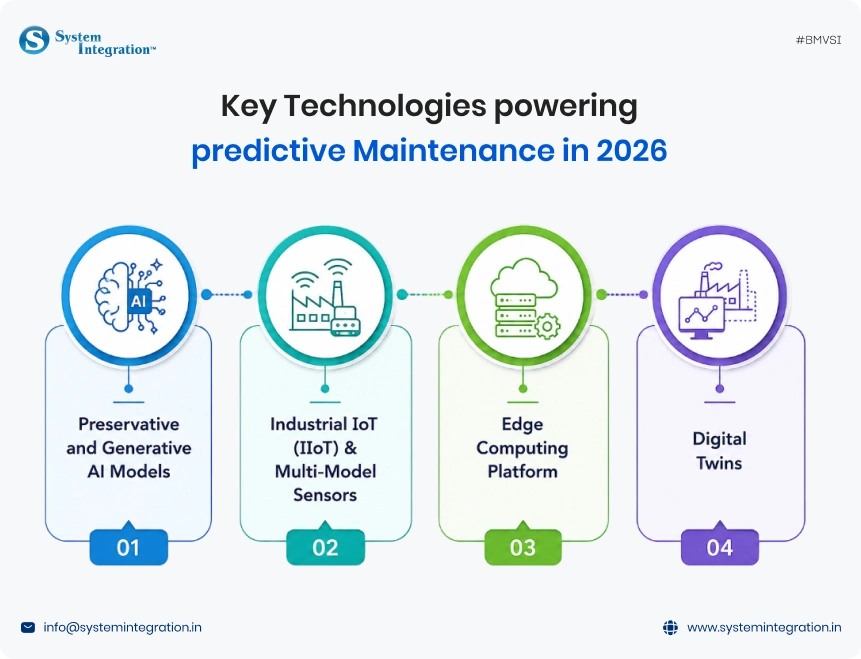
➜ Preservative and Generative AI Models: Prescriptive AI provides recommendations for the most effective maintenance actions while Generative AI can analyze complex equipment data, generate insights and help technicians troubleshoot.
➜ Industrial IoT (IIoT) & Multi-Model Sensors: IIoT devices and multi-modal sensors constantly collect vibration, temperature, acoustic, pressure and electrical data for precise in-situ equipment health monitoring.
➜ Edge Computing Platform: The Edge computing processes machine data locally, allows real time analytics, detects failures more quickly, has lower latency and solidifies predictive maintenance decision making.
➜ Digital Twins: Digital twins are a concept which creates virtual replicas of physical assets, simulating their performance and predicting failures before they occur while optimizing maintenance strategies.
Common mistakes that stops predictive maintenance from working properly
Alert Fatigue and Ignored Dashboards
Challenge: Predictive Maintenance systems generate too many false or low-priority alerts that it overwhelms maintenance teams which can lead to critical warnings being missed, and confidence in predictive maintenance is reduced.
Solution for it: Implement the AI-based alert stacking, avoid false positives and notify only mission-critical issues that need urgent resolution.
Bad Data Quality/Old Equipment Constraints
Challenge: Inaccurate sensor data or legacy machinery without connectivity robs the prediction of precision, which results in wrongful insights about equipment and poor maintenance choices.
Solution for it: Use quality sensors, calibrate devices routinely, purify collected data, and wherever applicable, leverage IIoT gateways to retrofit legacy equipment.
Lack of Maintenance-Team Buy-In
Challenge: Without the appropriate training and trust, suggestions from artificial intelligence can be discarded with no adoption of data-driven decision making methodologies or even threat to lean. Maintenance is going through a transformation challenge.
Solution: Train maintenance staff, include them in the implementation and use pilot projects to create a quantifiable result that builds confidence.
Using the wrong sensors for critical failure modes
Problem: Utilizing sensors that are not well-suited to the asset or monitoring parameters irrelevant to potential failure leads to a lack of clear indicators of failure, weakens prediction capability and increases risk of unplanned equipment failure.
Solution: First do a failure more analysis (FMEA) analysis and select sensors that monitor the most frequent and costly equipment failure points.
Predictive Maintenance ROI Calculator: What to Expect in A Year
In the first year, a predictive maintenance program typically generates around 40% to 60% ROI and a 6 to 14 month payback period, largely through 30% reduction in unplanned downtime. The financial benefits include reduced emergency repair costs, higher recovery from avoiding stoppages.
The Formula Finance Team Actually Use
ROI%
= ((Downtime Hour Saved X cost per hour) + Labour Saving – PdM Investment) x 100
PAYBACKS (MONTHS)
= PdM Investment % (Monthly Downtime Savings % Monthly Labor Savings)
How to Choose a Predictive Maintenance Platform in 2026?
Must-Have Features Checklist
- Monitoring equipment/end-to-end health in real-time
- Failure prediction and anomaly detection with AI/ML
- Integration with CMMS, SCADA, PLC and ERP systems in a seamless manner
- Custom alerts Automated maintenance workflows
- Strong cybersecurity powered by cloud or edge scalability
Build or Buy, or a Combination of Both
Build: By building a custom predictive maintenance platform, you gain control over all of the features, AI models and data security factors. This platform is ideal for large businesses that have their dedicated IT teams, unique operational needs, and also possess vital resources to invest in long-run development/maintenance.
Buy: you can buy the platform, its implementation is much quicker (and at a lower upfront price) which has been proven to work with ongoing support from the vendor. It is great for small and mid-size manufacturers who want to get things done fast without deep technical development.
Hybrid: A hybrid solution takes a commercial product as the foundation and adds custom integrations, embedded AI models or domain-specific workflows. This gives the flexibility that a tailor-made solution provides while greatly reducing implementation time and cost, making it suitable for manufacturers who are modernizing existing operations.
| Which Approach Should You Choose? Build: if customization is your first priority; Buy: if speed and simplicity are the core priorities; Hybrid: flexibility with quicker time to value. |
Questions to Ask Vendors Before Signing
- How Well Can You Predict AI Failures?
- What industrial systems (CMMS, SCADA, PLC, ERP) do you integrate with?
- Does the platform have support for legacy devices and IIoT?
- What are your security, compliance and data ownership policies?
- What does the implementation timeline, training, and ongoing support look like?
Concluding Words
Having predicted maintenance as a core pillar of smart factory automation helps manufacturers reduce unplanned downtime, optimize maintenance costs and extend equipment life. This is exactly the reason that predictive maintenance has now become one of the crucial strategies of smart factories.
FAQs
It can be defined as a strategy that uses Artificial Intelligence, Industrial IoT (IIoT) sensors and real-time data analytics to forecast the failure of equipment before the occurrence of catastrophe. This allows smart factories to lower their unplanned downtime, maintenance expenses and improve the equipment-based reliability.
Sensors and AI models are used in predictive maintenance to monitor machine health continuously. Maintenance teams can therefore arrange repairs prior to a breakdown by identifying early indicators that wear or failure is imminent, allowing them to cut unplanned downtime rates in half.
Predictive maintenance is heavily used in automotive & manufacturing, food and beverage, pharmaceuticals, oil & gas, energy mining & heavy industrial industries where equipment up-time is very important.
Yes. By installing various AI tools, devices around legacy machines, manufacturers can gather operational data and execute predictive maintenance without replacing existing equipment.