Introduction
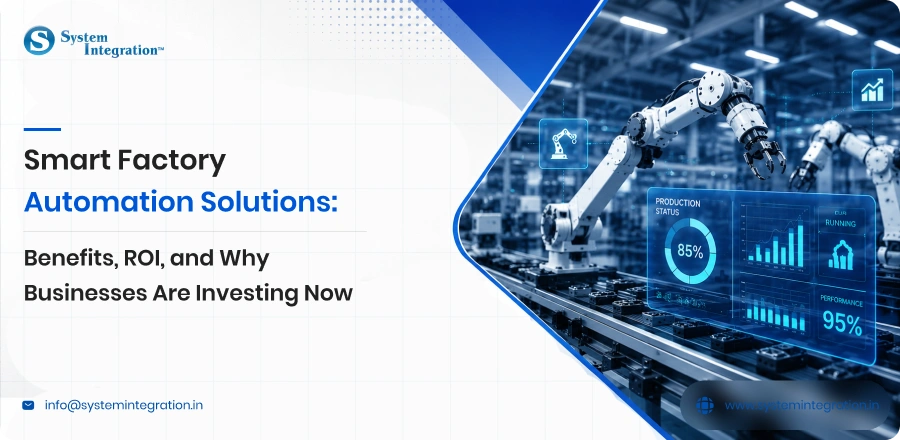
The future is here in the form of smart factories, machines that speak to each other, sensors that record every process in real time and artificial intelligence to make quicker and smarter decisions, leading sometimes even before a human notices there is an issue.
Using connected systems in smart factories helps improve efficiency, reduce downtime, enhance product quality and lower operational costs as opposed to monitoring and reactive maintenance manually.
With industry revolutionizing the global manufacturing sector, smart factories are laying a strong base for an intelligent, agile future production system that can evolve rapidly with changing market needs. This blog covers benefits, ROI calculations and more about smart factory automation.
How Smart Factories Differ from Traditional Automation
The aim of conventional automation is the automation of specific machines or unproductive operations. Each machine works independently, with little communication between procedures. When things go wrong, engineers often don’t find out until the production line is impacted.
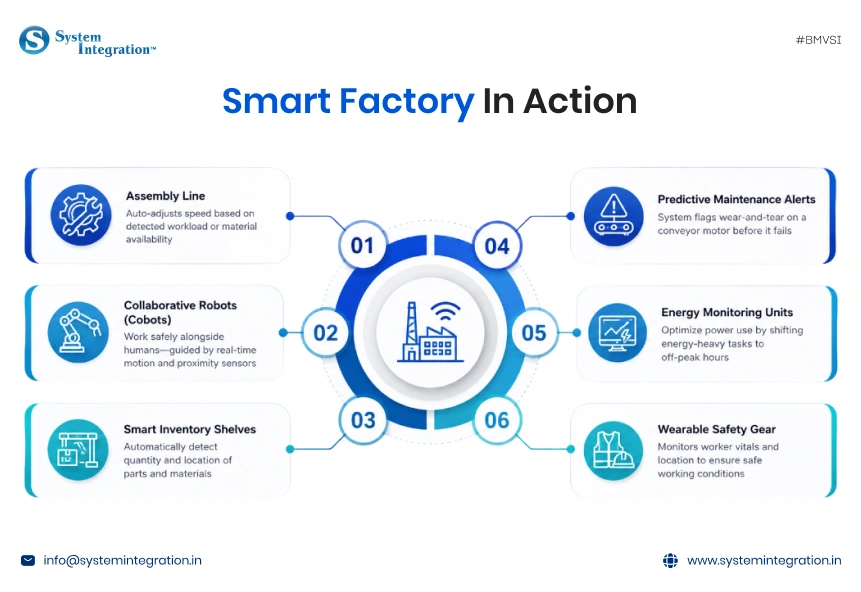
A smart factory takes automation to the next level. Smart tech stacks interconnect machines, detectors, digital solutions and engineers, sharing real-time data continuously. This enables production lines to self-monitor, predict equipment failures before they happen, adapt operations on the fly and optimise efficiency with minimal human intervention.
Simply put, traditional automation lets machines work automatically, and smart factories let whole production systems work intelligently.
Core Components: IIoT, AI, Robotics, and Real-Time Connectivity
Smart factories are powered by several advanced technologies working in concert. Each plays a unique role in helping manufacturing to be faster, smarter and more efficient.
- Real-Time Connectivity: Cloud, edge and high-speed networks keep machines, systems and teams connected so they can monitor immediately and make faster decisions.
- Artificial Intelligence (AI): AI looks at this data to find patterns, predict when machines might fail, improve quality and suggest better decisions on production.
- Industrial Internet of Things (IIoT): Smart sensors are deployed on machines, equipment and production lines to collect data, giving manufacturers full visibility into what is happening in their factories.
- Robotics: Modern robots perform repetitive, complex, or dangerous tasks with great speed and precision. Many collaborative robots can even safely work next to human workers.
Together, these technologies create a factory that can learn, adapt, and optimise itself continuously.
Benefits of Investing in Smart Factory Automation Now
➜ Labour shortages and increasing wage pressures
Rising wage costs and a dearth of skilled workers are making it increasingly difficult for manufacturers to maintain productivity. In a smart factory, repetitive tasks will be automated, helping to reduce the dependence on manual labour and allowing employees to engage in higher-value work, improving efficiency.
➜ Supply chain volatility and the need for speed
Frequent disruptions in the supply chain require manufacturers to react quickly to changes in demand and the availability of materials. Real-time visibility, predictive insights, and flexible production through smart factory automation enable businesses to adapt faster and reduce delays and operational risks.
➜ Early Adopters’ Competitive Pressure
Smart factory automation offers the benefits of higher productivity, lower costs, better product quality and faster delivery. To remain competitive and meet the expectations of industry leaders and customers, companies are investing in intelligent manufacturing technologies.
➜ Falling Technology Prices and Rapid Time-to-Value
The cost of advanced technologies such as AI, IIoT, cloud computing and robotics has never been lower. Smart factory automation can be adopted more quickly by businesses and they can begin to see measurable operational improvements sooner, with lower implementation costs and quicker returns on investment.
How to Make ROI Calculations for Your Facility
By using this equation:
ROI (%) = [(Annual Profits − Total Investment) ÷ Total Investment] × 100
Example:
Investment in Automation – $100,000
Annual Labor Profit – $70,000
Maintenance Cost Savings – $30,000
Energy Cost Savings – $20,000
Total Annual Profit = $80,000
ROI = [(120,000 − 100,000) ÷ 100,000] × 100 = 10% (Year 1)
In one Year, your total profit reaches 20% ROI in the first year, and because the initial investment has already recovered, the business continues to profit.
PRO TIP: Every factory is different. Your actual ROI depends on various factors, such as the costs of labour in your regions, the production volume and more.
Common ROI Timelines by Investment Type
| Predictive maintenance with AI | 6 to 12 months |
| Industrial IoT systems | 12 to 18 months |
| Robotics process automation | 12 to 24 months |
| Total transformation into a smart factory | 2 to 5 years |
How to choose the Right AI Software Development Company?
Selecting the right AI Software Development company is critical.
Look for companies that:
- Understand production workflows
- Offer a scalable automation architecture
- Ensure the company adheres to your industry standards
- Provide AI integration capabilities
- Deliver long-term support
Businesses evaluating vendors often look for the best Software Development company in India due to strong engineering talent and competitive pricing.
Wrapping Up Thoughts
Smart factories give manufacturers a decisive advantage in an increasingly unpredictable and fast-moving business landscape. Smart factory transformation becomes a key strategy for staying resilient and future-ready.
Implementing robust smart factory solutions will allow businesses to minimise downtime, ensure better optimisation, quality products and agile operations that will remain competitive in the increasingly digital industrial world of the future.
FAQs
A smart factory is a manufacturing facility that uses connected technologies such as IoT, AI, sensors, robotics, and data analytics to automate processes, monitor operations in real time, and make smarter decisions. It helps manufacturers improve productivity, reduce downtime, and increase efficiency.
On the whole, manufacturers start to see quantifiable returns within 12-36 months. Your ROI is contingent on various parameters like the extent of implementation, efficiency gains in operations, reduced downtime, labour savings and increased production throughput. Organizations that target high-return use cases can often deliver results more quickly.
By reducing manual tasks, minimising downtime through predictive maintenance, optimizing production workflows, improving product quality and allowing real-time decision-making based on operational data, it increases efficiency.
Smart factories use real-time data, AI, and automation to identify bottlenecks, optimise workflows, and reduce manual errors. These tools help teams anticipate problems before they occur.