Introduction
No longer confined to the pages of science fiction, artificial intelligence is emerging as one of the key engines in India’s digital transformation journey. With businesses, governments and startups adopting AI at an unprecedented pace, new AI powered solutions are being integrated across industries nationwide to increase efficiency, drive down costs and improve the overall experience.
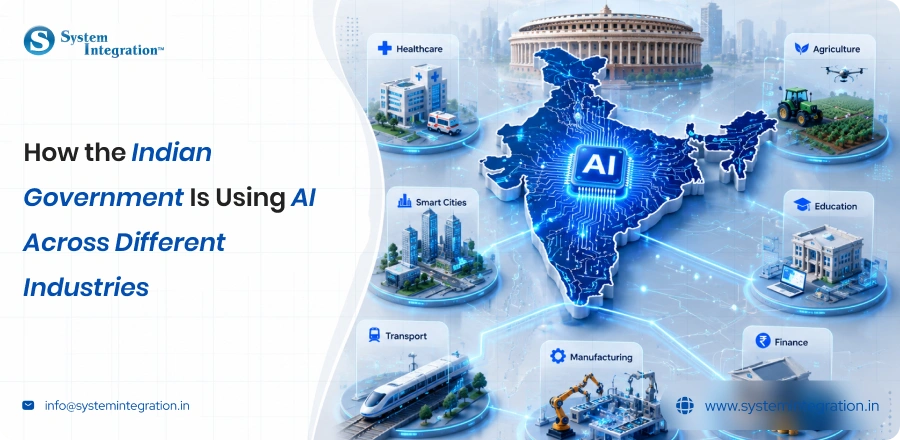
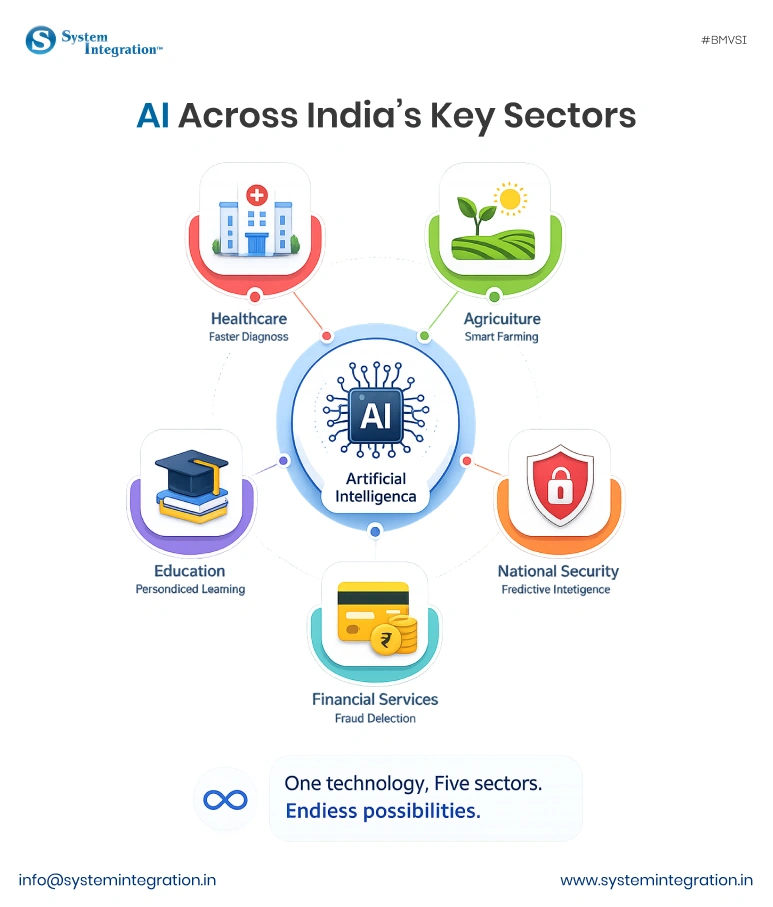
AI across key sectors in India to enable faster medical diagnoses, personalized learning, optimise manufacturing, secure financial services and modernise agriculture.
By 2023, India has the capability to establish itself as a global AI innovation hub owing to strong government initiatives, a growing startup ecosystem & increased investments in AI infrastructure.
The organizations which will have a competitive advantage and tap growth opportunities are those that will start leveraging Artificial Intelligence strategically as adoption of AI accelerates.
This article will detail how AI is driving change across sectors like healthcare, finance and retail in India, the advantages it’s bringing to bear and what this technological transition means for businesses, labourers and the economy.
The Foundation: India AI Mission and National AI Strategy
National Strategy for AI
The story of Artificial Intelligence in India took a definitive turn in 2018 when NITI Aayog published the National Strategy for Artificial Intelligence, popularly known as #AIForAll. The vision of the strategy was to harness AI for inclusive economic growth and social development, rather than focusing simply on commercial applications.
The framework recognises five sectors that will be positively impacted by AI:
➜ Healthcare
➜ Agriculture
➜ Education
➜ Smart mobility and transportation
➜ Smart cities and infrastructure
Other important matters highlighted in the strategy included developing capabilities for AI research, increasing access to quality datasets, finding new talent in AI, incentivising public-private partnerships, and creating noble principles for ethical AI.
AI Governance Guidelines (AIGG) and AI Safety Institute
With the rapid adoption of AI, the status of these systems being trustworthy, transparent & secure has become even more key. To put these concerns to rest, India has announced the release of AI Governance Guidelines (AIGG) to establish responsible development and the deployment of Artificial Intelligence systems.
Organisations are urged to pay attention to the guidelines,
➜ Transparency in AI decision-making
➜ Fairness and bias mitigation
➜ Privacy and data protection
➜ Security and reliability
➜ Human oversight and accountability
The other is the India AI Safety Institute, which was set up to enhance research on safety in AI, assess cutting-edge AI models, and design qualifying frameworks for reliable AI systems.
How AI is Transforming India’s Top Sectors
AI in Healthcare
AI Diagnostics in Rural and Underserved Areas
In rural Indian areas, where both specialist doctors and advanced medical facilities are limited, AI-powered diagnostic tools that allow quick detection of diseases, guide remote consultations between patients and doctors, or assist health workers who rarely have access to accurate diagnoses significantly improve healthcare access.
Hospital AI Centre of Excellence (Delhi)
In New Delhi, the AI Centre of Excellence in Healthcare promotes advanced healthcare solutions through AI research & innovation and collaboration to improve clinical decision-making, accelerate medical research, and provide better patient outcomes throughout India.
| Mahakumbh 2025 - Crowd and Health Management In Mahakumbh 2025, AI-enabled crowd monitoring, traffic management, and health surveillance, analysing real-time data, help authorities improve emergency response, optimise resource deployment, and enhance public safety for millions of visitors. |
AI in Agriculture: from Guesswork to Smart Farming
This is how AI is revolutionising agriculture India:
- AI-assisted help for farmers
- AI chatbots integrated with platforms like PM-KISAN address farmers’ queries, redress grievances and offer personalised farming advice in regional languages, bringing expert guidance to farmers’ fingertips at any time.
- Partnering with AI Centres of Excellence
- The AI Centre of Excellence in Agriculture is developing next generation farming solutions, promoting precision agriculture and supporting research that helps farmers grow more with less.
- More precise crop and weather predictions
- AI can help farmers predict crop yields, plan irrigation and prepare for changing climate conditions by analysing weather patterns, soil conditions, satellite imagery, and historical data.
- Smart Farming platforms like Kisan AI Dhenu
- AI-based platforms offer crop health, pest detection, fertiliser usage and market prices in real-time, so their recommendation to farmers help them take prompt decisions based on data.
The impact: AI is revolutionizing agriculture into precision farming, assisting Indian farmers to be more productive with lower wastage and become climate-and market-resilient.
Transforming the Education Sector through AI
The key AI application includes:
- Curriculum integration
- The Central Board of Secondary Education (CBSE) and NCERT introduce AI as early as Class 6, offering AI as an optional subject in Classes 9-12.
- Personalised Adaptive Learning
- Platforms use AI to track student error patterns and learning speed, and deliver tailored, JEE-level problem sets and lessons.
- Multilingual and Inclusive Learning
- The DIKSHA platform uses AI for read-aloud features, video keyword search, and translating textbooks into 22 Indian languages.
- Virtual Tutors and Admin Automation
- AI chatbots provide 24/7 doubt resolution, while automated analytics help manage student attendance and identify at-risk learners early on.
AI in National Security and Law Enforcement
Here are some ways AI is improving national security and law enforcement:
- Predictive policing and OSINT tools
- Accessing patterns of crime, public data and Open-Source Intelligence or OSINT resources for risk detection, predicting the hot spots of crimes and supporting proactive policing practices.
- Cyber security and threat detection ( powered by AI )
- Machine learning systems also continuously monitor the networks, able to identify suspicious activities and cyberattacks in real-time and respond faster to safeguard critical infrastructure and sensitive data.
- Digital forensics platforms
- Analysis of digital evidence unlocked by AI, like emails, mobile devices, CCTV footage and documents, proves that it accelerates both the forensic investigations and help investigators identify key insights more efficiently.
- Multi-source intelligence fusion systems
- AI combines the data from the surveillance system, sensors, satellite imagery, and intelligence databases into a unified view, enabling faster decision-making and better coordination across security agencies.
AI in Financial Intelligence and Regulation
Key AI initiatives and regulatory frameworks currently shaping India’s financial sector include:
- RBI’s Internal AI Models: The Reserve Bank of India uses proprietary AI model like ChiRAG for language processing and MuleHunter to help banks detect illicit mule accounts used in financial fraud.
- Credit Expansion (ULI): The unified lending interface (ULI) uses AI to analyze “digital footprints” for credit risks, making frictionless credit accessible to millions who lack traditional credit scores.
- The free – AI Framework: Introduced by the RBI to govern AI in banking, this framework mandates that all regulated entities implement board-approved AI policies, independent algorithmic validation, and strict ‘ human-in-loop’ requirements for high-impact credit or investment decisions.
- Fraud and AML Tracking: the Financial Intelligence Unit (FIU) and banking institutions use AI identity verification and transaction monitoring to strengthen anti-money laundering (AML) and know-your-customer (KYC) compliance.
Challenges in Government AI Adoption
➜ Departmental Data Fragmentation
Government data is often trapped in silos, making it difficult to share and use to develop AI models that need a high-quality data set.
➜ State Policy Gaps
States’ adoption of AI is not uniform, with differences in policies, funding, and implementation slowing progress across the country.
➜ Limited Infrastructure & Compute Access
Many public institutions don’t have the high-performance computing resources and cloud infrastructure needed to develop and deploy advanced AI solutions.
➜ Lack of Skills and Talent
There is also a shortage of AI professionals, data scientists and skilled government personnel that make it difficult to effectively implement and manage AI initiatives.
Summarizing Up
AI is transforming India’s future by making our industries smarter, public services more efficient, and businesses more innovative. As adoption continues to accelerate, working with an experienced AI development company can help organisations build scalable, secure and future-ready AI solutions that drive long-term growth and competitive edge.
FAQs
The India AI Mission is the Government of India’s flagship initiative to catalyse the adoption of AI across the country. It is focused on building AI infrastructure, supporting startups, developing skilled talent, promoting research and enabling responsible AI innovation across sectors and public service.
AI is extensively used in healthcare, agriculture, education, finance, transportation, public administration, law enforcement and smart cities. These sectors use AI for automation, predictive analytics, citizen services, better decision-making, etc.
India still does not enjoy a dedicated law related to AI. Yet, the government has been taking initiatives such as AI Governance Guidelines (AIGG), IndiaAI Mission and recently launched Digital Personal Data Protection (DPDP) Act, 2023, for the responsible development of AI and data protection.
AI enables chatbots that have improved citizen services, optimised traffic management, assisted grievance and redressal, enhanced healthcare diagnostics and service delivery amongst government departments, using it to enable faster data-driven decisions.