Introduction
Did you know that smart factories in the United States have reported productivity improvements of up to 65% and operational cost reductions of up to 50% through smart factory solutions?
These remarkable results are a testimony to why global businesses are quickly embracing smart factory automation.
To put it in simple words, manufacturing automation companies utilizes connected machines, sensors, artificial intelligence (AI), robotics and real-time data to automate manufacturing processes while enhancing decision-making and eliminating manual intervention.
With costs escalating, lack of skilled experts in the market and increasing customer expectations; implement smarter manufacturing adoption has become a competitive necessity more than just a choice.
This blog will cover how smart factory automation works, the technologies that enable it, its main advantages, real-world use case examples and why it is paving way for the future in today’s manufacturing industry.
What is Smart Factory Automation?
Smart factory automation is the use of modern technologies such as robotics, sensors, artificial intelligence (AI), cloud computing, and the Internet of Things (IoT) to run a factory in a smarter, faster, and more efficient way.
Think of it like this:
- Traditional factory ➜ workers and machines follow instructions for every step.
- Smart factory ➜ workers, machines, and AI working together, learning from data, and optimizing processes automatically.
Identify Business Processes to Automate
↪ Repetitive and Time Consuming Tasks: Automate time-consuming tasks like data entry, data management, approvals & other administrative work to save time as well as avoid errors.
↪ Customer support Workflows: Chatbots and automated ticketing systems to answer customer queries and provide faster responses.
↪ Sales and Lead Management: Automate lead capture, follow-ups, sales & customer engagement processes to increase conversions.
↪ HR & Employee Onboarding: automate the recruitment process, simplify verification document steps, and train employees with the automation tools.
↪ Finance and Reporting Operations: Use RPA to enable invoice processing, expense tracking, payroll management, and financial reports generation with improved accuracy.
Core Technologies Powering Smart Factory Solutions
Industrial Internet of Things (IIoT)
What it is: Networked sensors, smart devices, and edge computing nodes embedded directly into manufacturing machinery.
Function: Smart solutions Collects and transmits granular real-time data on temperature, vibration, energy consumption, and cycle times.
Impact: delivers complete visibility into the shop floor and supply chain.
Artificial Intelligence (AI) and Machine Learning (ML)
What it is: advanced software algorithms that process raw IIoT data to identify patterns, make predictions, and automate decision-making.
Function: Powers predictive maintenance (forecasting machine failures before they happen) and Adaptive Quality Assurance (auto-correcting manufacturing defects in real-time).
Impact: Minimises unplanned downtime and slashes scrap and rework rates.
Robotics and Autonomous Systems
What it is: fixed industrial robotics arms, autonomous mobile robots (AMRs), and automated guided vehicles (AGVs).
Function: take over repetitive, labour-intensive, or hazardous tasks. Today’s AMRs dynamically navigate the factory floor, transporting materials safely alongside human workers.
Impact: Increases throughput, boosts precision, and improves workplace safety.
Industrial Cybersecurity
What it is: Specialized security frameworks designed to protect interconnected operational technology (OT) networks from cyber threats.
Function: Safeguards control systems (like SCADA and PLCs) from external breaches or internal system anomalies.
Impact: Ensures business continuity and protects vital intellectual property.
Digital Twin
What it is: exact, real-time virtual replicas of physical assets, processes, or entire factory floors.
Function: allows operations to simulate new production workflows, stress-test physical changes, and optimize layouts virtually before executing them in reality.
Impact: Eliminates expensive trial-and-error, reduces waste, and accelerates product development.
Industry Specific Benefits of Smart Factory Solutions
| Industry | Smart Automation Benefit |
|---|---|
| Automotive | Increases the assembly line's flexibility, automated robots execute high precision painting while sensors ensure parts are fitted perfectly. |
| Pharmaceuticals | Compliance automation, contamination control and track-and-trace capabilities. Automate systems to monitor environmental conditions. |
| Food & Beverage | Strict hygiene standards and shelf life compliance. Quality inspection, demand-driven production. |
| Aerospace | Enables accurate quality assurance and traceability. Precision manufacturing, digital twin simulation |
| Electronics | Achieve micro-level precision. Micro-assembly robotics, zero-defect production. Enables the assembly of tiny, complex components without near-zero defect rates. |
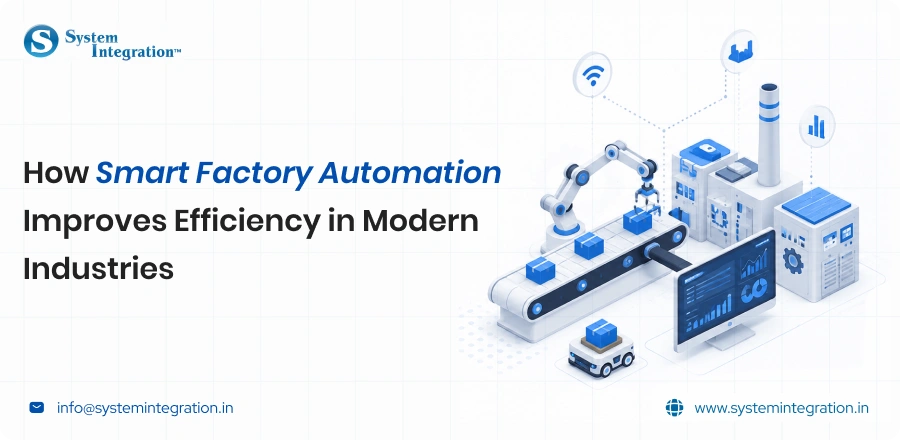
How Smart Factory Automation Improves Efficiency
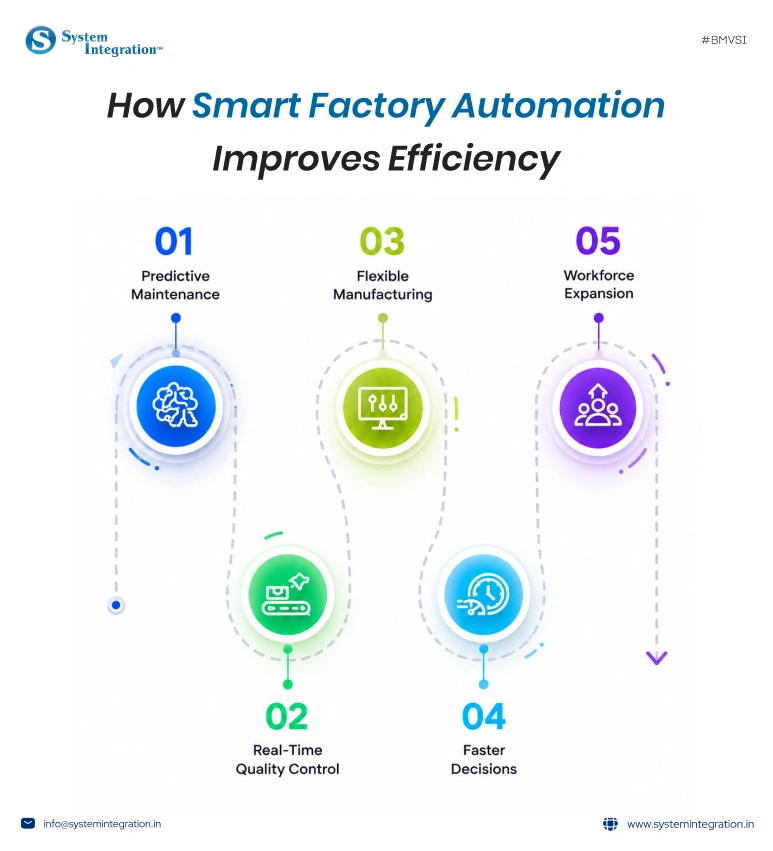
Predictive Maintenance Reduces Downtime
- Moving from reactive to predictive: prevention of failures before they happen.
- AI models detect 2–4 weeks of advanced bearing degradation detection, seal wear and alignment drift before failure and generate automatic work orders with Equipment ID, Failure mode and recommended parts, which makes it possible to avoid 30% of unplanned downtime reductions.
Real-Time Quality Control
- AI-based inspection systems to replace manual checks
- AI inspection systems help achieve over 95% uptime for equipment and improve quality defects by approximately 70–80% in smart factories.
Flexible and Adaptive Manufacturing
- Smart factory uses automation, AI, and IoT to automatically adjust production lines, tooling, and workflows.
- Flexible manufacturing systems can quickly reconfigure themselves to produce different products or variants without much retooling or set-up time, thus enabling mass customisation while retaining the efficiency of mass production.
Faster Decisions with Real-Time Data
- Real-time data eliminates the guesswork from the factory floor and supports data-backed actions.
- Today’s automation is a mix of robotics, real-time sensing, machine learning and feedback loops, not only delivering operational efficiency but also driving the rate of decision making.
Expanding the Workforce, Not Replacing It
- Rather than eliminating jobs, it automates repetitive tasks and let focus on more important tasks.
- Facilities are shifting from smart factory fundamentals to cognitive networks, incorporating hybrid human-AI workforces and ecosystems of intelligent agents.
The Future of Smart Solutions
- Agentic AI learning and deciding by itself without any need for human intervention. Thus, consuming less time and making quicker and more accurate decisions.
- Agentic AI is likely to accelerate smart manufacturing and operations, with adoption expected to increase significantly in the coming years.
- Industry 5.0 is focused on human-centred automation instead of pure machine replacement for collaborative manufacturing.
- In 2026, Smart manufacturing adoption has reached 47%, while Efficiency gains driven by AI across industries have reached up to 31%
Conclusion
Smart factory solutions deliver visible ROI by improving efficiency, lowering costs, raising quality, increasing productivity and providing more operational agility. Are you ready to revolutionise your production floor? Partner with renowned manufacturing automation companies and kick-start your journey towards a smart factory of the future.
FAQs
By reducing manual tasks, minimizing downtime through predictive maintenance, optimizing production workflows, improving product quality and allowing real-time decision-making based on operational data it increases efficiency.
Smart factories often involve concepts such as Industrial IoT (IIoT), artificial intelligence (AI), advanced analytics, cloud computing, machine learning, robotics & automation, edge computing and digital twins to develop smart connected manufacturing ecosystems.
Identify repetitive activities, and start with free or inexpensive automation tools. Even better, there are several platforms available that allow you to begin with a free plan, allowing you to set up email notifications, lead management, file transfers and other mundane tasks, reducing the burden of your job as your business grows.
On the whole, manufacturers start to see quantifiable returns within 12-36 months. Your ROI is contingent on various parameters like the extent of implementation, efficiency gains in operations, reduced downtime, labour savings and increased production throughput. Organizations that target high-return use cases can often deliver results more quickly.