Introduction
The global market of mobile app development stands at around $305 billion in 2026 and is on track to reach around $618 billion by 2031.
And the number of downloads of the app is increasing rapidly. Thus, having a mobile app for the business is not enough anymore.
To stand out in this competitive landscape, businesses need to focus on providing exceptional user experiences, seamless performance and features that solve real customer problems.
Today’s users expect personalised recommendations, immediate assistance, secure transactions, and seamless experiences across all devices.
Whether you are a startup launching a new product or an enterprise trying to enhance customer engagement, investing in mobile app development is no longer an option but a strategic necessity. Thus, in this blog, we will walk you through every step of the mobile app development journey simply, clearly and in right order.
The Types of Mobile App Development
Native Apps
Native applications are designed for a specific operating system, like iOS or Android. They provide better performance, a natural user experience and all device features and hardware accessibility.
- Key Elements:
- High-speed performance
- Better user experience
- Full device integration
- Enhanced security
- Offline functionality
Hybrid Apps
Hybrid Apps Hybrid apps use the power of web technologies and native mobile app at certain level. One codebase runs on several platforms, which makes it quicker and cheaper for businesses to develop.
- Key Features:
- Single codebase
- Lower development costs
- Faster deployment
- Cross-platform compatibility
- Easier maintenance
Cross-Platform Apps
Cross-platform apps are created through platforms such as Flutter and React Native, which enable devs to build the applications under several different OS from one codebase with nearly nativity.
- Key Features:
- Shared codebase
- Reduced development time
- Consistent user experience
- Near-native performance
- Faster updates
Progressive Web Apps (PWAs)
Progressive Web Apps are web applications that offer an experience similar to native apps from a browser. They load near instantly, function offline, and remove the hassle of downloading apps from app stores.
- Key Features:
- No app store required
- Fast loading speeds
- Offline access
- Lower development costs
- Easy updates
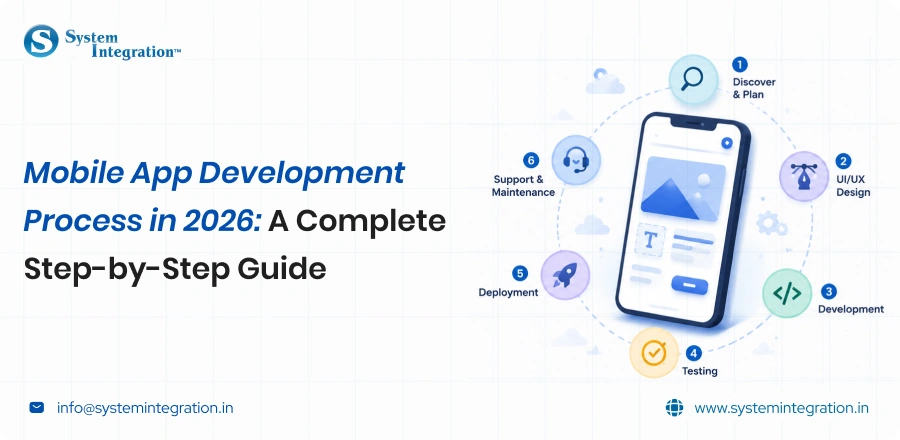
Complete Steps Of Mobile App Development: From Start To End
Step 1: Ideation and Concept Validation
The first step is to define the main purpose of your app. This outline features what you are building, which will help you remain persistent in providing value to users with your app.
Recognise your target audience and their pain points. The more familiar you are with your audience, the stronger your product will be.
Market research & competitor analysis to see if there are gaps, opportunities or room for improvement. To make your product more competitive.
Step 2: Planning & Requirement Gathering
Prior to any development, determine what success means for your app. Set target metrics that you will use to measure success, such as the number of users acquired, engagement multipliers, growth in revenue/profit, customer retention rate or whatever your key metrics are.
How to Build a Product Roadmap and Prioritize Features
- Key Steps:
- Define must-have and nice-to-have features
- Minimum Viable Product (MVP)
- Plan feature releases in phases
- Align features with business goals
Estimating Timeline, Team, and Budget
- Key Considerations:
- Determine project scope and complexity
- Identify required development resources
- Set realistic development milestones
- Budget testing and maintenance
- Include contingency for unexpected changes
Step 3: Select the Best Technology Stack
| Key Technologies | Best For |
|---|---|
| Swift, Kotlin | High-performance native apps need platform-specific functionality and a better user experience. |
| Flutter, React Native | Lower costs and faster development with a common codebase for iOS and Android |
| Node.js, Python, Java, AWS, Azure, Firebase, PostgreSQL, MongoDB | Handling application logic, data storage, authentication and scalability |
| AI/ML, Generative AI, AR/VR, IoT | Customised experience, automation, predictive insights, and interactive in-app capabilities. |
Step 4: UI/UX Design: Developing Brand with Modern User in Mind
A good UI/UX design improves readability, increases brand recognition, and provides accessibility for a wide audience of users. And a great UI/UX designer can help businesses establish a visual blueprint for teams planning layouts, features, and user journeys.
Plus, prototypes help validate ideas in the early stages, usability problems can be identified sooner, helping prevent costly changes down the line.
Also, the design must be responsive as it delivers a consistent user experience on different devices, screen sizes or whether the device is in portrait or landscape.
Step 5: The Development Phase: Bringing App To Life
Front-End Development
This involves coding the client side of the application. iOS or Android developers translate the designed UI/UX (from tools like Figma or Sketch) into an interactive layout.
Key Tasks: ensuring visual responsiveness, implementing animations, and building the interface components that a user interacts with.
Technologies: frameworks such as Flutter, React Native, or Swift/Kotlin are commonly used.
Back-End Development
This is the “brain” of your application. This secures the logic and manages the flow of information between the app and the database.
Key Tasks: setting up serves, managing user accounts (authentication), data storage, and configuring push notifications.
Technologies: platforms and languages such as Node.js, Firebase, or Supabase.
API Integration
APIs (application programming interfaces) allows your front-end to communicate with your back-end and any third-party services.
Key Tasks: enabling features like geolocation, payment processing(e.g., Stripe or Razorpay), and social media logins.
Step 6: Quality Assurance and App Testing
Quality assurance and app testing ensure software functions reliably, is secure, and provides a seamless user experience. It involves a combination of manual and automated processes throughout the development lifecycle to detect defects before the app reaches the end user.
Manual Testing: QA testers manually interact with the app to simulate real-world human behaviour and exploratory testing.
Automated Testing: Developers write scripts to run repetitive tests (e.g., regression or CI/CD integration) automatically, which speeds up the testing cycle.
Explore our automated software testing services to help businesses streamline quality assurance with advanced automation frameworks, enabling faster releases, reduced testing costs, and reliable software performance across web, mobile, and enterprise applications.
Step 7: Post-launch maintenance and optimisation
It ensures the app works smoothly and stays secure, compatible with new operating systems, and relevant to changing user needs and market trends.
Corrective Maintenance: it involves resolving the errors and bugs from the app, which are creating any kind of problems in the app and also involves the OS updates regularly to keep the app scalable.
Adaptive Maintenance: adjusting the codebase to support annual OS updates. Ensuring the app works flawlessly on newly released smartphones, tablets, and varying screen sizes.
Feature Enhancements & User Experience: adding small features or modifying the existing ones, tweaking UI/UX, or adjusting workflows based on user reviews. Tracking user behaviour using various tools to enhance user retention.
Mobile App Development Costs In 2026
Applications rely on advanced infrastructure, data manipulation, and smart automation capabilities, which are going to be more expensive.
| App Complexity | Development Time | Estimated Cost Range |
|---|---|---|
| Basic AI App | 1–2 Months+ | $5,000 – $15,000+ |
| Medium AI App | 4–6 Months+ | $20,000 – $40,000+ |
| Advanced AI App | 7–12 Months+ | $40,000 – $70,000+ |
Why Businesses Opt for App Development in India
India continues to be one of the top destinations for mobile app development services owing to:
👉 Pricing Competitiveness
👉 Expert development teams
👉 Expertise in strong AI
👉 Faster delivery of projects
👉 Flexible models of engagement
The high-quality results at a reasonable cost are a major reason why many global businesses outsource AI app development to Indian software companies.
How to Select the Right Mobile Development Partner
➜ Essential Qualities to Consider While Picking a Development Agency
Pick a development agency that has demonstrated experience, clear communication skills, technology proficiency and implementation, as well as industry experience and a portfolio of work. While AI reliance mainly provides you with post-launch support, domains working on scalability are just as important.
➜ Things to ask before you sign a contract
Inquire about project schedules, development methods, communication procedures, ownership rights, security measures in place, pricing structure and post-launch assistance. Having clear expectations early on is key to avoiding confusion and surprises later, both in terms of managing the project and its budget.
➜ Stay Away From Wrong Fits
Be aware that some companies promise the wrong or unrealistic timelines, unclear pricing, poor communications, or do not have any maintenance plans.
Concluding Words
Building a successful mobile application takes planning, the right technology stack to maximise performance efficiency and scalability for growth, user experience-focused design, and continued optimisation. Working with the best mobile app development company enables exceptional quality, scalability, reliability, performance and long-term business value while effectively engaging customers.
FAQs
It usually takes:
- Basic app = around 1 to 3 months
- Medium complex app = around 3 to 6 months
- Complex app = around 6 to 12 months
Mobile app development costs range globally from round $5,000 to 100,000+, depending on the company’s requirements and the type of app they are creating and on which platform they want to launch it.
- Choose native app development if you want high performance and complex apps, and want an app dedicated to any one platform.
- Choose cross-platform app development if you want an app in a cost-effective manner and for iOS and Android platforms.
Start by creating the basic features in the app, and also avoid creating the app from scratch, which will cost so much. Adopt a low/no-code development process.