Introduction
Considering automation, but a bit worried that it might break the budget for your small business? You’re not alone.
Lots of business owners think that automation means an expensive cost, complex computer programs and a dedicated IT team. The reality is that by 2026, the cost of automation has never been lower and its penetration more widespread.
Businesses of any size can implement budget-friendly automation solutions to streamline invoicing, marketing, or operations from automating repetitive tasks like lead management and customer support. The true cost varies according to the complexity of workflows, myriad tools required, and integration, as well as ongoing maintenance.
In this section, we’ll look at the real cost of business automation in 2026, review different pricing models, and help you understand what to expect before you make an investment. This will give you a clear picture of how automation can provide long-term savings and business growth.
What is Automation?
AI automation refers to the use of artificial intelligence technologies to perform automated, low-human-involvement, and repetitive tasks, workflows, and business operations. It can analyse data and learn patterns to arrive at decisions, adjusting itself over time for better performance.
Currently, automation finds its applications in various places core to the industry, such as healthcare, finance, retail, customer support, and manufacturing. Thus, automation helps in reducing the cost of manual and unproductive processes and enhances the efficiency of your business.
| Key Benefits of AI Automation 🤖📈 ✅ Automation of repetitive tasks and time-saving ✅ Helps businesses reduce operational costs ✅ Improves productivity and operational efficiency ✅ Reduce the Human Errors in the workflow ✅ Provides faster responses to enhance customer support ✅ Gives data-driven insights to make better decisions |
Key Technologies Behind AI Automation
↪ Machine Learning
Through ML, AI systems can learn from past data, discover patterns, and enhance performance. It enables businesses to automate predictions, recommendations, fraud detection and more for intelligent decision-making without human supervision.
↪ Natural Language Processing
NPL acts as the “interpreter” between human and machine communication and machine action, letting AI comprehend, interpret and generate text or speech to automate complex, language-based workflows.
↪ Generative AI
Generative AI utilizes advanced AI models to generate content like text, images, code, audio and videos. Businesses employ it for tasks as diverse as content creation, software development, customer communications, and more.
↪ AI Agents
AI agents are smart systems capable of independently completing tasks by studying data, making decisions, and taking actions. Automation solutions help businesses automate workflows, manage operations, interact with users and enhance productivity.
How Much Does Automation Cost in 2026?
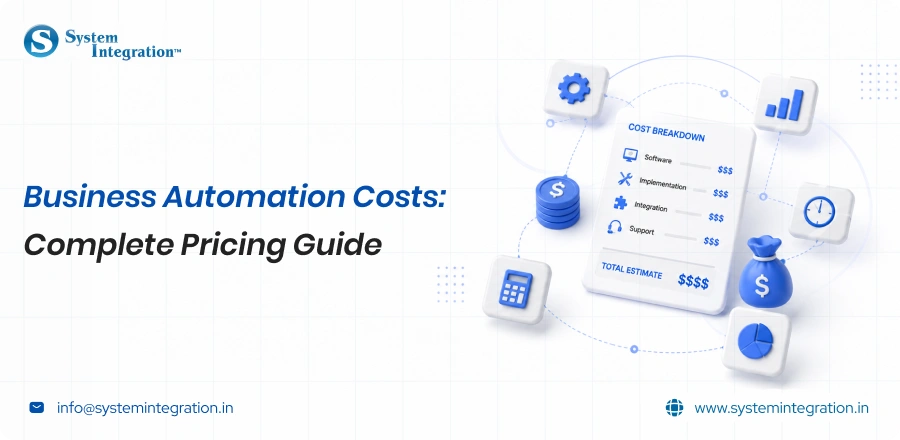
Automation costs vary widely based on complexity and scope. Below is a realistic breakdown.
| Automation Type | Estimated Cost Range |
|---|---|
| Basic low-cost automation | $500 to $2,000 |
| Small workflow automation | $2,000 to $8,000 |
| Marketing automation systems | $5,000 to $20,000 |
| Robotic process automation implementation | $10,000 to $50,000 |
| AI workflow automation systems | $15,000 to $100,000 |
| Enterprise automation infrastructure | $100,000 to $300,000+ |
These numbers represent custom automation implementations by an automation company.
However, businesses can start with low-cost automation tools using platforms like Zapier, Make, or Airtable integrations.
Cost Comparison: Manual vs Automation
Let’s consider a simple example.
A business hires 3 operations employees for manual repetitive data processing.
Approx cost per employee:
- $25,000 per year.
Total annual cost:
- $75,000.
Automation system cost:
Component Cost
Automation Development $8000
Maintenance $1500/year
Total first year cost: $9,500
Savings in first year: $65,500
This is why automation adoption continues to grow globally. According to Gartner, organisations implementing automation can achieve ROI within 6–12 months.
Factors that influence automation cost
Several factors determine the final automation investment.
- Complexity of Workflow
Simple automations like form integrations are inexpensive. Complex workflows involving multiple systems, APIs, and AI models require higher budgets. - Number of Systems Involved
Automation connecting: CRM, ERP, marketing platforms, analytics tools will require deeper system integration. - AI Requirements
Adding AI increases costs because of model training, data processing, cloud infrastructure. This is especially relevant for artificial intelligence automation solutions. - Custom Development vs No-Code
No-code tools enable low-cost automation, but they may have limitations. Custom systems provide flexibility but require experienced developers. Businesses often consult with experts before choosing the right architecture.
Top Automation Tools for Small Businesses in 2026 and Their Costs
n8n Pricing
n8n’s flexible pricing (including self-hosted and cloud solutions) makes it popular among businesses that want customisable and scalable workflow automation.
- Free self-hosted option
- Cloud plans start at about $24 per month.
- No limits to workflow customisation
- Lower long-term costs for automation
Make Pricing
Visual workflows Make a budget-friendly automation solution, ideal for businesses that need to develop complex integrations at lower operating costs.
- Limited operations with free plan.
- Paid plans start from around $10.59/month
- Fees according to the operations used
- Great for complex workflow automations
Zapier Pricing
Founded in 2011, Zapier has a low-commitment pricing structure (ideal for small businesses), along with comprehensive automation over basic functions, advanced workflows that utilize AI-type features to bend processes to your will, or premium app integrations.
- Free plan for basic workflows
- Paid plans start around $19.99/month
- Pricing increases with task volume
- Premium apps require higher-tier plans
Microsoft Copilot for Business ($30/User/Month)
Microsoft Copilot is designed to enable productivity at work by integrating AI across Microsoft 365 apps, allowing teams in the workplace to automate mundane daily tasks and streamline efficiency.
- Costs $30 per user/month
- Requires an eligible Microsoft 365 plan
- AI assistance in Office apps
- Best for Microsoft-based businesses
Concluding Words
Implementing proper automation solutions will help small enterprises in minimising the costs, improving efficiency and growing with confidence. Once you invest in the right tools and workflows, there will be no more manual tasks requiring a lot of time to accomplish. You can work on other, more productive things instead, and grow much faster with higher ROI while adjusting your business for long-term growth.
FAQs
It is determined by the size of your business, your goals, and the tools you choose. You can get basic automation starting from around $20–$100 per month, but custom workflows and AI-powered automation might cost up to 500–5,000+ as a one-time setup price, plus recurring software fees.
Yes. The utilization of automation diminishes repetitive work, enhances productivity, reduces manual errors, and enables employees to spend more time on higher-value tasks without further increasing headcount, which is a reason why small teams seem to benefit the most.
Identify repetitive activities, and start with free or inexpensive automation tools. Even better, there are several platforms available that allow you to begin with a free plan, allowing you to set up email notifications, lead management, file transfers and other mundane tasks, reducing the burden of your job as your business grows.
For the majority of small businesses, meaningful ROI can be realised within 3 to 6 months but this varies depending on both the depth of the automation and how often their automated processes are used. The savings from high-impact workflows can be realized in weeks!