Introduction
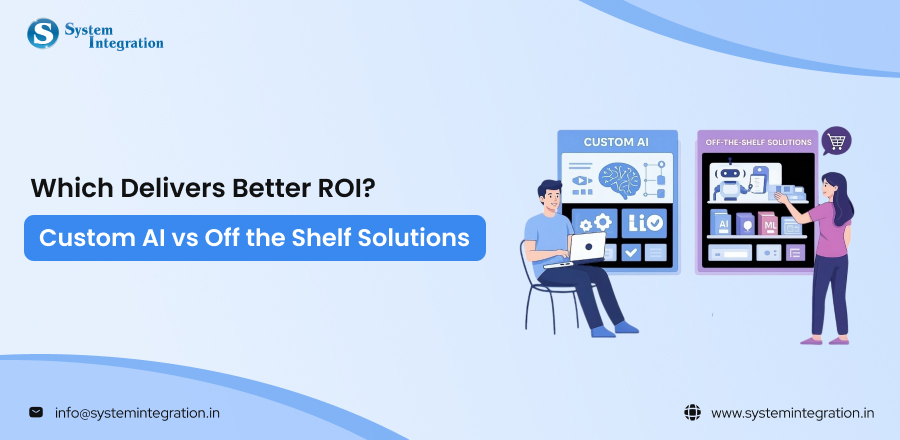
Picking a custom AI vs an off-the-shelf solution feels like picking between a custom tailor and from a mall clearance section. Both can provide fitting, but one will probably fit better.
So, many businesses want to pick off-the-shelf AI solutions based on ease of use and speed to produce results, like instant ramen for dinner: fast, easy, and sometimes surprisingly tasty! But when your business really needs something custom-built and tailored for you and your needs.
That’s exactly where custom AI solutions come. They are designed to specifically fit around your workflows, data, and goals. Yes, it takes longer and costs more up front, but ultimately the ROI(return on investment) is substantial. In this blog, we will provide you with an ROI comparison of both custom and off-the-shelf AI solutions to help you make a better choice.
What is Off-the-Shelf Solution?
It’s a pre-built application also known as “off the shelf”. This type of application offers a ready set of features and functionalities that delivers better user experience. With the rise of AI automation in 2026, ready-made solutions are lets quick workflow and faster deployment.
One of the most popular examples of ready-made applications is, education app, which enables institutions to deliver quality education to students anytime and anywhere.
| Advantages of off-the-shelf solutions ✅ Low upfront cost ✅ Speed of deployment ✅ Continuous upgrades Limitations of off-the-shelf solutions ⚠️ Only generic training of data ⚠️ Limited customization ⚠️ Data control limits ⚠️ Expensive to scale |
What is Custom App Development?
Custom mobile app development means building an app from scratch, depending on your company’s demands and goals. The app is first planned, then designed and developed, and finally quality tested and launched in the market. It can be built for any platform like Android, iOS, or both platforms, using a cross-platform development method.
| Benefits of Custom Application Development ✅ Cost-effective ✅ Better efficiency ✅ Increased scalability ✅ Ease of customization ✅ Effortless integration ✅ Lower security risk ✅ Improved user experience |
Essential Differences between Ready-Made App VS Custom Development
| Element | Ready-Made App | Custom Development |
|---|---|---|
| time -to-market | Ready-made apps can be deployed in days or weeks, making it ideal for rapid launch | Custom development involves lengthy process of planning and coding taking months to launch |
| Customization Level | Offers limited customisations following its rigid structure. | Complete customization that fits the unique business need |
| Cost | Ready-made apps have lower initial costs and often subscription based | More costly from the start but no platform dependency fees |
| Scalability & Performance | It may struggle to scale; performance is limited | Designed for distributed and real-time processing. |
The Complete Method to Calculate ROI for Real Results
The calculation of ROI of solutions are evaluated by analysing the measurable improvements from AI with the total investment demanded to build and uphold it. In other phrases, ROI equals the value gained minus the total cost, divided by the total cost.
Now, if you have AI incorporated into your app, then it makes the calculation slightly more complex.
To get an accurate assessment, leaders must go beyond surface numbers and evaluate both tangible and intangible results.
Tangible results includes direct cost reductions, process automation and revenue growth. Intangible results include improved decision accuracy and faster response times.
Key Components of AI ROI Calculation
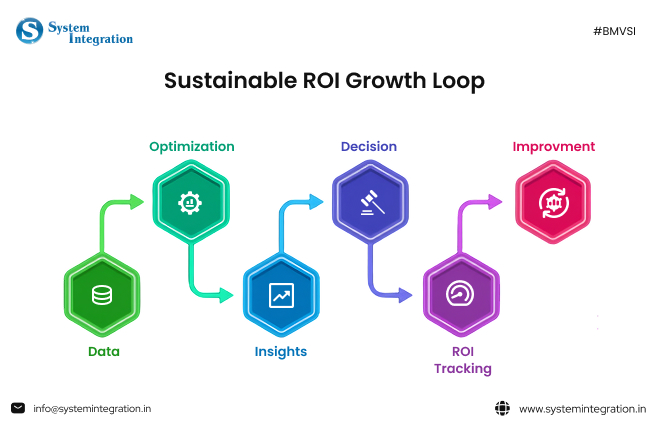
1. Initial investments: they cover data collections, infrastructure setup, development, and model training. These early expenses from the baseline for all ROI evaluations determine how efficiently future improvements deliver value.
2. Operational and maintenance costs: it covers data collections, infrastructure and technical support. Ensures reliable performance and helps in bypassing costly downtime.
3. Business gains: it represents the measurable results like enhanced revenue, reduced errors, and quicker workflows. Tracking these outcomes over time shows how AI contributes to financial growth.
4. Strategic impact: captures long-term leverages such as forecasting, smarter decisions, and quicker innovation. These advantages strengthen competitiveness and shape sustainable growth.
Detailed Comparison of Traditional App ROI and AI App ROI
| Aspect | Off-the-Shelf App ROI | Custom App ROI |
|---|---|---|
| Value pattern | Furnish measurable value soon after deployment, but remains static until updated. | Increases the value gradually as algorithms learns and update from newer data available. |
| Scalability | Grows through fixed feature addition and costs linearly. | Encourages continuous innovation using data-driven insights. |
| Performance longevity | Performance decreases without any upgrade or redesign. | Performance improves continuously through retention and feedback cycles. |
| Innovation scope | Limited to existing features and functionalities of app. | Encourages continuous innovation using data driven insights. |
| Risk exposure | Low because behaviour remains predefined. | Higher during early stages when model accuracy depends on training quality. |
| Return timeline | Offers fast but limited short-term returns. | Delivers gradual, long-term returns that strengthen as data maturity increases. |
Proven Strategies to Enhance the ROI of App for the Business
- Create a clear business objective
- Set clear and achievable goals
- Define aim as per financial and operational outcomes.
- Revisit objectives regularly to ensure alignment.
- Invest in high-quality infrastructure
- Well structured pipeline for continuous data collection
- Remove outdated and duplicate records
- Secure data accessibility.
- Integrate AI into Everyday Business Operations
- Decide tasks where AI agents can replace repetitive work
- Encourage teams to use AI in daily decision making
- Track performance with help of AI in dashboards
- Track and benchmark using AI ROI metrics
- Measure KPIs for decision accuracy.
- Compare pre and post AI results for transparency
- Use AI dashboards for process improvement reviews
Why Custom App will Dominate the Next Decade?
The global custom software development market size was estimated at USD 43.16 billion in 2024 and is projected to reach USD 146.18 billion by 2030, growing at a CAGR of 22.6% from 2025 to 2030.
- Custom apps allow businesses to solve specific customer pain points that generic or ready made apps can address.
- Utilizng AI custom apps analyze real time user behaviour to offer personalized recommendation.
- With users unlikely to return to a bad and unpleasant app experience, custom built, intuitive interfaces are crucial for retention.
- Custom app seamlessly integrates with IoT, wearables, AI, and blockchain, allowing companies to innovate rather than merely operate.
Ending Throughts
Custom app development is more than just a technology decision it’s a growth strategy. An AI software development company enables businesses to develop scalable solutions that can adapt to meet future needs, resulting in infinite efficiency, flexibility and long-term ROI that generic software cannot keep up with.
FAQs
There are some data security risks when using ready-made solutions. However, with the custom made app, you can avoid this problem as you can integrate the dedicated tools that take care of these factors.
The implementation times of a custom AI solution depend on many factors. On average if you have basic requirements and not complex AI integrations then it can take anywhere from a few months to over a year (depending on complexity and data requirements).
Pick ready made app, if you do not have complex app development requirements and also want to complete in a short period of time. However, if you have any unique requirements than custom development would be better.
Yes, you can switch between the ready-made to custom solutions. As a fact, many businesses start with ready-made solutions and later switch it to create custom one for their business.