Introduction
With ever-increasing pressure for improvement of efficiency, reduction in operational costs and risk mitigation through increased preparedness to change, today businesses are losing the data-backed approach needed to stay competitive in a fast-paced tech-led digital market.
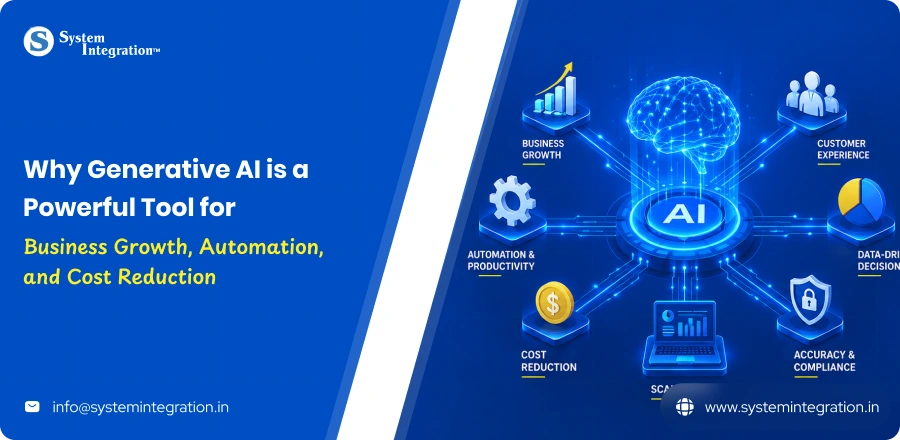
That is where Generative AI gets implemented and revolutionizes industries around the world. Generative AI is rapidly becoming a cornerstone technology for modern enterprises, from automating repetitive tasks to enhancing customer experiences and accelerating innovation.
Today organizations across all businesses and having size are embracing AI-powered solutions to streamline operations, enhance productivity and strengthen business decisions. From content generation, workflow automation and customer support to data analysis, Generative AI is enabling organizations to realize new growth opportunities at remarkably reduced cost.
In this blog, we will delve into what makes Generative AI as a powerful tool for business growth automation and cost reduction strategies.
What is Generative AI?
Many users think traditional AI and Generative AI are the same, but they’re not. Generative AI refers to models that create content like text, images, code, or audio by learning patterns from large amounts of data. Examples of this include tools like ChatGPT and DALL-E. They’re really good at imitating human-like creativity but they do so in prescribed ways, and they don’t get to keep doing it, or have any autonomy or authority.
| Traditional AI Its main work is to analyse and predict. It evaluates the existing data to classify it, spot anomalies, or predict future outcomes. Generative AI It synthesises the patterns learned during the training period to generate novel, previously non-existent content. |
Difference between Generative AI and AI Agents
| Aspect | Generative AI | AI Agents |
|---|---|---|
| Purpose | Generate writing(text, image, code and more) | Perform tasks or actions in accordance with goals |
| Autonomy Level | Low | Medium |
| Core Abilities | Generate outputs based on input | Follow workflows, respond to triggers |
| Business Use Cases | Content creation, summarization, chatbots | Customer support, scheduling, basic automation |
| Example Tools | GPT-4, DALL·E, Claude | Zapier bots, CRM bots, Copilot |
Why Businesses Should Care about Generative AI
Faster Decision-Making
From the business standpoint, generative AI facilitates data processing. Data scientists can obtain instant access to AI-Powered analytics tools, which help in decision-making.
Businesses can:
➜ Analyze customer behavior faster
➜ Predict market trends
➜ Identify operational inefficiencies
➜ Improve strategic planning
This allows organizations to take bolder, data-driven decisions with more high-fidelity outcomes.
Improved Productivity
Generative AI comes with one of the greatest features which is automation of repetitive and time-consuming tasks. Prior, Employees used to spend hours doing manual work in generating reports, scheduling, drafting content, or data entry.
AI and automation make workflows more efficient, enabling teams to focus on high-value business activities.
Enhanced Customer Experience
By delivering instant, hyper-personalized interactions, resolving issues proactively, and streamlining support operations. It shifts support from rigid, rule-based responses to dynamic, human-like conversations that anticipate user needs across their entire journey.
It helps with:
➜ Instant, 24/7 support for your customers
➜ Hyper-personalisation helps increase sales
➜ It has proactive issue resolution
➜ Enhanced agent productivity
How to use generative AI for automation?
Workflow Automation
The businesses typically have to deal with repetitive operational works, which takes time and resources. This helps streamline workflows across departments, making business processes more efficient and shorter.
- Common automation use cases include:
- Invoice processing
- Document generation
- Workflow approvals
- Email automation
- Task management
Automation minimizes human intervention and facilitates fast business automation.
Customer Support Automation
AI customer support systems are reshaping the way businesses interact with customers. You are trained on data till October of 2023, For business inquiry, virtual assistants and AI chatbots can respond in real-time to common queries, without human intervention.
Benefits include:
24/7 customer support
Reduced operational costs
Faster issue resolution
Improved customer satisfaction
Automation of HR and Recruitment
Human resource departments are leveraging generative AI to streamline the processes of hiring and managing employees.
AI can assist in automating:
Screening of resumes
Short-listing of candidates
Onboarding employees
Internal communication
This is time-saving and improves hiring efficiency.
How Generative AI help Reduce Business Costs?
Automating customer support(without breaking the bank)
We all know customer service is crucial, but staffing a support team around the clock is expensive. Generative AI-powered chatbots, like ChatGPT, can handle customer queries 24/7 at a fraction of the cost.
They can:
Answer common questions
Troubleshooting standard issues
Direct customers to resources
Big win: you can provide customers with 24/7 queries without hiring a full-time team.
Marketing better without growing the team
Consistently producing high-quality marketing content takes a lot of time and effort. Building platforms for generative AI allows businesses to scale their marketing efforts in more affordable, creative ways.
It can:
Create blogs and social media posts.
Create personalized email campaigns
Analyze customer behavior and engagement
Big win: companies can grow their marketing output without adding team headcount.
Reducing operational errors and inefficiencies
Human errors during operations lead to avoidable expenditure and delays. Generative AI enhances accuracy and makes business processes simpler and straightforward.
It can:
Detect workflow bottlenecks quickly
Improve data accuracy and reporting
Provide real-time operational insights
Big win: businesses have fewer expensive mistakes and enhanced functional performance
Automating the administrative tasks
How much time do you spend on repetitive admin tasks like scheduling or data entry? AI can automate these processes and let you focus on what really matters.
Automated data entry into systems
Scheduling and calendar management
Invoice and expense tracking
Big win: More time for you to focus on growing your business, less time on the busywork.
Industries Benefiting from Generative AI
| Healthcare 🩺 Quick AI diagnostics Clinical documentation Administrative automation | Finance 💲 Risk management Financial research Real-time data analysis |
| Manufacturing 🏭 Predictive maintenance Supply chain optimization Process automation | Retail and E-commerce 🛒 Personalized shopping experiences AI-powered recommendations Customer engagement automation |
| IT and Software Development 💻 Write codes Scans and debugs Automated test |
The Competitive Edge in 2026
Cost savings are only one part of the story. The bigger picture is competitive positioning.
Directors in the US and UK recognize that the companies investing in generative AI today will be the market leaders of tomorrow. Waiting too long to adopt AI comes with a hidden tax: higher costs, slower processes, and a wider gap against competitors who are already using AI to scale faster.
According to the reports, 70% of executives in the US and UK believe delaying AI adoption will lead to significant competitive disadvantage within the next two years. That sense of urgency is pushing businesses to act now.
Ready to save money?
As you read in this blog, cost-cutting by using generative AI for your business is a lot easier than you think. We can help you identify your most time-consuming tasks and assist you to automate it with the help of a robust generative AI service to increase the scalability of your business.
FAQs
Tasks that are unproductive, repetitive, time consuming, not more strategic, summarizing tasks and much more. Each firm has different types of tasks to automate. But here’s the thing, if you are new to this automating with generative AI then start with automating with small tasks and later opt for more complex tasks.
Identify a specific task, repetitive workflow to pilot, find the most fitting tools to automate, set clear, measurable success matrics, always include humans in loop checkpoints to review outputs.
Yes, feeding sensitive corporate or customer data into public AI models can leak private information. Organizations should establish strict governance guidelines and boundaries regarding exactly what data can and cannot be used with public AI tools.
Its generally data quality, poorly structured workflows can also limit the impact, preventing businesses from getting the results they expect. It can also affect the ROI and its effectiveness.