Introduction
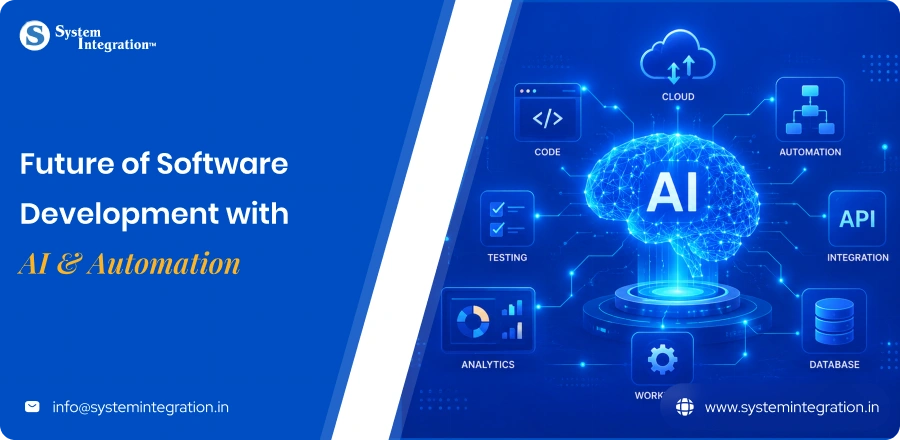
AI is no longer a distinct project. It’s already here and changing how we build software. As it advances, new questions emerge about its impact.
How deeply will AI be woven into software development? What new opportunities will emerge for companies building AI-powered tools? Perhaps most importantly, how will developers and AI collaborate over the next three to five years?
The AI 2027 outlook highlights the need for practical use, domain-specific design, and a focus on real results over hype.
In this article, we’ll discuss insights on how AI and automation are transforming the software development landscape today, its future and the impact in the upcoming decade. An in-depth look at the challenges and opportunities that lie ahead for developers and organisations.
Artificial Intelligence & Automation in Software Development: What is it?
Artificial Intelligence in Software Development refers to the use of intelligent systems to analyse data, generate code, detect errors, predict outcomes and improve development workflows.
Automation, by contrast, aims to reduce repetitive manual work by using predefined workflows and tools.
AI and automation together allow developers to build software faster, smarter and with fewer mistakes.
- Examples include:
- AI-based code generation tools
- Software testing automated
- Continuous Integration and Delivery (CI/CD)
- Debugging with AI
- Infrastructure management automation
- Systems for intelligent project management
| Difference between Traditional Automation and AI Automation 🤖⚙️ 📌 Traditional Automation: Traditional automation is a command-based, rule-based system that performs repetitive jobs using specified instructions and unchangeable workflows without learning or adapting to changes. 📌 AI Automation: AI automation services are a step ahead with the use of Artificial Intelligence and machine learning to analyse data, make decisions autonomously, adapt to changing conditions and develop/optimise processes over time. |
How AI is Transforming the Software Development Landscape?
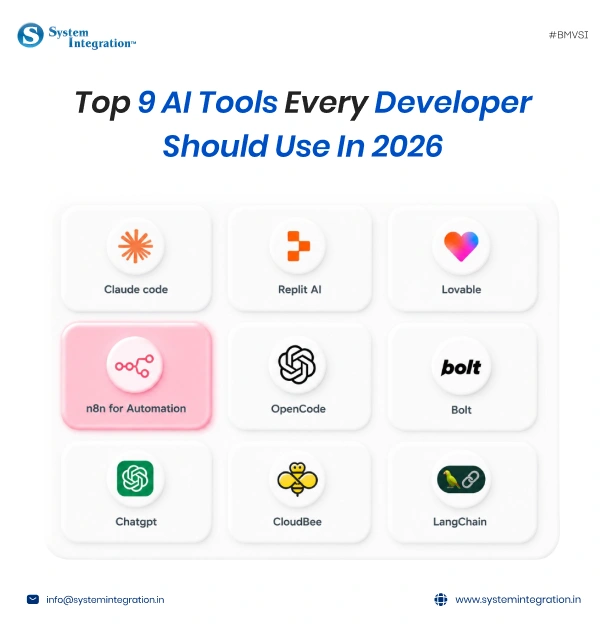
AI-Assisted Coding
Using the power of AI, developers are well supported with coding tools that help them in writing code snippets, completing the function and also suggesting improvements (in real time).
- These tools:
- Reduce repetitive coding tasks
- Improve developer productivity
- Accelerate software delivery
- Help junior developers learn faster
AI coding assistants can analyse past codebases and suggest leaner, more efficient solutions.
Automated Testing & Quality Assurance
One of the more time-consuming tasks of software development is testing. This process is made faster and more reliable with AI automation.
- AI-powered testing can:
- Automatically identify bugs
- Predict high-risk areas
- Generate test cases
- Perform regression testing
- Detect UI inconsistencies
This increases software quality but greatly decreases the amount of time that needs to be spent testing.
Intelligent Project Management
Artificial intelligence tools are now helping project managers make better decisions through analysis of historical data and team performance.
- AI project management assists with:
- Task prioritization
- Resource allocation
- Timeline prediction
- Risk analysis
- Workflow optimization
As a result, it allows to plan better and deliver software with better efficiency.
AI in UI/UX Design
The traditional need for higher UI/UX can now be replaced by modern AI tools to monitor user behaviour and propose the necessary changes in UI.
- AI helps designers by:
- Generating design prototypes
- Recommending layouts
- Improving accessibility
- Personalizing user experiences
This has allowed companies to develop smarter, better user experiences centred apps.
AI-Powered Cybersecurity
With growing cyber threats, AI is critical in securing software.
- AI-based security systems can:
- Detect suspicious activities
- Monitor vulnerabilities in real time
- Predict potential threats
- Automate security responses
The challenges and limitations of AI in software development
While the progress in AI is rapid, the full integration of AI into software development will likely take years, with a gradual shift in tools and workflows. Facing challenges like:
Data dependency: AI models require vast amounts of training data, and the quality of that data directly impacts the quality of the generated code.
Maintainability and debugging: AI-generated code might be more complex to understand and debug, requiring new tools and techniques.
Security risks: AI models can be vulnerable to attacks, and ensuring the security of AI-generated code is crucial.
Will AI Replace Programmers and Software Engineers?
This question bothers most of the developers as the use of AI is increasing, and it’s also capable of doing a lot of things without any human supervision. Thus, this question is also valid.
But the answer is clear no…!!!
AI is not equipped to replace programmers and software engineers because current GenAI tools have several limitations when it comes to coding.
- AI impacts software development across automation, debugging, and project forecasting.
- Several limitations of AI in software development include its lack of innovation, potential for inaccurate code, and potential security risks.
How to choose the Right AI Software Development Company?
Selecting the right AI Software Development company is critical.
- Look for companies that:
- Understand business workflows
- Offer a scalable automation architecture
- Provide AI integration capabilities
- Deliver long-term support
Businesses evaluating vendors often look for the best Software Development company in India due to strong engineering talent and competitive pricing.
How can businesses prepare for the future?
It’s time for the companies to begin investing in AI and automation strategies so they can continue to remain competitive.
Key Steps Include:
✔️ Adopting AI development tools
✔️ Automating repetitive workflows
✔️ Training development teams
✔️ Investing in cloud infrastructure
✔️ Collaborating with professional AI development firms
Early AI adopters will have a robust competitive advantage in the future digital economy.
Conclusion
The future of software development is redefined by AI and automation. Everything from smart coding assistants to fully automated deployment pipelines is letting businesses build more intelligent, quicker and scalable apps.
The contest will not be man v AI in the future; it will be humans paired with machine learning to deliver new digital products.
Firms that adapt AI software development for their digital solutions will perform better in the competitive market and lead in the coming years.
FAQs
Unlike traditional automation, AI automation moves beyond simple rules. It uses advanced algorithms to learn and adapt to complex problems. It makes sense of data(structured or unstructured), identifies patterns, and applies them to dynamic situations.
- Healthcare
- Real-estate
- Financial services
- Manufacturing and logistics
- Retail services
- E-commerce
It totally depends on your requirements, and in the initial phase, it requires a high investment. However, in return, it gives a higher ROI as compared to buying the software.
No, but the role is evolving. Instead of eliminating developers, AI will do most of the repetitive and unproductive work and help developers focus more on the complex development process.