Introduction
Ever experienced that you visit the website and open a chatbox to ask a few questions, and a robot starts the conversation like
Hi there! How can I help you today? Instantly after three seconds, are you still there?
Like, relax, bro… I just opened the chatbox.
This is one of the most common reasons why the sales team loses some of the potential leads.
Here enters the AI chatbot in the game. It doesn’t throw random fixed replies, and instead it understands the requirements and replies accordingly, and also learns and improvises from each conversation and keeps itself updated.
AI chatbots can smoothly automate sales processes, capture leads and good sales opportunities that humans tend to miss.
The result?
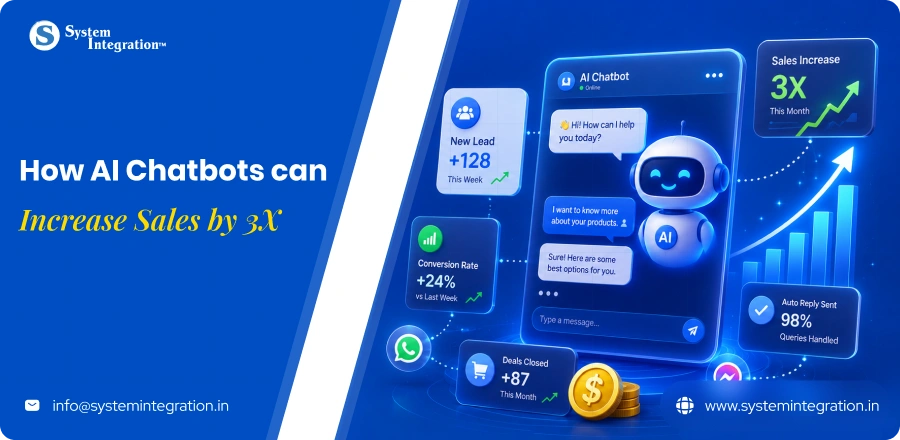
Making customers happier, better retention, and in most cases, 2-3X conversions. So in this blog, we will discuss how AI chatbots convert conversations into constant growth for your business.
What is AI Chatbot?
An AI chatbot is the software used in sales that uses natural learning process(NLP) and machine learning to create human-like conversations with online shoppers across web, mobile, and messaging platforms. Unlike static or scripted rule-based bots, modern AI chatbots understand context, adapt their responses based on their previous conversations, and improve with each new conversation.
Among all the industries, sales and retail lead the AI chatbot adoption; sales alone hold the largest share of the conversational AI market. This increasing adaptation in sales reveals that firms are highly trusting of AI tools and chatbots for increasing sales.
Types of AI Chatbots Used in Sales
| Type | Description |
|---|---|
| Rule-Based Chatbots | These are the “follow-the-script” bots. Follow a set of rules and decision trees, directing users through defined paths. |
| AI-Powered (Conversational) Chatbots | These bots are cleverer and more humanlike. They use technologies like Natural Language Processing (NLP) to grasp user intent and respond dynamically. |
| Voice-Enabled Chatbots | The benefits of chatbots are that they can converse in voice form rather than type. Integrated with voice assistants, they can search for products, place orders, or even get customer support. |
| Hybrid Chatbots | Hybrid Chatbots are a combination of rule-based and AI-powered bots. Follow pre-defined flows and can switch to AI-based responses. |
| Social Media Chatbots | These bots run on systems such as Instagram, WhatsApp or Facebook Messenger. They allow businesses to interact with customers directly. |
| Customer Support Chatbots | Tailored for post-purchase support, these bots help with order tracking, returns and refunds as well as complaint resolution. |
Here’s the Workflow of the AI Chatbot
↪ Receiving Message: through your Property Management System, the chatbot receives customers’ details like ID, details and captures the texts of users’ questions.
↪ Content Retrieval: the bots, after receiving the texts, search their database, which pulls the rules, current booking/order status and other vital details regarding users.
↪ Response Generation: later, it processes your customer’s question considering all the related data, and replies to them in a personalised manner instead of a robotic way.
↪ Validation and Send: it verifies the information and your data, and if the confidence score is good and the response sounds great, it sends it immediately, and if not, then it waits for your approval.
↪ Learning: during the entire process of receiving the query, responding, and fetching the data, it learns through each step and keeps upgrading itself.
How AI Chatbots Increase Sales 3X
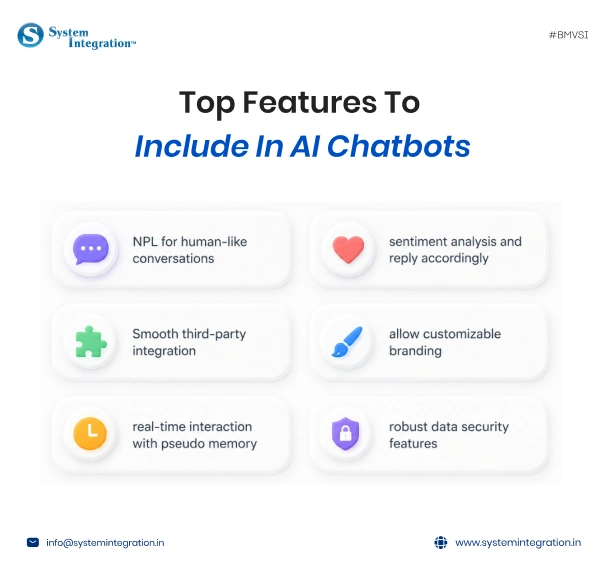
- Immediate Response Increases Conversion Rates
- AI chatbots provide immediate responses to customer queries without delays
- Instant replies help to decrease customer irritation and boost engagement
- Users spend more time on the site
- Immediate support tends to convert more leads into customers.
- Personalized Product Recommendations
- AI chatbots are powered by an understanding of customer interests and browsing behaviour
- Product recommendations as per historical purchases and interests
- Customers are more satisfied and engaged when they have personalised experiences
- Tailored recommendations increase purchase probability
- Automated Lead Qualification
- Automatic client information extraction through AI chatbots
- Weeds out serious buyers from general inquiries
- Save time of sales and marketing teams
- Better lead management translates to improved sales efficiency
- 24/7 Customer Engagement
- AI chatbots are available throughout the day without a break
- Makes it possible for businesses to access customers after office hours
- Increases customer Trust with 24/7 availability
- Increases global customer engagement opportunities
- Omnichannel Customer Communication
- Today, AI chatbots are increasingly capable of working across a multitude of communication channels.
- Maintains consistent customer interactions everywhere
- Improves customer convenience and accessibility
- Strengthens brand communication and engagement
Top Real Use Cases of AI Chatbots Boosting Revenue
Customer support chatbot
AI customer support chatbots are designed to answer repetitive customer queries instantly and increase user satisfaction. They are available around the clock and resolve complex errors without a human agent. All this enhances customer retention and long-term revenue growth for businesses.
Examples
- Instant order tracking and return queries resolving for e-commerce stores
- SaaS businesses with automated support for troubleshooting & onboarding
- Healthcare clinics scheduling appointments and answering patient FAQs
AI Leadbot
AI leadbots engage website visitors automatically, gather customer information, qualify leads and direct users to the sales action. It helps businesses quickly identify high-intent prospects, minimize manual effort, and drive higher conversions through personalised real-time interactions and automated follow-ups.
Examples
- Websites for real estate companies pulling in buyer inquiries
- Automated qualification of software development leads by IT service firms
- Prospective student inquiries captured by educational institutes in real-time.
AI Chatbot for website
Website AI chatbots communicate with web visitors in real-time and respond to any of your product or service-related inquiries, and assist users throughout the buying journey. They enhance user experience, lower bounce rates and enable you to convert more website visitors into customers sustainably & confidently.
Examples
- Web chatbots that allow you to book a Restaurant Table Online
- Tech currents: Fashion brands are helping users find products based on preferences.
- Optimising travel agencies packages and leads.
Chatbot for Upselling & Cross-Selling
AI chatbots boost revenue by recommending relevant products and premium services based on the customer behaviour. In conversations, they offer personalised recommendations that entice customers to buy more items, upgrade plans, or discover complementary products that increase the overall cart value.
Examples
- E-commerce shops recommending complementary accessories at checkout
- Streaming sites offering premium subscription upgrades
- Hotels that automatically provide room upgrades and additional experiences
Tips to Select the Best AI Chatbot
➢ Accuracy And Language Understanding
An intelligent chatbot should be able to comprehend user intents, context and language variations to provide accurate answers, reduce errors, and support multiple languages for consistent conversations users can rely on.
➢ Customization And Flexibility
Customization enables companies to customize chatbot behaviour, tone of voice, workflows and responses to directly fit the brand requirements, and flexibility to handle changing processes and new automation use cases smoothly.
➢ Integration And Capabilities
Integrations chatbots can easily interface with CRMs, databases, custom APIs and enterprise tools for pulling real-time data, automating workflows, returning tailored responses, or even going beyond conversation-based interactions.
➢ Scalability
Scalability ensures that the chatbot can cope with growing conversation volume, users and data without becoming a bottleneck for business growth or peak traffic, global rollouts, as well as guaranteeing response consistency over all interaction channels.
➢ Security And Data Privacy
Security and data privacy are one of the most important factors when selecting a chatbot, in other words, we need encryption, a secure authentication process, compliance with standards and regulations, controlled data access/right and clear instructions for how data is processed for safety.
➢ Cost Effectiveness
Cost effectiveness looks at whether the chatbot provides value above its price, taking into account setup costs, subscriptions, scalability, maintenance, automation benefits and long-term ROI for businesses both small and large.
Bottom Line
AI chatbots will become much smarter as AI technology develops. Early adoption of these technologies will give businesses a competitive edge as consumers want quick, personalized, and conversational purchasing experiences.
Working with an experienced software development company which provides scalable AI chatbot services can help you to develop a robust AI chatbot and also help you choose the right strategy, technology stack, and implementation method if you’re not sure which chatbot solution is best for your company.
FAQs
Pilor projects typically show measurable revenue growth in 3 to 6 months. When scaled across channels, an AI chatbot for abandoned cart recovery and upselling can contribute to a 2 to 3x increase in sales over a 12-month period, depending on traffic and product mix.
Yes, when used correctly, AI chatbots can increase conversions. They also assist in product discovery. They can answer all the pre-purchase questions of customers in real-time. Their personalization suggestions and real-time support play a major role in increasing sales.
- AI chatbots are mostly designed for conversation and answering queries using predefined scripts or natural language processing.
- Whereas an AI agent is an autonomous system that uses reasoning, memory and external tools to perform multi-step tasks and to achieve a goal.
It depends on the tool. Some chatbots are plug-and-play and can be live in just a matter of hours, while others need integration into your existing system or application. Most e-commerce platforms offer native or low-code options.