Introduction
Have you ever wished that your disturbing office task would disappear as fast as a snack disappears from the table room? This is precisely the part where AI automation comes into play.
Rather than requiring hours from humans on tasks like data entry, customer reply, scheduling or report generation, AI-powered systems are automated and smart. Whereas conventional automation requires human assistance and intervention, AI automation learns patterns, makes decisions, and improves autonomously without human assistance over time.
From any industry today, enterprises are using AI automation for productivity improvements, faster customer experience, fewer errors and so on. Whether it is chatbots responding to a customer query at 3:00 AM or AI tools that manage workflow and analyze mountains of data, automation is changing the way businesses are run today.
In this blog, we’ll look at what AI automation is, its key benefits and real-world examples of how companies are using it to work smarter, faster and more efficiently in 2026.
What is AI Automation?
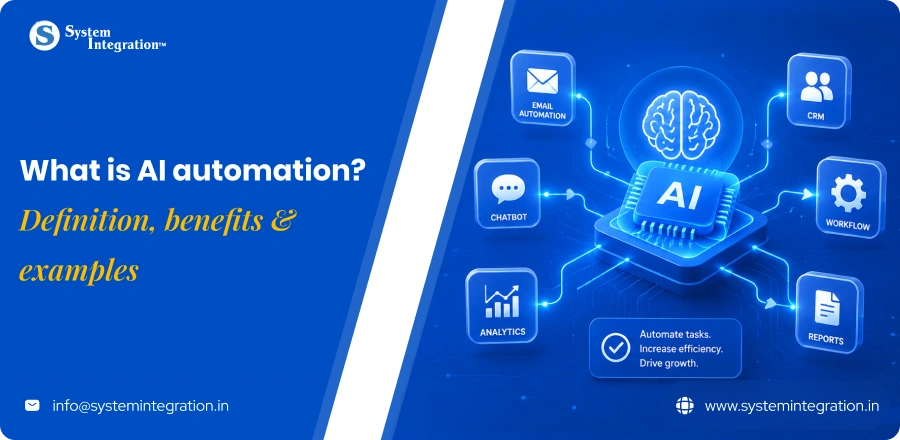
AI automation refers to the utilization of artificial intelligence technologies to perform automated, low-human-involvement and repetitive tasks, workflows and business operations. It can analyse data and learn patterns to arrive at decisions, adjusting itself over time for better performance.
Currently, AI automation finds its applications in various places core to the industry, such as healthcare, finance, retail, customer support, and manufacturing. Businesses are leveraging AI from AI chatbots answering customer queries to smart systems doing data analysis. Thus, automation helps in reducing the cost of manual and unproductive processes and enhances the efficiency of your business.
| Key Benefits of AI Automation 🤖📈 ✅ Automation of repetitive tasks and time-saving ✅ Helps businesses reduce operational costs ✅ Improves productivity and operational efficiency ✅ Reduce the Human Errors in the workflow ✅ Provides faster responses to enhance customer support ✅ Gives data-driven insights to make better decisions |
How AI Automation Works?
| Steps | Description |
|---|---|
| Data Collection and Ingestion | AI automation starts with gathering data from multiple sources. The data is collected, classified and loaded into AI systems for analysis, workflow processing and intelligent decision-making. |
| Data Processing and Preparation | Data is cleaned, structured, filtered and prepared for analysis. AI systems eliminate duplicates, resolve inconsistencies, and convert raw data into structured datasets that enhance model accuracy and workflow performance. |
| AI Model Analysis and Decision Logic | AI models work with curated data sets using algorithms, predictive analytics, and pre-defined business rules. It identifies patterns, predicts outcomes, and makes smart decisions automatically. |
| Automated Workflow Execution | Following decisions, AI automation tools automatically trigger workflows without the need for human involvement. These workflows can include task assignments or interfacing with users via intelligent automated systems. |
| Feedback and Model Optimization | AI automation is continuously learning from outcomes, user interactions, and performance data. Feedback is key to improving model precision, fine-tuning workflows and better decision-making abilities. |
Key Technologies Behind AI Automation
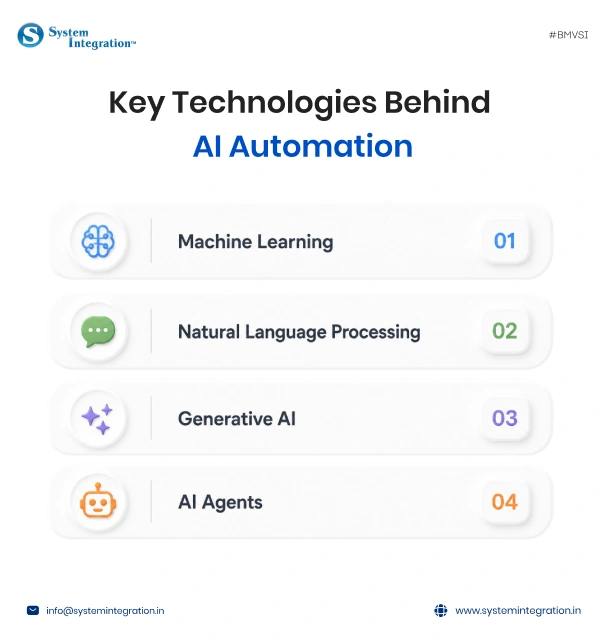
↪ Machine Learning
Through ML, AI systems can learn from past data, discover patterns, and enhance performance. It enables businesses to automate predictions, recommendations, fraud detection and more for intelligent decision-making without human supervision.
↪ Natural Language Processing
NPL acts as the “interpreter” between human and machine communication and machine action, letting AI comprehend, interpret and generate text or speech to automate complex, language-based workflows.
↪ Generative AI
Generative AI utilizes advanced AI models to generate content like text, images, code, audio and videos. Businesses employ it for tasks as diverse as content creation, software development, customer communications, and more.
↪ AI Agents
AI agents are smart systems capable of independently completing tasks by studying data, making decisions, and taking actions. Automation solutions help businesses automate workflows, manage operations, interact with users and enhance productivity.
Common Types of AI Automation
- Robotic Process Automation (RPA)
- Automates repetitive rule-based business tasks without human intervention
- Handles data entry, invoice processing, and report generation efficiently
- Integrates with existing software systems and enterprise applications
- Reduces manual workload while improving operational productivity and accuracy
- Conversational AI & Chatbots
- Uses AI to interact with customers through text or voice conversations
- Provides instant responses to customer queries and support requests
- Operates 24/7 to improve customer engagement and service availability
- Enhances user experiences with personalized and intelligent communication
- AI Workflow Automation
- Automate end-to-end business workflows, plans, and machines with intelligent decision support systems
- Bridges the gap between apps, tools, and teams by leveraging intelligent automation pipelines
- Support for Efficient operational coordination, approvals and task management
- Acceptable, causes delays and increases the overall business productivity
| Pro Tip 💡 Do not automate specific tasks, automate the whole workflow 🔄📈. With smart AI workflow automation services, your apps, teams, approvals and processes come together into one seamless system that cuts delays and drives greater coordination to help your business operate faster with fewer manual bottlenecks. |
- Predictive Analytics Automation
- Detects future business trends and outcomes by studying historical data
- Enables proactive, data-driven strategic incentive decisions
- Accurately identifies the risk, customer behaviour and operational opportunities
- More accurate forecasts and more efficient business planning
- AI-Powered Customer Support
- You automate customer interactions using chatbots and virtual AI assistants
- Solves common customer problems in a flash with no human support agents required
- Effectively enables customers to get personalized recommendations and real-time customer assistance
- Significantly enhances response velocity and customer happiness
- Intelligent Document Processing
- It automatically uplifts business documents using AI-based technology to extract, classify and process.
- Can process invoices, contracts, forms and reports with determination
- Significantly lessens time taken in manual document and data processing activities
- Enhances compliance, operational efficiency and acts as a bridge between information management operations
Real World Examples of AI Automation
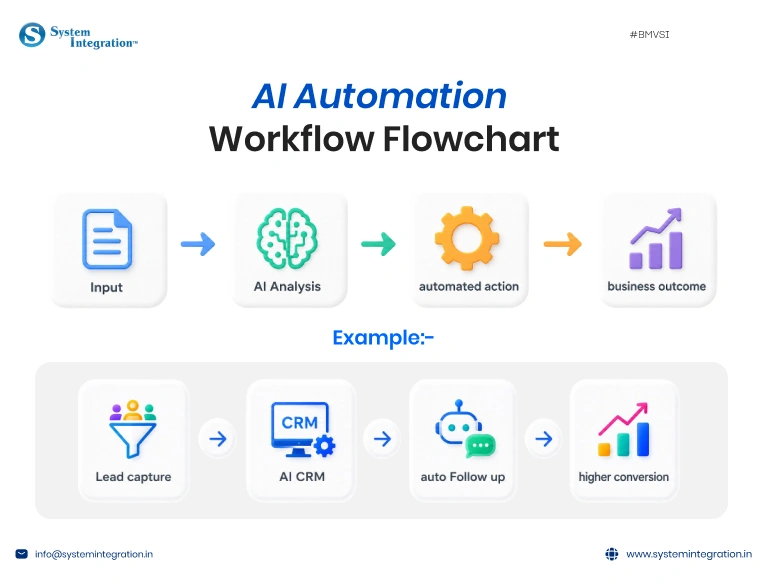
AI Automation for Sales
Now sales experts won’t have to devote a significant part of their day to repetitive tasks like data entry and lead follow-up, all thanks to AI automation. With AI working 24/7 on tasks like CRM automation, sales experts can focus on building strong relationships and closing deals.
AI Automation for IT Service
IT teams can automate ticket management, system monitoring and alerts in cybersecurity with the help of AI automation. AI-powered chatbots and workflows, as above, lead to real work efficiency in IT Service by reducing downtime, improving response time, etc.
AI Automation for Marketing
Among the different use cases, AI tools are leveraged in businesses for personalized email campaigns, social media scheduling, customer segmentation and lead nurturing. AI helps you analyze customer behaviour for better targeting, engagement, and campaign performance in marketing.
AI Automation for Commerce
AI empowers e-commerce companies with product recommendations, inventory management, customer support and order tracking. AI also makes shopping experiences better, and moves sales further up the funnel into conversions, while smart automation helps in managing daily commerce operations so that businesses work as efficiently and economically as possible.
AI Automation for Automotive Industry
Use Cases of AI Automation in the automotive industries are Predictive maintenance, Production Line or Autonomous Driving systems, and quality Inspections. AI will largely make manufacturers improve vehicle safety, operational efficiency, and manufacturing accuracy.
AI Automation for the Healthcare Industry
AI automation for appointment scheduling, analyzing medical data, monitoring patients and virtual assistants when it comes to healthcare providers. AI also uses a Low of other objective Utilization treatment’S, diagnostic accuracy partially.
AI Automation for the Manufacturing Industry
AI automation can be utilized in manufacturing industries for predictive maintenance, robotics, supply chain optimization and quality control. Manufacturing processes also benefit from the incorporation of systems driven by artificial intelligence to increase production speed, decrease operational costs and reduce errors.
How can Businesses Start with AI Automation?
- Identify the high-value process
- Customer support: deploying AI chatbots for 24/7 inquiries.
- Data entry: using IDP for extracting data from documents.
- Lead capture: automating the lead capture process.
- Logistics: AI-driven demand forecasting.
- Choose the right tools
- Tools like Make and Zapier act as bridges, connecting apps like Shopify, CRM systems, and AI APIs.
- Use tools like Voiceflow to build custom conversational AI without coding.
- Use robust, structured databases like Supabase or specialised CRM systems to make data “automation-friendly”
- Start with the small pilot project
- Select one small process, such as automatically replying to customer emails, to prove value.
- Document the current process of flow before building the new, automated workflow.
- Ensure AI failures do not reach customers by building in verification steps or human approval workflows.
- Build the internal capabilities
- Train your team to collaborate with AI rather than fearing replacement.
- Use tools like ChatGPT to help configure API integrations and write scripts.
- Measure and optimize
- Track time saved, cost reductions (typically 15-30%), and error rate improvement.
- Ensure that data is properly structured in a central repository, as poorly managed data inhibits effective AI usage.
Ready to Take the Next Step?
Ultimately, you must have an idea of what AI Automation is. It helps in reducing the administrative overhead to help employees focus on other strategic tasks. However, keep in mind that as AI automates unproductive tasks, it also requires employees to focus on developing new skills and tech-centric capabilities.
Still don’t know where to begin with AI automation in your business? Partner with BMV System Integration, it’s the best AI automation company that furnishes all types of AI automation services with integrated AI agents that assist you in each step.
FAQs
AI automations refer to the use of AI in automating repetitive tasks like data entry, copy pasting every detail to the sheets, etc. It uses deep learning and NPL to enable systems to learn, adapt, and handle complex problems with minimal human input.
Unlike traditional automation, AI automation moves beyond simple rules. It uses advanced algorithms to learn and adapt to complex problems. It makes sense of data(structured or unstructured), identifies patterns, and applies them to dynamic situations.
Typically, industries with high volumes of data, struggling with productivity, and in need of personalized solutions benefit most from AI. This includes healthcare, financial services, retail, e-Commerce, manufacturing, and logistics.
When automating your business tasks, look for an AI automation technologies provider that provides a wide range of services of AI automation, AI agents and more. Who have team of experts and can furnish scalable solutions that are customized for your business only.