
Introduction
If we are honest, coding used to be sitting in front of a computer, drinking too much coffee and pondering your life choices at 2 am. Now?
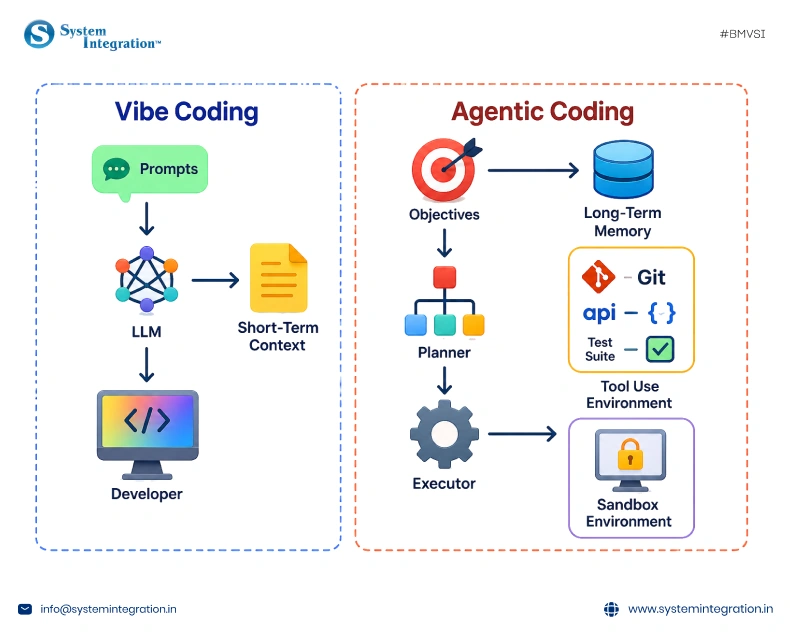
Enter two modern AI-driven coding tech stacks for supremacy: vibe coding vs agentic coding. The second is feeling as if you are in a creative flow, effortlessly building things from instinct and momentum. The other is more like a super-efficient version of a digital assistant whose job is to plan, decide and execute what you need done nearly automatically.
Which one actually gets the work done better? Is it the human-driven, instinct-driven “vibe,” or is it the structured but AI-powered autonomy of agentic systems? It will greatly affect production, scalability, and innovation of the products that you build… As modern development evolves rapidly, making the right choice can make all the difference.
Through this blog, we will explain both terms in basic and practical language without overwhelming you with jargon to develop an understanding of their strengths, weaknesses & how one fits your development style in 2026.
What is Vibe Coding?
Coined by OpenAI co-founder Andrej Karpathy in February 2025, vibe coding is a natural-language, human-in-the-loop workflow.
It’s like you talk to AI about how you want the website or app, and it builds, and you go with the flow. Now this even works smoothly and fine in some scenarios. It actually works fine for small and risk-free tasks.
It also works perfectly for people who are not engineers and want to express the idea of the app or any digital solution they want to create. Instead of showing up with the requirement doc, they can now use natural language to prototype what they’re trying to express.
Is vibe coding for beginners?
The simple answer is yes. Let’s know why.
Zero setup 👉 just a browser tab and an LLM chat
Instant dopamine 👉 deploy to Netlify/Vercel in minutes
Teachable moments 👉 ask “explain this function” and get a live lesson
However, even AI luminary Andrew Ng cautions that, despite the playful name, the process can be mentally taxing. You are still responsible for architecture, security and QA.
Here are the Drawbacks of Vibe Coding
- Poor structure: Vibe coding can end up messy, since it ignores planning for vibes. As time goes by and projects grow, they build architecture without any structure most of the time; keeping your semantics at hand makes this a bad thing.
- Scaleability: What works in a “flow state” while building small tasks might collapse when producing large, complex, or production-level systems.
- Inconsistent quality: Depending on whether the code is written as the mood strikes or momentum builds, it may vary in quality, which makes it harder to maintain standards across a team.
- Lack of sufficient documentation: Developers in the midst of a creative streak may neglect to properly document their releases, which can lead to confusion down the road or during times when anything needs maintenance or update.
- Likely to increase technical debt: With urgent decisions that are more instinct-driven, shortcuts may be taken, creating future maintenance difficulties to remediate.
What is Agentic AI Coding?
Agentic coding is an innovative method of software development in which agents driven by artificial intelligence take part in coding activities, for tasks such as planning, creating, testing, and optimising code and executing these agentic AI services with little intervention by a human.
Due to the autonomous nature of the intelligent system, developers no longer apply manual methods to each coding step of the process. As a result, instead of developers acting strictly in a developer’s role, they will perform a supervisory and strategy-based role in relation to the outcomes of their coding projects.
So Why Try Agentic Coding?
Increase your productivity: Automates repetitive coding tasks so that developers can concentrate on solving high-value problems.
Accelerated design cycles: Be more productive with smart task execution and on-the-fly code generation.
Enhanced code quality: AI agents can continuously test, debug and optimize the code.
Improved scalability: can be more scalable using a proper, structured, and modular approach, especially when dealing with larger systems.
Decreases errors by humans: reduces mistakes with automated validation and consistency checks.
Enables smarter workflows: It facilitates automated development from planning to deployment.
Key Differences between Vibe Coding and Agentic AI Coding
| Factors | Vibe Coding | Agentic AI Coding |
|---|---|---|
| Approach | Intuitive, developer flow & creativity driven | Structured, goal-oriented, driven by AI agents and parameters |
| Control | Fully human-controlled | Shared control of developers with AI agents |
| Speed | Ride short bursts, leverage the momentum of others | Comparatively fast due to the automation and can run multiple tasks at a time |
| Scalability | Struggles with large, complex systems | Optimized for large and complicated architectures |
| Code Quality | Very often dev dependent and less from product. | In line with automation test, validation and optimization |
| Collaboration | These are more individual-focused, not as much team-aligned | Structured processes that mesh well with teams and could be integrated into their development pipelines |
Why Agentic AI Coding help with Larger Software Development Processes?
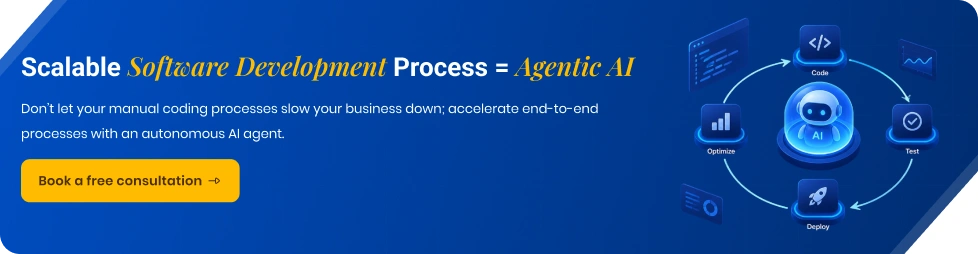
Agentic AI helps you accelerate your work as it autonomously handles multi-step tasks, such as designing, coding, testing, and debugging, rather than just suggesting. It acts as an intelligent, autonomous agents that manage multiple workflows, navigates repositories, and interacts with developer tools to speed up the cycle.
- Autonomous end-to-end workflows
- System-wide context awareness
- Intelligent debugging and testing
- Swift DevOps and CI/CD
- Multi-agent collaboration
Which is Better, Vibe Coding or Agentic AI?
It’s not about picking a “winner” between vibe coding and agentic AI coding, it’s about picking what works best for you.
If you don’t like to get too much involved with code, experiment and throw things together quickly, vibe coding is for you. You are quick, trusting your instincts and getting things done without overthinking.
But once your project becomes serious, with larger features, tighter deadlines, or team collaboration, agentic AI coding is more suitable.
Here’s one way of thinking about it:
👉 Explore ideas through vibe coding
👉 Create and grow them through agentic programming
The truth is that you don’t have to pick just one. The smartest developers are blending both in 2026, starting with creativity and ending with structure.
What Happens When You Mix Them Both
Imagine coding like creating a movie. While vibe coding is like preparing the scripts and an engaging storyline, agentic AI coding is like lights, camera and action that brings it to life. Combining them, you get a killer workflow.
| 🤖 Spec it, build it: you describe the projects, the agent builds it. 🧑💻Tweak and test: you refine the logic; the agent stress-tests it. 🚀 Dream big: you brainstorm features, the agent drafts them before you even hit “save”. |
The future? It’s you and your AI agent, coding in sync. You bring the vision, nuance, the “vibe”. The agent brings the hustle, tackling all the complexity of workflows with zero burnout.
Expert Tips for Developers
➢ Utilise vibe coding for brainstroming: When you are ideating or exploring a new idea, vibe-based coding will allow flexibility to move fast without barriers.
➢ Agentic AI to scale your codes: once your project contracts complexity, introduce agents to organize, improve and evolve code.
➢ Agentic AI for production-ready apps: for stable, secure and maintainable systems you can trust agentic AI for automated workflows & also automated testing.
➢ combine use of both: Initiate vibe coding to start the ideas flow, then switch to agentic AI for an optimal/rational scaling and deployment capacity.
Wrapping it up
In the clash of vibe coding vs Agentic AI coding, there’s no loser, just two paths to better coding. Vibe coding lets you dream big and prototype fast, while agentic coding takes your vision and runs with it. Together, they are a powerhouse, blending human intuitions with AI grit.
Thus, the best would be to use the hybrid approach of both agentic AI and vibe coding, using them as a creative approach of collaboration while maintaining the human insight that defines great engineering.
FAQs
Vibe coding works well for those who aren’t engineers and with low-risk tasks. It’s also fine when security isn’t the concern, and you aren’t shipping production code that someone has to maintain over time.
Vibe coding focuses on interactive AI assistance where developers guide and refine code. Agentic AI coding relies on autonomous AI agents that plan and execute tasks independently.
Yes, it can. But it rarely works by simply prompting an AI to build a secure app and deploying the results. Instead, it needs a proper approach.
It will significantly evolve the role from writing the code to orchestrating, reviewing, and architecting AI-generated code, resulting in boosting productivity.