Introduction
Various industries hit the pause button at a time when the world seems to run on breaking news alerts and uncertainty, but when it comes to IT? It quietly hits “update.”
Global conflicts have surely impacted the supply chains across countries, but for an IT firm, it has opened the doors to innovations and opportunities that decide how business operates in these uncertain times.
Technology is a fundamental part of doing business. IT companies have now become the invisible champions of continuity, safeguarding critical data and facilitating remote work around the clock.
IT companies can step into that gap, and not only as service partners, but rather as problem-solvers in extreme demand. In this blog, we will see how global conflict brings challenges, but on the other hand, opens new avenues never imagined for IT companies to adapt and innovate.
The Growing Impact of Global Conflicts on Businesses
1) Supply chain disruptions: conflicts in key regions, such as the straits of Hormuz, disrupt logistics, causing severe delays and increasing costs for manufacturers and retailers.
2) Economic uncertainty and investment risks: increased geopolitical tensions, such as US-China trade tensions, cause financial market instability, currency fluctuations, and a decline in foreign investment.
3) Regulatory and sanctions compliance: companies face challenges navigating complex sanctions, trade restrictions, and shifting legal jurisdictions in conflicts zone.
4) Cybersecurity threats: state-sponsored cyberattacks are a major concern, with businesses facing higher risks of data breaches and infrastructure damage.
| Types of Cybersecurity Threats ⚠️ 👉 Malware (malicious software) 👉 Phishing 👉 Ransomware 👉 Social Engineering 👉 Insider Threats 👉 Man in the Middle |
IT Opportunities Created by Global Conflicts
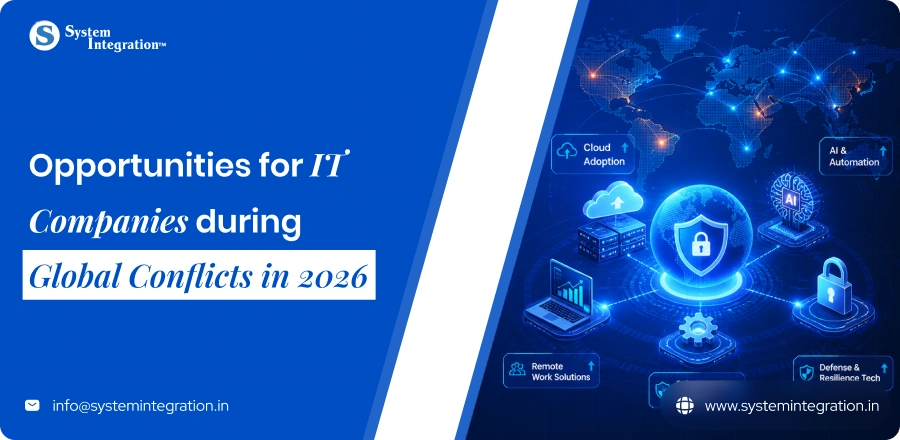
- Digital Transformation Acceleration
- Digital tech provides rapid, real-time sharing of information, which allows for a quick response in time and makes faster decisions.
- Tech is no longer just a support function, but a central component of national security, resilience, and operational superiority.
- Growth in Cybersecurity Services
- Cyber security services are growing fast, driven by global conflicts and growing threats of espionage and attacks on organisations.
- Businesses everywhere are now investing heavily in threat detection, incident response and resilient digital defence strategies.
- Increased Demand for Cloud and Backup Solutions
- With companies’ focus on data protection, remote access, and disaster recovery, the need for cloud and backup solutions is only growing.
- To guarantee uninterrupted operations across the globe, companies are embracing scalable cloud infrastructures and automated backup solutions.
- Expansion of IT Outsourcing to Stable Countries (like India)
- The global instability is causing the outsourcing of IT services to stable countries such as India, where companies can ensure continuity, AI and ML consulting at cost efficiency and access to skilled resources.
- Companies are shifting operations to safe areas to address geopolitical risks in a smart way.
- Rise in Automation and Cost-Saving Technologies
- As organisations try to minimize their reliance on an unpredictable environment, the conflicts push them toward automation and cost-saving technologies.
- Many businesses adopted new age technologies, including AI, robotics and process automation for better efficiency and operational resilience.

The Latest Emerging Technologies Gaining Momentum
✅ Physical AI(robotics/embedded AI) and Quantum Computing
The convergence of Physical AI and Quantum Computing represents the transformative emerging technology, projected to mature by 2028-2030. Physical AI brings intelligence into real-world environments, enabling robots and autonomous systems to perceive, reason about, and act within physical spaces.
Meanwhile, quantum computing is transitioning from laboratory promise to business reality. This computing paradigm represents a leap comparable to the transition from valve-based computers to microprocessors, with potentially similar impact on our lives.
✅ Multi-agent Systems Transform Work
If ‘agents’ were 2025’s buzzword, 2026 is when they become an everyday reality. Multi-agent systems deploy modular AI agents that collaborate on complex tasks, taking action on our behalf rather than simply answering questions.
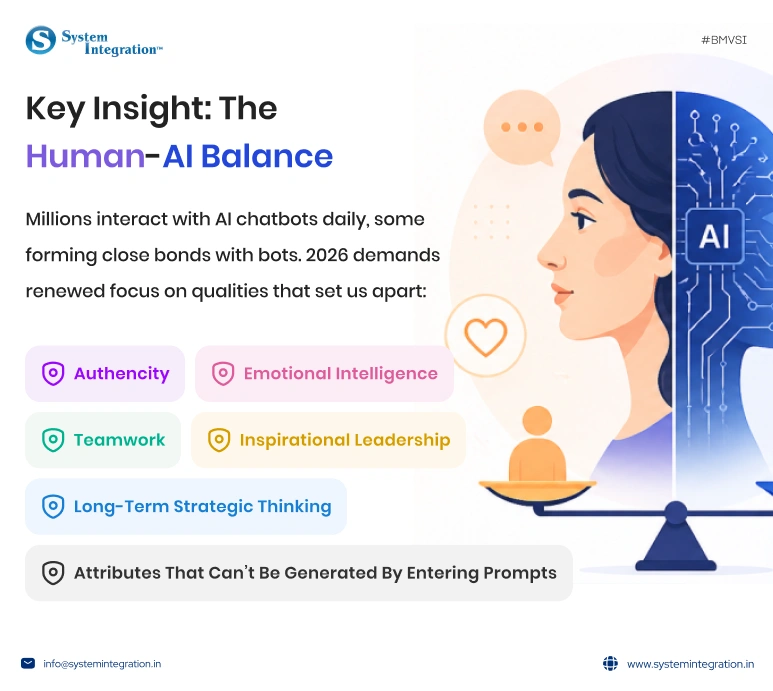
From automating business decisions to coordinating schedules, there are multiple use cases of AI agents that handle planning and problem-solving, freeing humans for higher-value work requiring creativity and strategic thinking.
✅ Security and the Human Trust in an AI-Driven World
As AI becomes ubiquitous, establishing trust grows critical. Preemptive cybersecurity moves beyond reactive defence, using AI and analytics to anticipate and neutralise threats before they cause harm.
AI security platforms address unique vulnerabilities from AI adoption, including adversarial attacks and data poisoning.
✅ Post Quantum Cryptography
Post Quantum Cryptography refers to cryptographic algorithms designed to secure digital information against future, powerful quantum computers that could break current encryption(like RSA/ECC).
Its approach includes lattice-based cryptography, hash-based signatures, code-based cryptography, and multivariate quadratic equations.
Challenges IT Companies Must Navigate
Regulatory and Compliance Issues
Governments tighten regulations, create new data laws and at times, overnight, arbitrarily implement limits outside a country´s borders on the flow of data.
For IT companies, it means being ever up to date, adapting quickly and ensuring that every solution complies with constantly-changing compliance requirements: a small failure could lead to big legal problems.
Data privacy concerns
The more uncertainty there is, the more valuable data becomes and also the greater risks surrounding it. The data sets keep tight lips on how they are stored, shared and protected, which makes businesses extra careful.
IT organisations have to balance the planning for those same things cost and security, but also need, requiring decent encryption, a limited ability to get into it (is there access control?), and frankly, being fully transparent about what they might be collecting in the process. In short, trust is as important as technology.
Infrastructure limitations in conflict zones
But not all places have already stable internet, electric energy or physical facilities—not in wartime anyway. IT companies need to think outside the box, creating solutions that would function under circumstances of poor or limited connectivity. Its not about perfect systems, but systems that outlive and work under any conditions.
Strategies to Capitalize the Opportunities
➜ Building resilient and scalable solutions
During uncertain times, businesses do not only want solutions, but they also want robust solutions. IT companies that thrive on resilience (local disruptions) and scalability (addition with needs) immediately catch the eye. It is building a system which only works on bad days, not just on good ones.
➜ Strengthening cybersecurity offerings
Arguably, one thing that a conflict does ensure is more cyber threats. Here is where IT firms can come to the forefront with advanced, proactive cybersecurity offerings services which encompass things like aggressive threat detection, real-time monitoring and response systems. Businesses nowadays are not just purchasing software; they are purchasing peace of mind.
➜ Forming strategic partnerships
No company can do it all on their own, least of all in chaotic, high-stakes situations. IT firms are collaborating with cloud providers, security firms or regional players to enhance capabilities while entering new markets and co-delivering complex solutions. In this case, collaboration is not a choice, it is a growth strategy.
➜ Investing in innovation
That leads some businesses to cut back during uncertain times, but the most intelligent IT companies double down on innovation. AI-enabled automation, artificial intelligence statistics, adaptive systems, whatever it is, when these companies invest in new technologies to make sure they are always one step ahead. Standing still, after all, is the quickest route to catching the next train.
Looking Forward: Innovation in a Transforming Global Landscape
Despite the problems that the global conflicts pose to the IT sector, it is also an opportunity for growth. There is a push to adopt new technologies and think differently about how to develop and collaborate across countries.
The future of the IT companies is bright with promises of advanced cybersecurity measures, cloud-based infrastructure growth, fintech innovations and international tech stack partnerships.
Companies that adapt to change and adopt new technologies have a great chance of succeeding and can build a future-proof business.
Summarizing Words
Global conflicts in 2026 have caused new challenges for various industries. But when it comes to IT? It quietly hits “update.” Global conflicts have surely impacted the supply chains across countries, but for an IT firm, it has opened the doors to innovations and opportunities that decide how business operates in these uncertain times.
Thus, future-proof your business by developing strong strategies to get the most from these global conflicts. Consulting with expert AI software consultants can help you in this objective, as they have a team of experts who are experienced and skilled.
FAQs
War makes AI development happen faster for defence purposes. It also causes problems with getting the things we need, moving talented people around and working together globally. This slows down the growth of the AI system.
Businesses can protect themselves by getting things from places, investing in secure AI systems that are secure, following the rules, and teaching their teams about AI and how to keep it safe.
It serves as a critical lifeline during tumultuous times by enabling business continuity, remote workforce flexibility, and rapid cost adjustments. It removes the reliance on physical, on-premises infrastructure, allowing organisations to operate from anywhere.
Companies opt for outsourcing to stable countries to have fewer hazards. Reliable infrastructure, a skilled workforce and lower-cost IT services keep countries like India at an advantage.