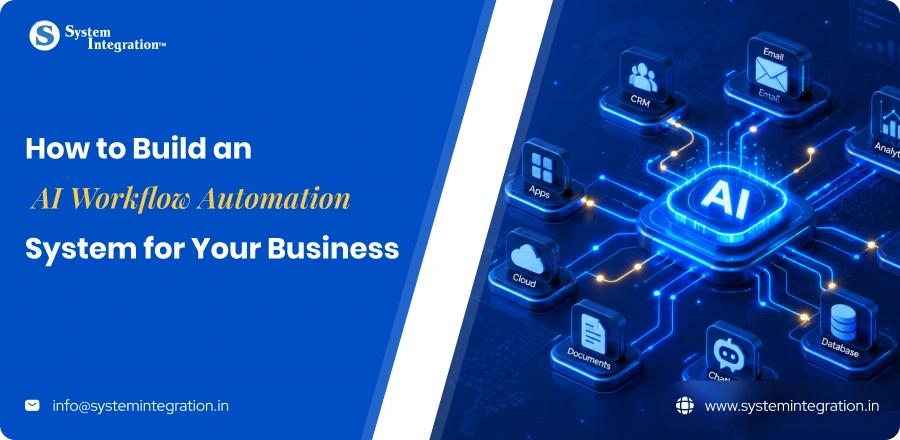
Introduction
Ever think your business is running on a combination of sticky notes, endless emails, and that one employee that somehow remembers everything? That’s not a workflow. That’s survival mode.
In 2026, businesses won’t just need automation, they’ll need intelligent systems that can think, respond and act faster than manual processes ever could.
AI-powered workflow automation systems help businesses automate repetitive tasks, link multiple tools, analyse data in real-time, and enhance decision-making without continuous human intervention. AI-powered workflows can cut errors, save time and boost productivity across departments, from handling customer enquiries and leads to automating approvals and generating reports.
The best part?
With the help of modern AI tools, no-code platforms, and workflow automation software, you can build scalable & efficient systems customized to your operations without requiring much technical know-how. This blog will show you how to create an automated AI workflow that simply runs processes for business in the long run.
What is an AI Workflow Automation System?
An AI workflow automation system is a technology that enables businesses to automate processes based on Artificial Intelligence (AI). It differs from basic automation because it can read algorithms, analyze data, decide what to do next, try different patterns for learning and improve workflows over time.
It enables businesses to automate their manual work, reduce errors, and enhance operational efficiency in discrete business processes like customer support, lead management, data processing, project coordination, etc.
| Difference between Traditional Automation and AI Automation 🤖⚙️ 📌 Traditional Automation: Traditional automation is a command-based, rule-based system that performs repetitive jobs using specified instructions and unchangeable workflows without learning or adapting to changes. 📌 AI Automation: AI automation services are a step ahead with the use of Artificial Intelligence and machine learning to analyse data, make decisions autonomously, adapt to changing conditions and develop/optimise processes over time. |
Key elements of a workflow system
- AI Engine: where algorithms run, analyze data and obtain logic.
- Workflow automation software: the tools that connect and automate tasks on different platforms and applications.
- Data integration layer: It pulls and syncs data from a number of systems in real-time.
- ML Models: They keep learning with the data to help improve workflows in terms of accuracy and efficiency.
- Monitoring & Analytics Dashboard: allowing the organisation to track how well their workflow is performing, detect areas of concern and actionable insights
Benefits of AI Workflow Automation Tools
- Automating the repetitive tasks
- Tools that automate workflows in an AI environment automatically execute repetitive tasks, saving your team time and improving operational productivity that flows across everyday business processes.
- Enhances the cost savings
- The businesses rely on AI automation to cut down their operational expenses by minimizing manual workloads, maximizing resource utilization, and, most significantly, streamlining overall process efficiency.
- Decreases human errors
- AI automation reduces errors caused by humans in data processing, reporting, and workflows, so businesses can rely on it for consistent, accurate and reliable business operations each day.
- Accurate decision making
- AI systems run on real-time data collected from multiple valid sources that is analysed by networks at high speed to maintain the accuracy of decision-making and avoid human mistakes in this process.
- Improves the customer experience
- AI workflow automation enables faster responses to customer inquiries, personalized interactions with customers, automated support systems, and seamless service delivery across multiple channels, leading to enhanced customer experiences.
Identify Business Processes to Automate
↪ Repetitive and Time Consuming Tasks: Automate time-consuming tasks like data entry, file management, approvals & other administrative work to save time as well as avoid errors.
↪ Customer support Workflows: Chatbots and automated ticketing systems to answer customer queries and provide faster responses.
↪ Sales and Lead Management: Automate lead capture, follow-ups, sales & customer engagement processes to increase conversions.
↪ HR & Employee Onboarding: automate the recruitment process, simplify verification document steps, and train employees with the automation tools.
↪ Finance and Reporting Operations: Use RPA to enable invoice processing, expense tracking, payroll management, and financial reports generation with improved accuracy.
Select the Right AI Workflow Automation Tool

- No-Code & Low Code Platforms: Enable businesses to construct automated workflows with little or no programming ability.
- AI-Driven Workflow Management Tools: Automate key decisions, data processing and intelligent task management using Artificial Intelligence.
- Integration Capabilities: The platform should easily integrate with CRMs, databases, APIs & third-party business applications.
- Cloud versus On-Premise Solutions: Most of the new tools available are cloud-based and allow relocalized access, while on-premise solutions provide more control over resources used and data.
Steps to Build the AI Workflow Automation System
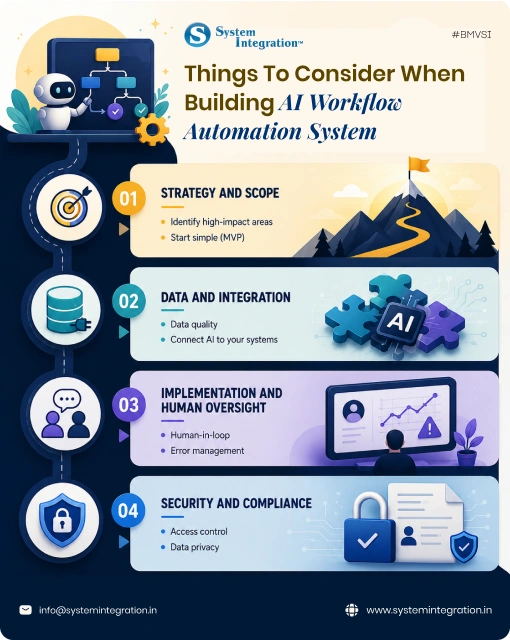
Step 1: Map the Workflow
Realize the end-to-end business process you want to automate. Make a detailed list of all the tasks, decision points, and team members. It allows you to learn about all the areas where automation could help save time, reduce manual work and improve overall efficiency and accuracy.
Step 2: Connect Business Applications
Connect the applications used by your company, such as CRM systems, Email platforms, project management tools and databases. Integrating properly enables the easy flow of data between applications and eliminates duplication through repetitive manual work.
Step 3: Integrate your AI models and business logic
So when you have specific tasks where AI, such as conducting an analysis, prediction, chat box response inputs, a model is functioning in decision-making. Workflow management logic should be defined clearly for when the system knows when to trigger actions, process information, and automate sophisticated business operations successfully
Step 4: Use the triggers and actions
Create triggers that automatically initiate the workflow whenever a particular event occurs, be it getting a form submission or a customer query. Then specify what the system can do and what you expect from it so that it automatically completes the process.
Step 5: Testing and Optimizing the workflow
Do multiple tests to make sure the workflow works fine from end-to-end without any failure or delay. Keep an eye on performance, analyse caveats and improve continuously to raise the precision of automation, speed & general business productivity in the long run.
How Much Does It Cost to Build an AI Workflow Automation System?
The basic low-cost AI workflow automation begins estimatedly from $500 to $8000. Later, the prices differ as per the complexity of the project and the type of automation the company needs.
It also depends of the factors like the location. As different regions have different price range. For example the USA have one of the most expensive developers and in asia you can find resources as lower rate for the same and more better services.
| Workflow Automation Type | Estimated Time Range |
|---|---|
| Simple task-based | 2 - 4 days |
| Simple integration | 1 - 2 weeks |
| RAG using company data | 4 - 8 weeks |
| Agentic workflow | 2 - 4 Months |
| Enterprise complexity | 6 - 12 months |
Technologies Applied in AI Workflows Automation
➙ AI and Machine Learning: Enable systems to analyze data, identify patterns, take decisions and optimise workflows over time.
➙ Natural Language Processing (NLP): NLP is a field in AI that allows systems to understand, interpret and use the language which you would typically use over chat, email, or voice.
➙ APIs and Integrations: Interconnect disparate software to facilitate data sharing between your business systems and automation platforms.
➙ Robotic Process Automation (RPA): Carries out repetitive rule-based tasks such as data entry, form processing and report generation without the need for human intervention.
➙ Cloud Computing: Offers scalable storage, helps you access from anywhere, and Flexible infrastructure for running AI automation systems.
Real World Use Cases of AI Workflow Automation
Automating Lead Generation
Workflow automation services assist in automating the whole process from manual to automation for lead capture, enrichment, scoring, and outreach in B2B lead generation. It is to ensure faster response times, more effective personalisation, and efficient data handling that helps sales teams focus on quality prospects and close deals efficiently.
Social media posting
A strong online presence takes more than posting once in a while. The challenge is that daily updates across several platforms quickly eat up time. Social media automation fixes that problem by handling the repetitive parts.
You can line up posts in advance, organize them into content libraries, and schedule them to go live when engagement is highest. Evergreen updates can even recycle on a loop to keep your feed active.
Customer Support Ticket Routing
The support team often gets drowned in requests, and without clear rules, tickets bounce around or sit unanswered. Routing solves this by matching issues to the right person the moment they arrive.
This directly rises the customer satisfaction, since routing speeds responses and improves first contact resolution. For your business, automation means your agents spend less time sorting and more time solving.
Employee Onboarding Workflows
Bringing in a new hire involves dozens of small steps that can quickly pile up for your HR and managers. Automating onboarding streamlines processes for new employee setup.
Workflows can generate offer letters for e-signature, send pre-start surveys, and route documents securely. On day one, IT receives an automated ticket to set up accounts, while payroll is notified to add the person to the system.
Future Trends of AI-Powered Workflow Automation
- Agentic AI workflow: Agentic AI will be able to manage multi-step workflows on their own with little human intervention.
- Hyperautomation: Businesses will use AI, RPA and analytics to create complex end-to-end automation of different systems and across departments.
- AI copilots for enterprise: AI copilots will assist teams in the course of understanding by suggesting instructional content, automating repetitive tasks, and boosting work output in day-to-day operations.
- Autonomous decision-making systems: The advanced AI systems will automatically analyze data, make predictions and business decisions at a faster speed than human beings.
Summarizing Words
With high employee productivity, minimal manual effort, and efficiently structured workflows, an AI workflow automation system optimally designs companies. AI automation is paving new ways from intelligent workflows to autonomous decision-making in terms of business processes. For future-proofing your firm, collaborate with an experienced AI Software Development Company to empower organisations to incorporate solutions for scalable automation in a future-ready manner.
FAQs
An AI workflow automation system exploits Artificial Intelligence capabilities to enable businesses to automatically perform tasks as well as make better decisions while keeping human assistance to a bare minimum.
Automation is affordable if it is utilized to save manual effort, eliminate errors, and reduce long term operational costs. SMBs can afford the automation, as there are various tools which can help in this work.
Unlike traditional automation, which is based on fixed rules, AI can analyse data and learn from patterns, helping workflows adapt to changing business needs.
Yes. A number of AI automation tools are scalable and can be personalized to cater to SMB budgets and operations, offering good ROI even on a smaller scale.