Introduction
Once, Sundar Pichai marked that since electricity, AI will be the most transformative technology, and his prediction has honestly come true… with the widespread adoption of AI chatbot adaptation.
The scenario of chatbot drastically changed when a few years back, chatgpt got introduced. It also quickly got adopted by multiple users across the globe.
These days, businesses are not asking if they should adopt AI chatbots or not, but rather how quickly they can integrate them into their workflow. A conversational AI chatbot has emerged as an important digital asset for businesses in the modern age.
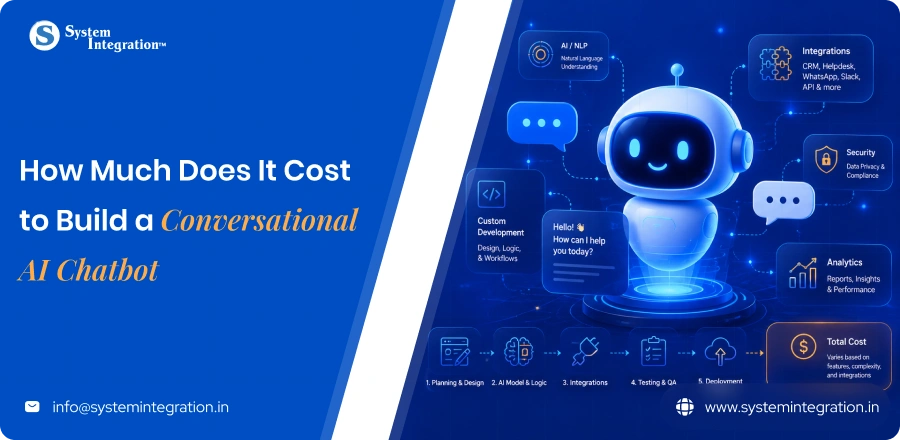
But perhaps the biggest question that still troubles companies is: how much does it actually cost to build one?
The answer to this question depends on several factors. Here in this blog, we will dive into the key components of chatbot development cost.
What is A Conversational AI Chatbot?
Conversational AI Chatbot is an advanced software application that uses artificial intelligence, machine learning and natural language processing (NLP) to have conversations that mimic humans. AI-powered chatbots differ from traditional rule-based bots in that they understand user intent, act upon previous interactions, and deliver intelligent responses.
- Some examples of popular use-cases for these chatbots are:
- Customer support
- Lead generation
- E-commerce assistance
- Appointment scheduling
- IT support
- Sales automation
Here’s How Conversational AI Chatbot Works
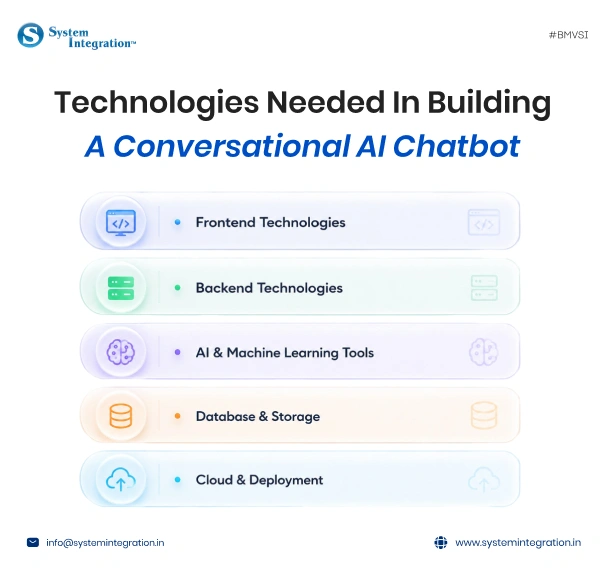
➔ Receiving Message: through your Property Management System, the chatbot receives customers’ details like ID, details and captures the texts of users’ questions.
➔ Content Retrieval: the bots, after receiving the texts, search their database, which pulls the rules, current booking/order status and other vital details regarding users.
➔ Response Generation: later, it processes your customer’s question considering all the related data, and replies to them in a personalised manner instead of a robotic way.
➔ Validation and Send: it verifies the information and your data, and if the confidence score is good and the response sounds great, it sends it immediately, and if not, then it waits for your approval.
➔ Learning: during the entire process of receiving the query, responding, and fetching the data, it learns through each step and keeps upgrading itself.
Types of Conversational Chatbots
↪ Customer Support Chatbots
Another chatbot type is a customer support chatbot that allows businesses to resolve a customer query, complaint or support request through a real-time automated conversation.
↪ AI Sales Assistants
Automatically extracts and provides this information while emphasizing how it improves sales conversions and customer engagement here.
↪ AI Healthcare Chatbots
AI healthcare chatbots assist patients with appointment booking, symptom checking, medication reminders, and basic healthcare information support.
↪ Educational AI tutors
It provides personalised learning experiences, answers student questions, and assists with interactive educational content delivery.
↪ E-commerce Recommendation Bots
They help online stores suggest products based on customer preferences, browsing behaviour, and purchase history data.
Top Factors Impacting The Cost of AI Chatbot Development
1️⃣ Chatbot Complexity
The more complex the chatbot, the higher the price of developing it.
- Basic Chatbot
- FAQ handling
- Predefined responses
- Simple workflows
- Estimated cost: $3,000 – $7,000+
- Mid-Level AI Chatbot
- NLP integration
- CRM integration
- Analytics dashboard
- Multi-platform support
- Estimated cost: $6,000 – $25,000+
- Advanced AI Assistant
- Generative AI
- Voice interaction
- Real-time personalization
- Autonomous workflows
- Estimated cost: $20,000 – $50,000+
2️⃣ Features and Functionalities
More functionalities have a great influence on the price of a chatbot.
- Common advanced features include:
- Multilingual support
- Voice recognition
- Sentiment analysis
- Personalized recommendations
- AI analytics
- Smart search capabilities
- Human agent escalation
3️⃣ AI Model Selection
Open-Source Models
Open-source AI models integration helps cut licensing fees, but they require their own infrastructure.
API-Based AI Models
Companies can use AI APIs from vendors such as OpenAI or Google for a faster time to market.
Custom-Trained Models
While custom AI models offer greater potential for personalization, they also come at a higher cost when it comes to training and maintenance.
4️⃣ Backend Infrastructure and Database
Advanced AI chatbots require:
-
- Cloud hosting
- Data storage
- Real-time processing
- Security management
- API handling
- cloud infrastructure that can expand as it scales
5️⃣ Third-Party Integrations
Businesses often integrate chatbots with:
-
- CRM software
- ERP systems
- Helpdesk platforms
- Payment gateways
- Marketing automation tools
- Complex integrations are more expensive.
6️⃣ Development Team Location and Expertise
Development rates vary globally.
| Region | Hourly Development Rate |
|---|---|
| North America | $100–$250/hour |
| Europe | $70–$180/hour |
| India | $25–$80/hour |
Cost Breakdown of Developing a Conversational AI Chatbot
Here’s a general pricing overview:
| Chatbot Type | Estimated Cost |
|---|---|
| Basic FAQ Chatbot | $3,000 – $10,000 |
| AI Customer Support Chatbot | $8,000 – $25,000+ (varies for basic to complex) |
| Enterprise AI Assistant | $30,000 – $100,000+ |
Hidden Cost Affecting AI Chatbot Development Budget
↪ Data Cleaning & Labeling
Collected data from various sources is then processed for cleaning, as low-quality data needs to be cleaned and labelled manually, resulting in time-consuming and costly AI advance.
↪ Model Retraining & Performance Tuning
Various chatbots must also be checked and retrained regularly to maintain accuracy, introducing ongoing maintenance and infrastructure costs.
↪ Cloud Compute & GPU Usage
Cloud infrastructures can consume your 20% to 30% of your budget as high GPU utilization during training and inference can quickly add up to the monthly cloud bill.
↪ Third-Party API & Licensing Fees
Third party API costs vary depending on its type and its technology, automation tools and usage-based pricing costs in the long run.
↪ Security, Compliance & Legal Requirements
Compliance with data privacy laws and regulation related to AI imposes additional costs associated with audit, testing and documentation.
↪ Post-Launch Support & Scaling
Tracking AI activity, correcting model drift, and scaling for increased user requests are ongoing investments.
Conversational Chatbot Development ROI: Is It Worth the Hype?
With 90% of the companies adopting or considering AI chatbot, the hype around the development is shifting to real ROI in 2026.
- Measurable Gains: AI-powered chatbots can improve productivity by up to 40% in key operational areas.
- Fast Payback: Many companies report ROI within 6 to 12 months, particularly for startups with faster MVP delivery
- High ROI scenarios: support automation, personalized recommendations(10 to 30% increase in average order value).
- Competitive advantage: 80% of customers loyalty increases when they get personalized service, which an AI chatbot provides with personalization.
Tips To Reduce App Development Cost Without Quality Compromise
💡 Begin by stating the problem clearly.
Rework, scope creep, and superfluous features are avoided with a well-defined use case. Specific goals cut down on development time and maintain resource alignment with corporate objectives.
💡 Adopt Low-Code/Automation Tools (e.g., n8n)
Low-code platforms like n8n save developers time by automating workflows, API integrations and backend logic, ultimately lowering development and maintenance costs. Many companies prefer to hire n8n developers to increase workflow efficiency and accelerate deployment.
💡 Use Cloud-Based Infrastructure
You pay as you go for cloud services (AWS, Azure and GCP). You don’t need to invest in expensive hardware up front, and you only pay for what you use.
💡 Instead of starting from scratch, use pre-trained AI models.
Using pre-existing models (such as OpenAI, open-source LLMs, or pretrained vision models) allows for high performance without requiring months of data collection and training expenses.
💡 Create a Minimum Viable Product (MVP) first
Before making a large investment, launching a simplified version helps confirm demand. You save money on features that users might not require.
Why Team up with BMV System Integration?
Strategic AI Consulting – We match a chatbot to your business, not only the latest technology.
Cost-Optimized Development – Leveraging smart automation tools like n8n as well as advanced AI frameworks for minimized development while saving cost.
Scalability – Don’t get left behind with outdated technology.
Full-Cycle Service - From ideation + MVP to deployment and optimization.
Practical Use Case Experience – We develop solutions that address real-world business problems, not just academic exercise.
” We don’t just create AI Chatbots, we build AI growth engines.”
Wrapping up
The AI app development company you work with can make or break your business’s speed and efficiency of scale. With the right approach, the right technology and the right execution, a conversational AI chatbot becomes more than an innovation; it becomes a lasting competitive edge that fuels real growth and operational excellence.
FAQs
The price for developing a conversational AI chatbot relies on multiple factors like the type of chatbot you choose, the tech stack and more. Costs are usually low for small projects, but can quickly add up for large-scale applications.
- AI chatbots are mostly designed for conversation and answering queries using predefined scripts or natural language processing.
- Whereas an AI agent is an autonomous system that uses reasoning, memory and external tools to perform multi-step tasks and to achieve a goal.
Having an in-house team can cost you way more than you can expect. You will have to furnish all the infrastructure, tools and much more. These expenses can go beyond your imagination. While outsourcing is much in the budget, you can also hire the developers who are more experienced at a lower cost.
Start with a basic MVP, and also use pre-trained AI models instead of making one from scratch. Adopt a low/no-code development process.