Introduction
AI is not an option now, it has become like an employee who can do tasks more quickly, that too without any coffee breaks.
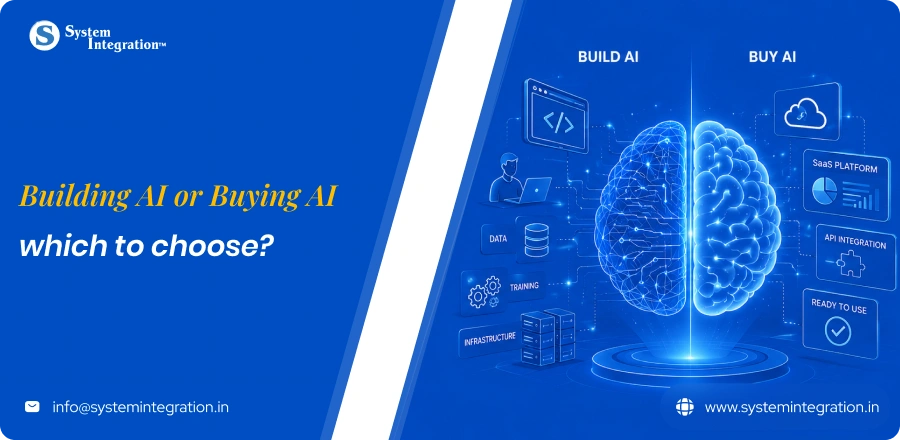
Artificial Intelligence went real quick from being a tech trend to being a business necessity for automating workflows and accelerating customer experiences. However, once a company commits to AI deployment, the next fairly large question arises, build it or buy?
Each has its own benefits, challenges, costs and implications for the future. Buying AI solutions provides faster time-to-market for businesses, with a lower upfront cost compared to building your own solution.
While buying allows flexibility, customisation and more control, building offers higher speed (of iteration). Let’s understand which approach suits your business more in this blog.
What Does “Building AI” Mean?
Building AI, also known as Custom solutions in Modern AI. It is a form of tailored Artificial Intelligence typically used for a company-specific business need. Rather than using off-the-shelf software, companies build their own AI models, workflows and infrastructure.
- Custom AI development often includes:
- Data collection and processing
- Machine learning model training
- AI infrastructure setup
- Integration with existing systems
- Continuous monitoring and optimization
This approach is usually adopted by organizations that need enhanced customization, domain-specific automation or maximum input over how their AI systems behave.
| Benefits of Building AI 🎯 📌 Full Customization Custom AI solutions are tailored according to business needs. All this allows firms to carve out features, workflows, and automations across the exact use cases they want. 📌Better Data Control Organizations can have a greater hold on sensitive business data, security protocols, and compliance requirements when they build AI inhouse. 📌Competitive Advantage A unique AI system can help a business stand out from its competitors by providing exclusive capabilities and enhanced customer experiences. 📌Scalability in the Long Term Custom-built AI systems can scale as the business expands. Companies can keep adding new features and optimising performance. |
What Does “Buying AI” Mean?
Buying AI When we are sourcing third-party vendors, we utilize out-of-the-box AI tools, platforms or software. They are already fully developed, and have been tested in the real world.
- Examples include:
- AI chatbots
- AI-powered CRMs
- Marketing automation tools
- Predictive analytics software
- AI customer support platforms
This option works well for organizations looking for quicker deployment, lower capital expenses and a better potential ROI.
Building vs Buying AI: Here is What You Need to Know
| Factor | Building AI | Buying AI |
|---|---|---|
| Cost | High upfront investment | Lower initial cost |
| Deployment Time | Longer development cycle | Faster implementation |
| Customization | Highly customizable | Limited customization |
| Scalability | Flexible long-term growth | Depends on vendor |
| Maintenance | Managed internally | Managed by vendor |
| Security | Better internal control | Third-party dependency |
How Building AI can Help Improve your Business Efficiency
- Customised for Your Unique Business Requirements: Custom software is also developed around your workflows, goals, and challenges. It builds on itself, getting rid of the common in generic tools and only focusing on what your team actually needs to increase productivity overnight.
- Automation of Repetitive Tasks: Custom solutions automate routine processes from data entry to reporting and approvals. It cuts down on manual errors, frees up time, and enables your team to work on higher-value strategic projects.
- Seamless System Integration: Whether in CRM, ERP or AI tools, integrations of third-party APIs are easy with custom software. This allows a seamless flow of data across departments and breaks down the information silos.
- Better Scalability as You Grow: As your company grows, so can your software. Custom solutions offer configurability, enabling new features, user roles, and integrations without disrupting ongoing operations.
- Enhanced Security & Data Control: Custom software adds stronger security measures that meet your industry requirements, ensuring sensitive business data remains secure and compliant with full control over architecture and hosting.
When Should Companies Build AI?
Building AI suites when:
- They require highly customised workflows
- This is an industry that requires compliance and security.
- They have strong technical teams
- AI as a long-term game
- They need unique competitive advantages
This approach is often liked by medium to large enterprises and technology-based businesses.
When Should Companies Buy AI?
Buying AI is suitable when:
- Businesses need quick implementation
- Budgets are limited
- Internal AI expertise is unavailable
- Standard AI features are sufficient
- Companies want lower operational complexity
Most of the time, startups and small businesses opt for existing AI solutions.
Hybrid Approach: Combining building AI and Buying AI
Today hybrid AI is getting adopted by most companies. This strategy asks for a mix of both approaches, the building and buying of AI effectively.
For example:
➔ Implemented custom integrations with pre-built AI APIs
➔ Integrating new workflows within existing AI applications
➔ Integration of external AI tools with the internal automation system
It assists the businesses to achieve a balance of speed, adaptability and cost-effectiveness.
Key Factors to Consider When Building AI or Buying AI
↪️ Know what you want
Observe and note your present work operations issues and business goals you want to achieve in the near future from the product you are building, so you can see where your existing tools can help and whether you need a custom solution.
↪️ Evaluate growth & scalability needs
When planning for growth, remember to always select the digital solution development that meets your long-term needs. For building the software, select the most fitting development partner, as this can make or break your solution.
↪️ Assess integration requirements
Perform market research and check out all the latest tech stacks and map out the landscape to see which one can be helpful to you in maintaining your solution scalable in the long run without slowing down when the customers increase, and assist you in growing in the competitive market.
↪️ Compare total costs of ownership
Look at the upfront costs and the total cost of ownership, including licenses, maintenance, updates, infrastructure, and training. Have a fixed budget before starting the process, as the cost can go very high otherwise.
↪️ Identify Risk Tolerance & Vendor Dependencies
Decide on how much control you would like to have over your tech stack roadmap. Understand the associated risks, tolerance, vendor pricing, data ownership, and platform flexibility before deciding.
Summarizing Thoughts
Buying AI is lower in costs and fewer headaches, which is great for getting MVPs to market faster, automating processes or running ahead of others in your industry. Building a tailored AI solution, meanwhile, gives you total control, the wide expanses of “you can build it as per your needs”.
However, for having the competitive edge in the market, partnering with the best AI software development company is vital, as it provides scalable AI solutions which scale as your business grows.
FAQs
It totally depends on your requirements, and in the initial phase, it requires a high investment. However, in return, it gives a higher ROI as compared to buying the AI software.
- Healthcare
- Real-estate
- Financial services
- Manufacturing and logistics
- Retail services
- E-commerce
Buying AI, if you do not have complex app development requirements and also want to complete in a specific time. However, if you have any unique requirements for the development process, then building AI would be better.
Major drawbacks include limited customization abilities, can’t develop a complex feature application and also potential performance issues which effects scaling of the app.