Introduction
Building an AI chatbot is no longer a “nice-to-have” experiment; it’s a strategic business decision. Customers expect instant responses, human‑like conversations, and zero tolerance for clunky bots that sound like they were trained in 2012.
If your chatbot still replies with “Please select from the following options” for everything, congratulations, you’ve already lost half your users.
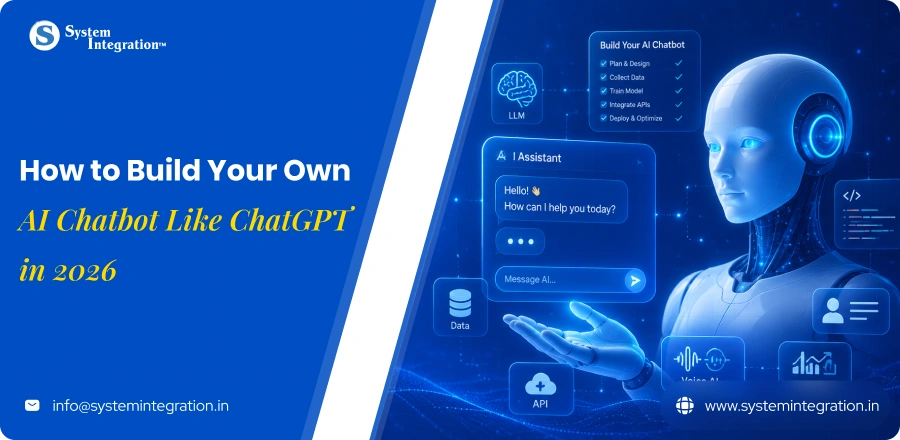
In this blog, we’ll break down how to build an AI chatbot like ChatGPT, covering features, development process, compliance needs, and real-world costs without the buzzword overload. A little humour included. Because even chatbots deserve personality.
Why Businesses need to have an AI Chatbot like ChatGPT?
In this competitive and mature digital market in the world. Customers here:
- Expect 24/7 instant support
- Prefer self-service over waiting on calls
- Can instantly tell when they’re talking to a bad bot
This is why businesses are rapidly investing in AI Chatbot Service solutions instead of basic rule-based bots.
From SaaS companies and E-Commerce brands to healthcare and finance, chatbots for customer service are now the frontline of user experience.
The message is clear: AI chatbots are no longer optional; they are becoming standard across multiple industries.
Top Features of an AI Chatbot Like ChatGPT
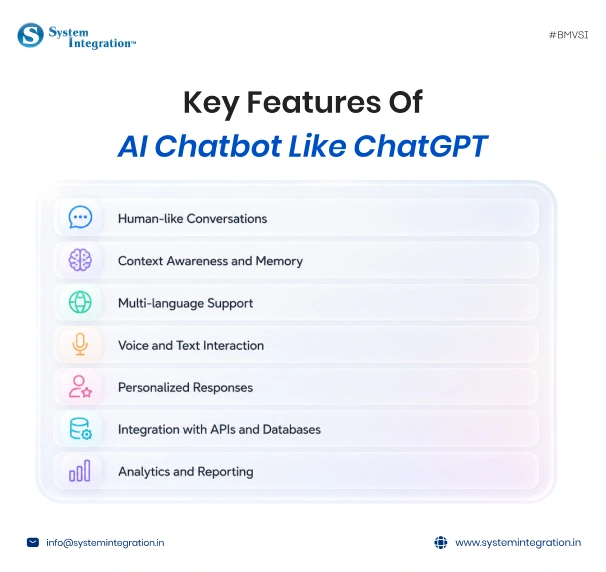
- Human-like Conversations
- AI chatbots are capable of understanding natural language, providing relatable responses and generating interactive conversations that are much like human communication experiences.
- Context Awareness and Memory
- More sophisticated and smart chatbots can recall past conversations, retain context, and give relevant, customized, and accurate responses during interactions.
- Multi-language Support
- AI chatbots are able to speak different languages, thus enabling companies to reach global customers, which improves accessibility and customer engagement globally.
- Voice and Text Interaction
- Users talk or write a message, and this will assist you in creating flexible, convenient, lives communicate experiences on platforms.
- Personalized Responses
- AI chatbots have a way of analyzing user behaviour, preferences and past conversation history that are able to provide relevant recommendations, answers and personalized customer experience.
- Integration with APIs and Databases
- Chatbots integrate with APIs, CRM systems, and databases to fetch real-time information and automate multiple business processes in an efficient way.
- Analytics and Reporting
- AI chatbots monitor conversation, user behaviour and performance metrics in real time to improve the customer experience as well as optimise bot strategies.
Types of AI Chatbots
↪ Customer Support Chatbots
Another chatbot type is a customer support chatbot that allows businesses to resolve a customer query, complaint or support request through a real-time automated conversation.
Key Features
- 24/7 customer assistance
- Instant query resolution
- Ticket creation and tracking
- Multi-channel communication support
↪ AI Sales Assistants
Automatically extracts and provides this information while emphasizing how it improves sales conversions and customer engagement here.
Key Features
- Automated lead qualification
- Personalized product suggestions
- Real-time customer engagement
- Sales funnel automation
↪ AI Healthcare Chatbots
AI healthcare chatbots assist patients with appointment booking, symptom checking, medication reminders, and basic healthcare information support.
Key Features
- Appointment scheduling support
- Symptom analysis assistance
- Medication reminder notifications
- Secure patient communication
- Educational AI Tutors
↪ Educational AI tutors
It provides personalised learning experiences, answers student questions, and assists with interactive educational content delivery.
Key Features
- Personalized learning support
- Instant doubt resolution
- Interactive learning sessions
- Progress tracking and analytics
- E-commerce Recommendation Bots
↪ E-commerce Recommendation Bots
They help online stores suggest products based on customer preferences, browsing behaviour, and purchase history data.
Key Features
- Smart product recommendations
- Personalized shopping experience
- Upselling and cross-selling
Step-By-Step Complete Process to Create AI Chatbot like ChatGPT
Step 1: Define Your Chatbot Objective
Determine What You Want Your Bot to Achieve. Identify the purpose of your chatbot, business goals, target audience and key use cases. Setting clear goals is important for conversational UXs and to ensure that the chatbot provides useful solutions in line with user expectations and business needs.
Step 2: Select the Appropriate AI Model
Based on your quality scale, budget and industry needs, select an AI model for your chatbot. Depending on their needs, businesses can opt for GPT models, integrate LLMs in applications or fine-tuned custom models. These improvements lead to enhanced performance of conversational agents with better personalization and higher conversational accuracy.
Step 3: Design Conversational Flow
Design a structured conversation flow defining user intents, bot responses for those intents, fallback messages and paths of interaction. By creating successful conversational design, you can drive user engagement, provide more natural communication experiences and enhance the way different customer scenarios interact with each other.
Step 4: Build the Backend
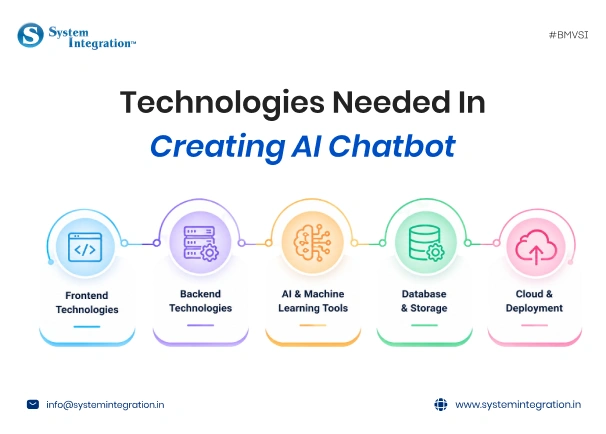
Build a robust server that integrates APIs, handles user authentication and data processing, and executes chatbot logic with database queries. A powerful backend provides reliable communication channels, scalability, performance and integration with 3rd party business apps and platforms.
Step 5: Build the Frontend Interface
Create a mobile responsive interface for the chatbot that is easy to navigate, aesthetically pleasing, and follows several smooth user interactions. Frontend capability to process mobile, web and app interfaces supporting messaging, voice, and promote use/UX.
Step 6: Train and Fine-Tune the AI
Train it with good data datasets, business terminology/data and examples of conversational exercises. Fine-tuning boosts response accuracy, contextual understanding and personalisation, which helps the chatbot to enable consistent interactions in a more relevant, intelligent manner.
Step 7: Add Advanced Features
Level up your bot with voice recognition, multilingual support, sentiment analysis, file uploads, AI memory and automation workflows. Further, these features enhance end-user engagement, business productivity, and build a smarter customer experience via conversational AI.
Step 8: Test the Chatbot
Test thoroughly to find bugs, refine conversation accuracy and test the flow. Perform chatbot performance testing on various devices, platforms and scenarios while also keeping track of security, speed, reliability and other experiences before deployment milestones.
Step 9: Deploy the Chatbot
Use robust cloud infrastructure to deploy the chatbot on websites, mobile apps or communication platforms. Iterate on performance by gathering user feedback, optimizing the bot responses in such a way that they are reusable and updating your features frequently to remain scalable in the long run as well as resilient while increasing customer satisfaction.
Estimated Cost of Developing a ChatGPT-like AI Chatbot
Like any other digital product, it is vital to consider the most critical factors, both operational and computational, to build an AI chatbot like ChatGPT.
To elaborate, the computational aspects of developing an AI-powered chatbot would include datasets, app complexity, customisations, for the end user, the range of features and functionalities, and so on.
The estimated cost of development is estimated by considering various factors like:
- The platform on which the app will be developed.
- Outsourcing, freelancing, or in-house team of developers
- Fine-tuning the chatbot on updated datasets
- Cloud-based resources for data storage
- Tech stack for the scalability of the app
Considering the above-discussed factors, the budget range for developing an AI chatbot like ChatGPT would start somewhere around $50,000 for a very standard model, and increase as you want to make a custom one for your enterprise.
How to Reduce the Cost of Developing an App like ChatGPT?
- Opting for the Right Resources
- One extremely viable solution is to outsource your AI chatbot development project. However, choosing the right development partner is indispensable in the sense that it would regard your budget concerns and still deliver a world-class product.
- Leading an MVP-Driven Dev Process
- Developing a minimum viable product(MVP) enables product builds to be triggered upon a predefined schematic with only core features. This serves as a foundation and aids in cost-saving by eliminating redundant elements.
- Constructing a unimodal dataset
- While most chatbots are unimodal, there are some that, to leverage the properties of the website, can render multimodal outputs in the form of text, audio, and video. While these are more enriching, unimodal chatbots can serve the required purposes as well and are comparably cost-effective.
Make your Business Future-Ready with AI Chatbot Service from BMV System Integration
At BMV System Integration, we have a robust team of experienced and skilled developers who are experts in creating intuitive digital experiences to construct future-ready businesses.
We deliver an end-to-end AI Chatbot service that fits your business needs and is scalable and adapts to your increasing number of users. Our job isn’t done after the completion of the development process, as we also provide post-development support to keep your AI chatbot scalable and future-proof.
FAQs
The average cost of AI chatbot development can vary widely depending on factors including interface design, chatbot complexity, data annotation, customisation level, etc.
Some coding knowledge is helpful, especially in languages like Python or JavaScript, since you’ll be working with the OpenAI API. That said, beginners can still get started by following step-by-step guides and using example code and docs provided by OpenAI.
OpenAI’s API is priced based on usage, meaning you pay for the tokens (pieces of text) your chatbot processes. Costs are usually low for small projects, but can quickly add up for large-scale applications.
Yes. Most modern AI chatbot platforms support RAG (Retrieval-Augmented Generation). You can upload your specific knowledge base, manuals, and FAQs so the bot uses your exact information instead of guessing.