
Introduction
Remember when you had to spend a lot of your time filling out a form with all your information that you already answered 7 times, trying to crack your doctor’s handwritten prescription that wasn’t any less of a puzzle.
Also, Googling your symptoms could only worsen the situation. because it turns out you have exactly 5 minutes left to live? 😂
So thanks to Generative AI, healthcare is ultimately receiving quite the software update it desperately needs. From AI that drafts the prescription (that you can easily understand) to setting your appointments and doesn’t forget (like you do), and much more.
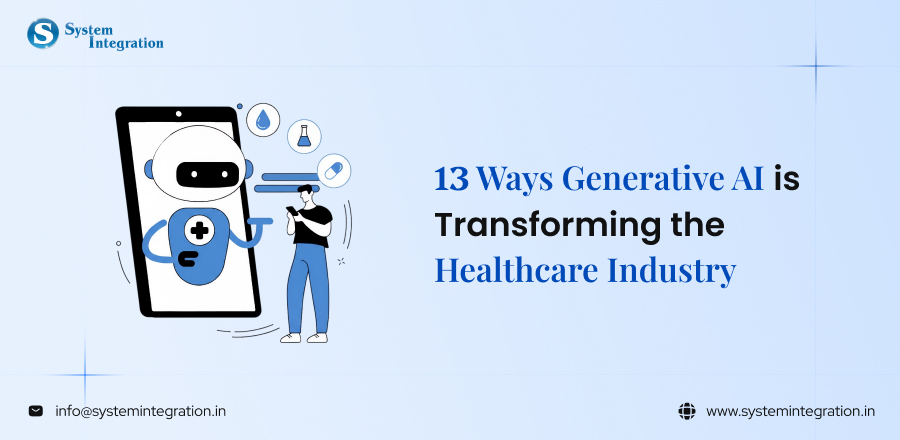
It’s assisting the healthcare industry to run much more smoothly than earlier, like helping doctors diagnose smarter, and patients spending less time standing in line. Let’s explore this blog and know 13 ways in which generative AI is strategically improving healthcare industry.
What is AI Generative in Healthcare?
Generative AI in healthcare utilises advanced algorithms, such as Large Language Models(LLMs) and Generative Adversarial Networks(GANs), to create new data, content, and insights, rather than just analysing existing data.
| “Interesting Facts About AI in Healthcare” ⭐ The USA is forecasted to generate $ 102.2 billion in revenue by 2030 through AI in industry. ⭐ More than half(53%) of EU healthcare organisations plan to use medical robotics. ⭐ Four in five (80%) pathologists believe AI will boost life expectancy. ⭐ Between 2022 and 2023 alone, the market grew by close to half (45%) from $ 15.4 billion to $22.4 billion. |
13 ways Generative AI is Transforming Healthcare
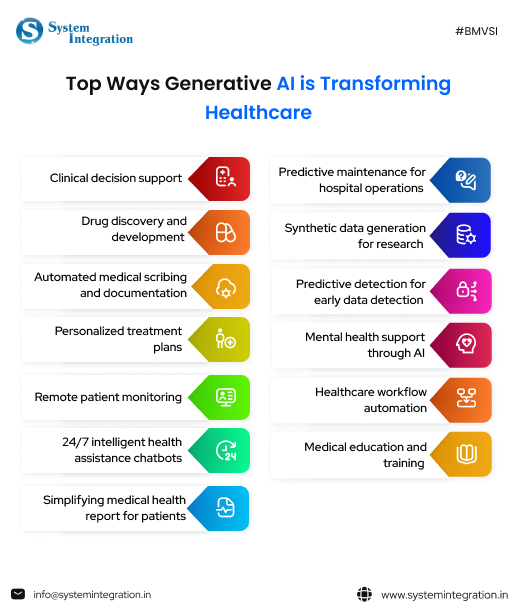
- Clinical decision support
- Technologies such as AI and machine learning are changing the way clinical support works and makes decisions.
- AI tools can process large amounts of data more efficiently than other tools and provide accurate information of patients.
- Using AI’s advanced pattern recognition capacities, patients can get more personalzed reccomendations in high value use cases.
- Drug discovery and development
- AI and other technologies can help overcome major drug discovery and development barriers.
- Generative AI even assist in reducing the R&D timeline.
- These tools are also helpful in gathering systems for complex drug manufacturing.
- Generative AI also helps in generating molecular structure.
- Automated medicla scribing and documentation
- Computer-generated medical scribing tools are changing the way doctors take down patient encounter notes and record them.
- AI systems listen to doctor–patient interactions and turn them into structured clinical notes, thereby decreasing provider documentation time.
- Through (administrative) burden reduction, healthcare providers can spend more time with their patients and accuracy and compliance increase.
- Personalized treatment plans
- Generative AI is making it possible to develop treatment plans that are uniquely tailored for the patient, using their history, genetics, lifestyle and continuous real-time monitoring of health status.
- AI models sift through huge sets of data to suggest personalized treatments and medication changes.
- This profiling-based personalization results in a more effective, safer and efficient treatment for the patient.
- Remote paitent monitoring
- AI-based remote monitoring systems make it possible to monitor the health of patients 24/7 outside of the hospital.
- Real-time data is sourced from wearables and connected devices, which AI processes to instantly recognize any abnormalities.
- This pre-complex care intervention model helps prevent re-hospitalization and allows for early medical management of chronic diseases.
- 24/7 intelligent health assitance chatbots
- Generative AI chatbots for 24/7 health advice and patient engagement.
- These AI assistants respond to medical questions, booking appointments and give symptom-driven advice.
- Chatbots can respond instantaneously and triage simple questions, making healthcare more available without having to hire extra people.
- Simplifing medical health report for paitents
- Generative AI turns complicated medical reports into simple to read descriptions for patients.
- For patients AI converts technical medical language into plain English.
- This increases patient knowledge, promotes informed consent, and builds the bond of trust between providers and patients.
- Predictive maintanence for hospital operations
- Artificial intelligence predictive analytics to optimize hospital operations and management of equipment.
- Machine learning systems predict when equipment will fail, and need service before it does.
- This minimizes downtime, decreases operational cost and optimises availability of care to the patient.
- Synthetic data generation for research
- Generative AI generates synthetic healthcare data for research and training of models.
- These datasets are statistically accurate, privacy-protecting and respect regulations.
- Diagnostics and medical research Synthetic data fuels innovation in drug discovery, diagnosis and medical research without sharing real patient data.
- Predictive detection for early data detection
- Predictive models, based on AI help in early disease detection using complex data analysis.
- It does so by spotting subtle patterns across medical imaging as well as lab results and patient history, flagging possible risks earlier.
- Early detection contributes to improved survival and reduces treatment expenditure as well as fostering the prevention of healthcare policy.
- Mental health support through AI
- AI applications that are generative in nature are enabling expanded access to therapists and mental health support.
- AI or machine-learning based virtual therapists are able to provide paper-to-person support (via
- written conversations) as well as mood monitoring, and coping techniques.
- Generative AI solutions can help close the Mental Health Gap, with confidential and accessible care.
- Healthcare workflow automaiton
- Generative AI supports the automation of repetitive administrative functions across the entirety of the healthcare industry.
- From appointment scheduling to claims processing, AI can efficiently span operations to many “back plug” processes of the business.
- The automation of the process will enhance productivity and reduce the opportunity for error, thus allowing healthcare staff to spend more time performing important functions related to providing care.
- Medical education and training
- Generative AI tools can create customized learning materials and personalized tutoring based on individual student needs.
- It creates complex, interactive patients histories and scenarios for simulations, allowing students to practice high-acuity situations in a safe, simulated environment.
- It also provides realtime feedback on performance, allowing students to track their progress and identify areas of improvement.

Wrapping Up
Generative AI has many advantages for the healthcare industry, including improved accuracy of diagnoses, lower operational and administrative costs, speedier development of prescription medications, increased engagement with patients, decreased burnout of clinicians, and improved personalized or individualized care with the use of data-driven evidence.
And to unlock full potential of partner with the best AI development company that is proficient in providing secure, compliant and scalable solutions that drive measurable productivity to your business.
FAQs
Generative AI has the potential to be secure when implemented with strict governance of data, adherence to applicable regulations such as HIPAA and/or GDPR, strong practices for compliance to cybersecurity, and human involvement created to assure that data is accurately used and used ethically.
Synthetic data is fake data generated by AI that mimics the statistical patterns of real patients. It is used for research and training AI models without violating patient privacy.
There are various reasons why the budget can exceed expectations. for example, if you have poor data quality than that can be one of the reasons, continuous change in the needs, or underestimating the training AI model.
AI reduces the cost of healthcare by streamlining operations, improving efficiency, and minimising waste. AI automated administrative workflows, such as billing, scheduling, and medical documentation, free up valuable time for healthcare professionals and reduce labour costs and administrative overhead.