Introduction
Did you know that healthcare organisations spend up to 30% of their time on paperwork and administrative tasks and not on patient care?
That’s one of the big reasons electronic medical records, or EMRs, have become such an important part of modern health care. From streamlining patient data management to improving clinical workflows and regulatory compliance, EMR software is transforming how healthcare providers function.
However, creating a robust EMR solution is much more complicated than creating a normal business application.
If you are a healthcare startup/hospital/Clinic going to invest in EMR, you are at the right place. So in our blog, we’ll talk about EMR software development costs, must-have features, challenges and everything you should know before executing the project.
What is EMR Software?
EMR software is a digital system that replaces traditional paper charts. It allows healthcare professionals to securely record, store, and manage patient health information, including medical history, diagnoses, prescriptions, and treatment plans.
Key Functions
➜ Clinical Documentation: doctors can easily log patient progress notes, symptoms, and vital signs.
➜ Prescription management: automatically checks for potential drug interactions and sends prescriptions securely.
➜ Billing and coding: translates clinical notes into standard medical billing codes to speed up the incidence claims.
➜ Lab integration: receives and organises diagnostic test results directly within the patient’s file.
What is EHR Software?
EHR(Electronic Health Record) software is a digital version of a patient’s medical chart. It stores comprehensive health information, including medical history, diagnoses, medications, allergies and more information related to the patient. It allows authorised healthcare providers to access, update, and securely share patient data across different medical practices and facilities.
Key Functionalities
- Managing Patient Records: Complete storage of the complete set of patient information (medical history, diagnoses, medications, allergies, treatment plans).
- Clinical Documentation: Provide means for the healthcare provider to efficiently create, update, and access digital clinical data.
- Appointment and Workflow Management: Streamline scheduling, patient check-ins, and administrative processes to improve operational efficiency.
- Reporting & Data Analytics: Ability to generate reports, track patient outcomes, and generate reports to assist in making better clinical and business-related decisions.
Difference Between EMR vs EHR
| EMR: contains medical data like a digital version of a patient’s chart, designed and is primarily used for basic clinical diagnosis and treatment within one office. EHR: a more detailed system designed to share a patient’s medical data securely across multiple healthcare organisations, specialists and labs. |
Global EMR Market Overview
Around the globe, many hospitals are replacing their paper-based medical records with EMR solutions to enhance efficiency in patient care and management. EMR is no longer an option for healthcare organisations, what with increasing patients and regulations, so you need them if you are a part of healthcare delivery in the modern world.
EMR Market Growth Statistics
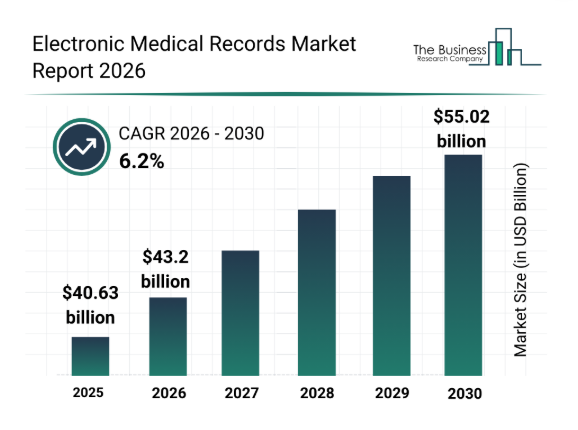
Market Size and Forecast
The EMR industry is projected to grow from 40.63 USD Billion in 2025 to 43.2 USD Billion by 2026, exhibiting a compound annual growth rate (CAGR) of 6.3% during the forecast period 2025-2035.
| 2025 market size | 40.63 (USD Billion) |
| 2026 market size | 43.2 (USD Billion) |
| CAGR (2025-2035) | 6.21% |
Why Healthcare Sector Investing in EMR?
➪ Digital Healthcare Initiatives
Governments, as well as healthcare organisations, are advocating for the adoption of digital modes, and hence, EMR systems are imperative for effective data management and coordinated patient care.
➪ Increasing Patient Expectations
Care teams now need to provide a seamless experience for modern patients, including online scheduling, electronic records and near real-time communication. EMR compliance is one-way provider-able for fulfilling these expectations, which leads to maximizing the level of patient satisfaction.
➪ Regulatory Requirements
Healthcare providers are subject to strict regulations regarding data privacy and documentation. EMR systems meet compliance requirements by making sure storage security, proper documentation, and restricted access to information.
Why Healthcare Businesses Need EMR Software
Enhanced clinical accuracy: Doctors can access complete patient histories instantly, reducing medication errors and avoiding redundant testing.
Streamlined workflows: automating tasks like patient scheduling, billing, and insurance claims processing cuts down on administrative burdens and waiting times.
Cost efficiency: EMRs decrease overhead by reducing physical paper storage space, lowering labour expenditures, and preventing wasted healthcare.
Data driven decision: built-in reporting and analytics give businesses insights into patient flow, revenue, treatment outcomes, and staff performance.
Key Features of EMR Software Development
➪ Patient Management
EHR is a digital version of a patient chart that efficiently tracks patient registration, medical histories and appointments to deliver organized records for improved healthcare.
➪Clinical Documentation
Facility Templates with SOAP Notes and Voice to Text Capabilities; Fast-Track Clinical Note Creation
➪ E-Prescription Management
Allows secure electronic prescriptions, tracks medication and connected pharmacies by alerts when interaction is not available.
➪ Billing and Insurance Integration
Reduces Administrative Burden by Streamlining Insurance Verification, CClaims Processing, Invoicing and Tracking Payments
➪ Lab and Imaging Integration
Aids in ordering tests, managing reports, and smooth access to lab and medical imaging results.
➪ Security and Compliance
Secures sensitive patient data by access controls, audit logs encrypt user information and comply with government regulations
➪ Telemedicine and Patient Portal
Supports virtual consultations, secure messaging, and convenient patient access to medical records and services.
Factors Affecting Development Cost
- Project Complexity
- More complex EMR systems with advanced workflows, support for multi-location clinics and custom functionalities naturally demand a higher level of investment in their development.
- Number of Features
- Developing it with more features like telemedicine, e-prescriptions, patient portals and analytics causes the development time to go up as well, leading to higher overall costs.
- UI/UX Design Requirements
- Using an easy-to-understand and intuitive layout increases usability but needs more design and development efforts.
- Third-Party Integrations
- Your calling is communicating with labs, pharmacies, insurance planning for years and other healthcare systems so that it will request an additional time of value in development.
- Compliance and Security Standards
- Adhering to healthcare standards and ensuring proper security management require much more effort and are increasing project volumes and costs.
- Development Team Location and Expertise
- The costs of writing healthcare applications differ based on location, proficiency, and experience with healthcare software development.
Estimated Cost Breakdown
| EMR Type | Estimated Cost |
|---|---|
| Basic EMR System | $30,000 – $60,000 |
| Mid-Level EMR Solution | $60,000 – $90,000 |
| Advanced Enterprise EMR | $80,000 – $100,000+ |
Practices that Lead to Successful EMR Software Development
➜ Prioritize user-centric design
Ensure the interfaces are simple and intuitive for use by doctors, nurses, and administrative staff.
➜ Build for scalability
System Scalability It should be scalable to accommodate the growing patient data and multiple healthcare facilities.
➜ Ensure interoperability
Utilize standards of HL7 and FHIR to transfer data flawlessly.
➜ Compliance is a first day task
The healthcare regulations like HIPAA, GDPR, etc should also be implemented from the very start of development.
➜ Select a competent healthcare IT partner
Partner with software development company that is familiar with healthcare workflows and compliance needs.
Future of EMR hospital software development
★ Systems that assist & not just record: instead of just filling datas, new systems can predict the potential risks in advance and send the alerts before it becomes a bigger problem.
★ Cloud infrastructure that grows with demand: as the volume of data increases, a flexible EMR software lets systems to expand without any technical errors or system blackouts.
★ Voice documentation: instead of writing down that long details of patients, voice technology helps in making documentation easy and not exhausting.
★ Stronger security habits: with increasing digital scams, healthcare companies and hospitals is paying more attention on continuous and controlled access to the data.
Concluding thoughts on EMR development
For EMR software in healthcare to deteriorate the health, they play a crucial role. The success of any product is relying on balancing between Available features, Compliance, Development Cost etc.
BMV System Integration is one of the best software development company that assist healthcare organizations with building sustainable and scalable EMR solutions which can support continuous business growth while driving digital transformation.
FAQs
The approximate price of EMR software development does range from $20,000-$100,000+, determined by the complexity of the system and demand for features, integrations, compliance requirements and customization.
It can take 4–6 months to build a basic EMR system, while a full-featured, enterprise-level solution may need 9–18 months or even longer, depending on the scope of the project and its complexity.
It includes patient management, clinical documentation, e-prescribing, appointment scheduling, billing & insurance integration, laboratory & imaging information management, security & compliance, and more.
EMRs (Electronic Medical Records) are used to hold a patient record that exists in a singular organization within the health care delivery system.
In contrast, EHRs are created primarily to enable the secure sharing of a patient’s overall medical record across multiple health care delivery provider organizations.