
Introduction
For most US enterprises, the challenge is no longer just growth, it’s profitable growth.
Rising labor costs, operational inefficiencies, and increasing customer expectations are forcing companies to rethink how they operate. Traditional cost-cutting methods like downsizing or outsourcing are no longer sustainable in a fast-moving, digital-first economy.
Instead, organizations are turning to intelligent automation as a smarter way to reduce operating costs while improving performance.
From automating back-office processes to enabling AI-driven decision-making, intelligent process automation is helping enterprises do more with less without compromising quality or speed.
What Makes Intelligent Automation Different?
Unlike basic automation that follows fixed rules, intelligent automation introduces learning and adaptability into business processes.
It combines:
- Artificial Intelligence (AI)
- Robotic Process Automation (RPA)
- Machine Learning (ML)
- Natural Language Processing (NLP)
This allows systems to:
- Understand unstructured data
- Make decisions
- Continuously improve
That’s why more companies are investing in intelligent automation services not just to automate tasks, but to transform entire workflows.
Why Cost Reduction Is Driving Adoption?
Cost optimization is the #1 reason enterprises are adopting automation. A few key patterns seen across US enterprises:
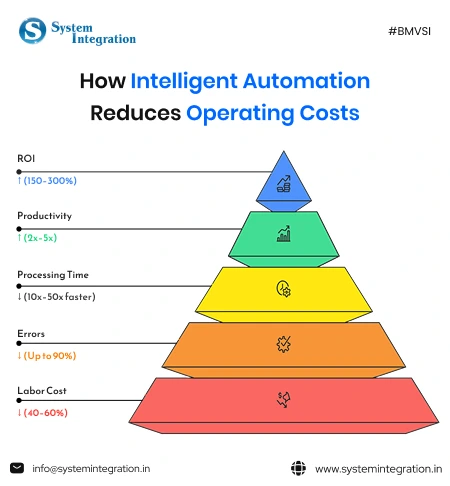
- Operational costs can drop by 40–60% with automation at scale
- Businesses recover their investment within 6–12 months
- Automated workflows reduce manual workload by up to 80%
These aren’t isolated outcomes, they’re becoming standard benchmarks across industries.
How US Enterprises Reduce Operating Costs Using Intelligent Automation?
1. Automating High-Volume, Repetitive Tasks
One of the quickest wins comes from automating routine tasks such as:
- Data entry
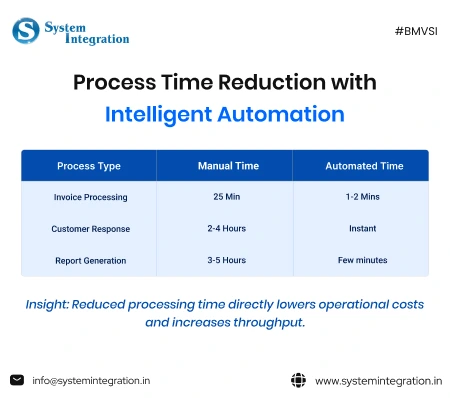
- Invoice processing
- Email handling
- Customer queries
Instead of hiring more employees, companies deploy AI systems that can handle thousands of tasks simultaneously.
👉 Result:
✅ Reduced labor costs
✅ Faster execution
✅ 24/7 operations
In some enterprises, automation handles 70–80% of repetitive workloads, freeing employees for higher-value work.
2. Cutting Costs Through Error Reduction
Errors are one of the biggest hidden costs in enterprise operations. Manual processes often lead to:
- Incorrect data entries
- Compliance issues
- Rework and delays
Intelligent process automation significantly reduces these risks by ensuring consistency and accuracy.
👉 Impact:
✅ Error rates drop drastically
✅ Compliance improves
✅ Rework costs are minimized
For industries like finance and healthcare, this translates into millions in savings annually.
3. Accelerating Process Cycles
Time is directly linked to cost. For example:
- Manual approvals may take days
- Automated workflows complete tasks in minutes or seconds
This speed improves:
✅ Cash flow cycles
✅ Order processing
✅ Customer response times
👉 Faster processes = lower operational cost per transaction.
4. Optimizing Resource Utilization
Another major benefit of intelligent automation services is better resource allocation.
Instead of:
- Hiring more staff
- Increasing operational overhead
Companies can:
✅ Reallocate employees to strategic roles
✅ Use automation to handle operational load
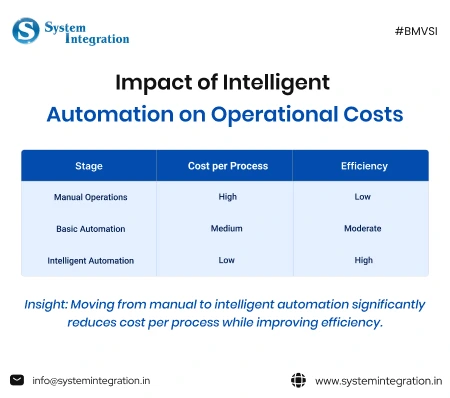
👉 This leads to leaner operations with higher output.
5. Enabling Scalable Growth Without Cost Explosion
Growth usually brings higher costs but not with automation. US enterprises are now scaling operations without proportional increases in:
- Workforce
- Infrastructure
- Operational complexity
For example:
✅ A customer support team supported by AI can handle 3–5x more queries without expanding the team
👉 This is one of the biggest reasons automation is becoming a competitive advantage.
Real-World Use Cases from US Enterprises
✓ Finance & Accounting
- Automated invoice processing
- AI-driven fraud detection
- Financial reporting automation
👉 Result: Faster processing and reduced compliance costs
✓ Healthcare
- Appointment scheduling
- Claims automation
- Patient communication
👉 Result: Lower administrative costs and improved patient experiences
✓ Manufacturing
- Predictive maintenance
- Supply chain automation
- Quality inspection using AI
👉 Result: Reduced downtime and operational waste
✓ Retail & E-commerce
- Chatbots for customer service
- Inventory management automation
- Order processing
👉 Result: Lower customer support costs and improved efficiency
ROI and Savings from Intelligent Automation
| Metric | Value |
|---|---|
| ROI | 150-300% |
| Payback Period | 6-12 Months |
| Cost Reduction | 40 - 70% |
| Productivity Increase | 2x - 5x |
The Strategic Shift: From Cost Cutting to Cost Optimization
Earlier, enterprises focused on reducing costs through:
- Outsourcing
- Downsizing
Now, the approach has changed. With intelligent automation, companies are:
✅ Eliminating inefficiencies
✅ Improving workflows
✅ Creating smarter operations
👉 It’s no longer about cutting costs, it’s about optimizing how the business runs.
Challenges Enterprises Must Address
While the advantages of intelligent automation are clear, successful implementation requires a thoughtful and strategic approach. Many enterprises face challenges not because of the technology itself, but due to how it is adopted.
- One of the most common issues is selecting the wrong processes to automate. Not every workflow is suitable for automation, and choosing low-impact or overly complex processes can limit results.
- Another major challenge is the lack of clear ROI measurement. Without defined benchmarks and performance tracking, it becomes difficult to justify investments or scale automation initiatives.
- Enterprises also struggle with integrating automation into legacy systems. Older infrastructure often lacks compatibility, making implementation more complex and time-consuming.
- Finally, employee resistance can slow down adoption. Teams may fear job displacement or feel uncertain about new technologies, which can impact overall success.
Successful US enterprises overcome these challenges by starting with high-impact use cases, building internal alignment, and scaling automation gradually with a clear roadmap.
| How Much Can You Actually Save with Intelligent Automation? Most US enterprises underestimate how much they can save. In just 60 seconds, get a clear estimate of your potential cost reduction, ROI, and efficiency gains. What They’ll Get? ✔️ Estimated operational cost savings ✔️ Automation impact on your workflows ✔️ ROI timeline (in months) ✔️ Productivity improvement insights Calculate My Cost Savings No SIgnup required • Instant results • Built for US enterprises |
Future Outlook
The future of intelligent automation in US enterprises is rapidly evolving beyond basic task automation.
Organizations are moving toward hyperautomation, where entire business processes are automated end-to-end with minimal human intervention. This includes seamless integration across departments and systems.
At the same time, AI-powered decision systems are becoming more common. These systems analyze data in real time and support faster, more accurate business decisions.
Looking ahead, enterprises are also exploring autonomous business processes, where AI systems can independently manage workflows, detect issues, and optimize performance without constant oversight.
Companies that embrace these advancements early are expected to gain significant advantages, including:
➡️ Lower operational costs
➡️ Faster innovation cycles
➡️ Stronger competitive positioning in the market
Conclusion
For modern US enterprises, intelligent automation has shifted from being a competitive advantage to a business necessity.
By adopting intelligent process automation, organizations can streamline operations, reduce inefficiencies, and significantly reduce operating costs while maintaining high performance.
Beyond cost savings, automation enables businesses to operate with greater agility, accuracy, and scalability key factors for long-term success.
In today’s efficiency-driven landscape, intelligent automation is not just a tool, but a foundation for sustainable growth and innovation.
FAQs
Intelligent automation refers to the use of AI, machine learning, and RPA to automate complex business processes and improve operational efficiency.
US enterprises use intelligent automation to streamline workflows, reduce manual intervention, enhance accuracy, and optimize operations across various departments.
Yes, many organizations report cost reductions of 40–70% by automating repetitive tasks and eliminating inefficiencies.
Intelligent process automation is an advanced approach that combines automation with AI to handle decision-based tasks, not just rule-based activities.
Industries such as finance, healthcare, manufacturing, retail, and IT experience the highest impact from automation adoption.
Most enterprises begin seeing returns within 6 to 12 months, depending on the scale and complexity of implementation.
These services include consulting, implementation, and optimization of automation solutions to help businesses scale efficiently.
While there is an initial investment, the long-term savings and efficiency gains typically outweigh the costs.
No, it primarily shifts employees from repetitive tasks to more strategic and value-driven roles.
The future lies in fully autonomous, AI-driven operations where businesses can run end-to-end processes with minimal human intervention.