
Introduction
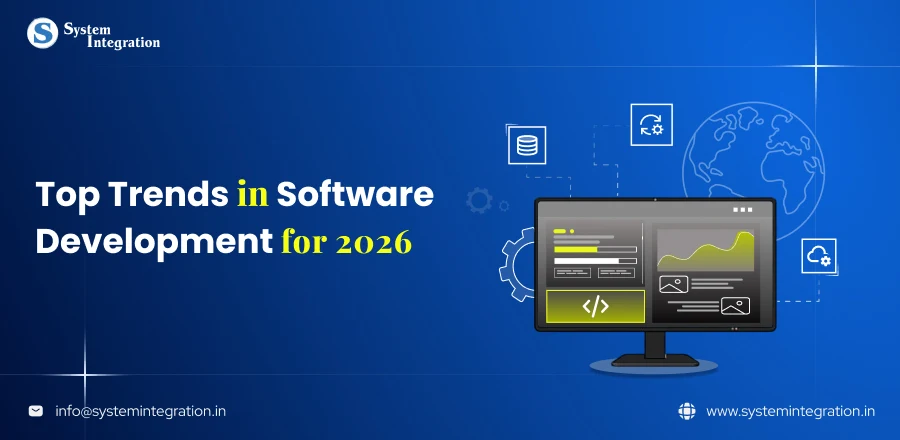
The transformation in software development has never been so high and in 2026 it will again raise the bar even more. Businesses are rapidly adopting AI and other trending tools and technologies to improve their software experience and boost their customer base.
This is shaping the workflows, architecture, and other business processes and improving the software development efficiency overall. As the competition rises, the success of any software development depends on how they use the latest technologies and tools. Thus, let’s explore in this blog further and know the latest trends for software development that businesses must watch.
The Overview Of Software Development Industry
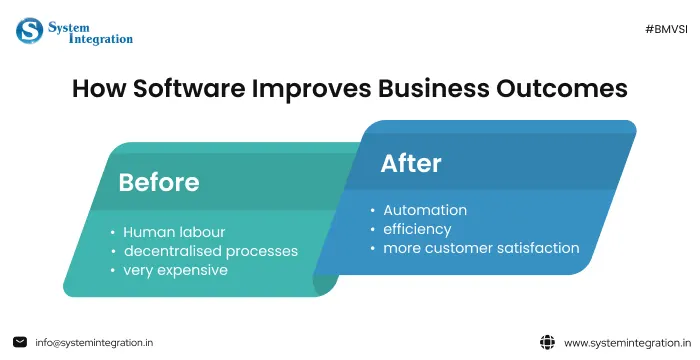
The software development industry acts as a digital transformation in almost any industry like healthcare, finance, manufacturing, retail and logistics. It’s about the work of creating, building, testing, deploying and maintaining applications that solve business problems, improve efficiency and make customers’ lives better.
Today, the software development industry is experiencing transformative growth, expecting the market size to reach $1,450.87 billion by 2031,with a strong emphasis on quality and innovation, such as automation and the use of low code platforms.
Top Software Development Trends
Adoption of AI
AI is fundamental to applications in 2026 for judgment, personalization, AI automation and predictive analytics. From AI copilots under development, to intelligent customer-facing systems, AI is accelerating both how software gets written and deployed.
It means less development effort will need to go into infrastructure and more room for teams to move fast and innovate, not repeat.
| Stages of Adoption 1) experimentation: testing AI in specific areas(e.g chatbots and basic automation). 2) integration: connecting AI tools with existing systems. 3) scaling: expanding successful pilots across the organization. 4) transformation: AI becomes a core, seamless part of operations and strategies. |
- Why this trend matter?
- Facilitates the accelerated development and deployment of software
- Improves user experience through personalization
- Drives data driven decision-making at scale
Low Code No Code
Low code and no code platforms are changing the way applications are developed, requiring less hand coding. In 2026, companies build on these platforms to quickly develop internally used tools, dashboards, workflows and integrations without needing much engineering effort. This trend has empowered non technical businesses to develop their own app.
- Why this trend matter?
- Speeds up application development cycles
- Decreases reliance on big development teams
- Conduit between the business and IT
Cybersecurity Automation
With cybersecurity automation, AI and rule based systems work together to not only identify but also respond to and contain threats in real time.
In 2026 automated security tools are vital component of applications. Today, automated security tools monitors applications on a continuous basis, detects vulnerabilities in early stages and takes action when encountering a threat without human delay.
| Example of Cybersecurity Automaiton → Treat detection and analysis: automatically collects data to identify suspicious patterns in real time. → incident response: triggers automated “playbooks” to contain treats, such as isolating a compromised device, blocking malicious URLs, or resetting compromised user passwords. → vulnerability management: continuously scan systems for known vulnerabilities. |
- Why this trend matter?
- Cuts down incident response times to security issues
- Reduces human error when identifying threats
- Scales to protect systems with less operational effort
Use of Agentic AI in businesses operations
Agentic AI is the term I use to describe autonomous AI agents that can plan, execute, and adapt tasks across systems without ongoing human intervention. Agentic AI in business In 2026, companies develop agentic AI for a variety of operations, including customer support, supply chain coordination, IT automation and finance workflows.
These AI agents work with enterprise tools, reason in context and interact with humans to get multistep problems done. This moves automation away from single task scripts and toward goal directed execution.
- Why this trend matter?
- Enables end to end process automation
- Lowers the cost of operation, and human burden
- Improves scalability and decision making speed
AI for data engineering
Part of this transformation includes the automation of data ingestion, data cleaning, transformation and validation through AI. In 2026, AI powered pipelines are able to detect anomalies, optimize schemas and address data quality in real time across large data ecosystems.
- Why this trend matter?
- Improves data quality and reliability
- So they cut down on manual work of managing the data pipelines
- Accelerates real time analysis of data allows you to get insights from big data
Blockchain beyond cryptocurrency
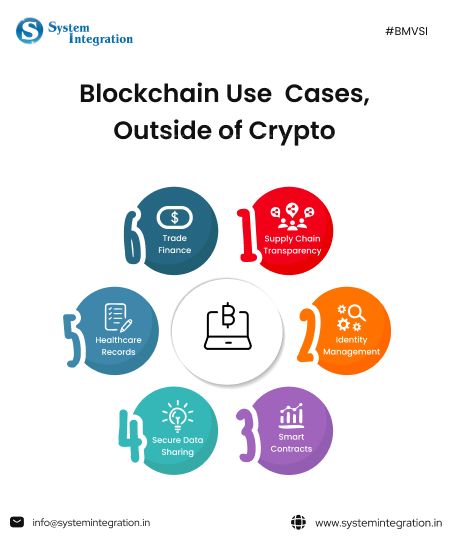
In 2026 companies rely on blockchain for transparency in supply chain, identity management, smart contracts and secure data sharing.
Through the provision of decentralized, infallible records, blockchain creates trust among numerous parties without intermediation.
- Why this trend matter?
- Increases transparency and trust
- Enhances data security and integrity
- Reduces reliance on centralized intermediaries
Devops and CI/CD
In 2026, In the exDevOps world, it’s all about continued improved collaboration, observability and security integration (aka DevSecOps) and AI power release management spread across complex cloud-native environments.
Today’s CI/CD pipelines even automate testing, deployment (and rollback) and monitoring with little human intervention.
- Why this trend matter?
- Speeds software delivery without compromising quality
- Increases the reliability of the system and the consistency of deployment
- Allows for rapid response and ongoing optimization
Are you ready to develop your robust software in 2026?
As 2026 approaches building intelligent, safe, scalable, and future ready systems is the goal of software development. The way that contemporary software provides actual business value is being redefined by trends like agentic AI, data engineering automation, advanced DevOps, and AI driven development.
Businesses just need the right development partner who can translate these trends into solid, practical solutions if they want to remain competitive. With BMV System Integration, you get future proof and scalable solutions as it is the best service providing AI software development company in India. Whether you need to utilize agnetic AI, generative AI or any type of trend into your software development service, this company is the best choice for it.
FAQs
Companies that grasp these trends ahead of their competition can:
- Make future proof technology decisions
- Avoid costly re-architecture later
- Out-innovate the competition faster
- Align your software purchases with the long game
No. It isn’t even feasible or strategic to embrace all trends. Start with trends that solve actual business problems, technologies that fit your existing goals and will scale as you grow, and tools that align with the systems you already use.
Yes, and typically anyway modernizing what you have in place is cheaper than starting again e.g. adding AI, automation or analytics Improving performance, security and UX.
By automating code generation, enhancing testing and debugging, enabling autonomous agents, and improving decision making through predictive analytics, artificial intelligence will play a major role in 2026. In order to increase productivity and shorten time to market without sacrificing code quality, developers will depend more and more on AI assistants.
Due to business demands for minimal human error, lower operating costs, and quicker releases, automation is becoming indispensable. By 2026, teams will be able to effectively streamline development, testing, deployment, and maintenance processes thanks to workflow automation tools, CI/CD pipelines, and AI-driven orchestration.