
Introduction
Let’s cut through the fluff: almost every marketer talks about AI in marketing automation like it’s a magic wand. But what’s the real impact? How much revenue did it actually drive, not just how many graphs it produced ?
In this blog, we’ll explore powerful use cases where marketing automation truly moved the needle backed by industry statistics, real analytics, and actually useful insights (no marketer-speak buzzword bingo here). We’ll also look at marketing automation tools that deliver measurable results and show you why AI is becoming mission-critical in 2026.
What is Marketing Automation? (Seriously, For Humans Who Hate Tech Definitions 😅)
Let’s kill the jargon first.
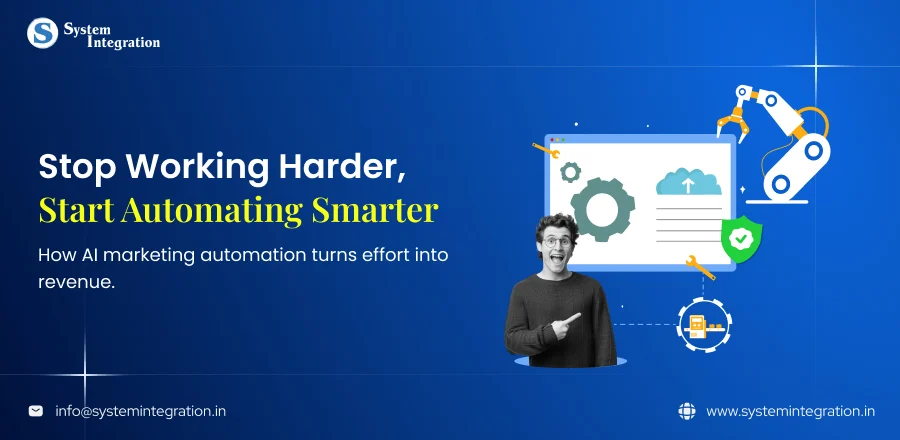
At its essence, marketing automation means using software to automate repetitive, rule-based tasks, like sending emails, scoring leads, posting on social media, or segmenting audiences, without someone doing it manually every time. Think of it as autopilot for your campaigns.
Now add AI to the equation.
What used to be a robot that followed rules becomes a thinking autopilot, one that predicts behavior, personalizes messaging at scale, and makes decisions based on data. That’s AI in marketing automation.
In fact:
- AI-driven marketing automation improves campaign efficiency by ~35% (Salesforce).
- 61% of marketers use AI for data-driven personalization.
- Predictive analytics via automation can increase conversion rates by ~30%.
So yeah, this isn’t just “set it and forget it.” It’s “set it, and win more customers.”
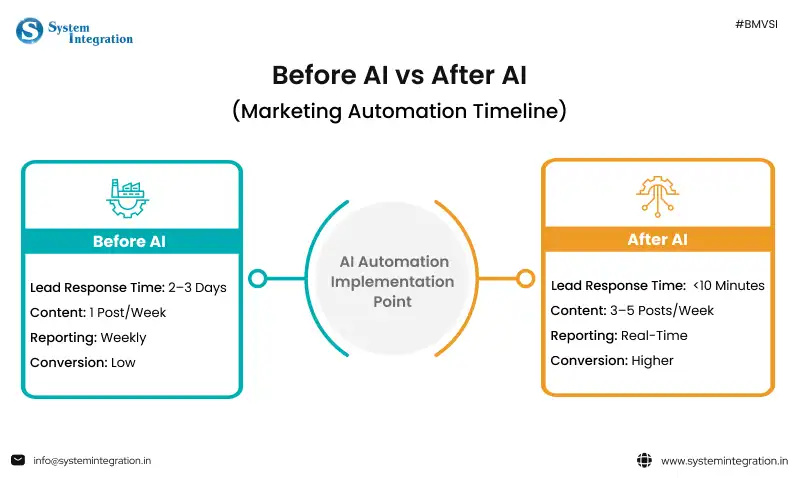
Why AI Marketing Automation Isn’t Optional, It’s Strategic.
Hold onto your coffee mug, because here’s where it gets serious:
- Companies that invest in AI marketing see ~300% average ROI from their tools.
- AI strategies deliver ~37% higher conversion rates and reduce customer acquisition costs by ~37%.
- Personalized campaigns powered by AI generate 6× higher transaction rates than generic campaigns.
- More than 90% of CMOs confirm clear ROI from AI tools.
Those numbers tell a story: MARKETING AUTOMATION ISN’T A LUXURY, IT’S A REVENUE ENGINE.
Top Use Cases of AI Marketing Automation With Real ROI
USE CASE #1: Predictive Lead Capture & Routing – Because Time Is Sales’ Best Friend
If leads aren’t followed up quickly, they go cold like that leftover pizza slice you swore you’d eat later.
Enter AI workflow automation.
Instead of humans manually entering contact info from forms or events, AI can:
↪ Extract contact details
↪ Classify lead quality
↪ Push them into the CRM
↪ Trigger personalized outreach instantly
This instantly speeds up lead response time, which is crucial because companies that respond within minutes, not hours, convert up to 7x more leads.
When you add AI into this workflow, you’re not just automating, you’re prioritizing the right leads at the right time, improving the odds of sales engagement by significant margins.
This kind of automation becomes even more powerful when paired with smart lead orchestration workflows that assign higher-priority prospects directly to sales reps and nurture lower-interest leads through automated personalized follow-ups.
USE CASE #2: Personalized Content at scale: Your audience doesn’t all speak “Generic”
Content creation has traditionally been a bottleneck, every blog, social post, or email campaign felt like a sprint, right?
AI flips that on its head.
When AI and automation come together:
↪ Blog posts can be drafted in minutes instead of hours
↪ Social media captions and visuals auto-generate based on trending topics
↪ Email sequences adapt based on user behavior
According to industry sources:
↪ AI content generation reduces production timelines by ~80%.
↪ AI-generated content sees ~30% higher engagement rates.
↪ 90% of content marketers plan to adopt AI tools.
So not only do teams save time, they create better content that attracts real users and ranks in search engines.
This use case alone is a major reason many brands now pair marketing automation tools with AI content modules because volume and quality matter.
USE CASE #3: Automated Customer Journey Orchestration – The Roadmap to Conversion
Every customer doesn’t follow the same path: some like emails, others click on social posts, others prefer videos. AI helps map this journey using real behavior data.
With AI-enhanced automation:
↪ Customers get the right message at the right time
↪ Engagement sequences adjust dynamically based on user actions
↪ Personalization happens at scale not manually
Notably:
↪ Personalized experiences delivered via automation can improve retention by ~20%.
↪ Customers are ~80% more likely to buy when experiences are customized.
Marketers can use these capabilities to nurture leads through purchase decisions, minimizing drop-off and maximizing conversion, essentially automating intuition.
USE CASE #4: AI Chatbots and Conversational Automations – Sales Reps that never sleep
Chatbots used to be annoying. (“Press 1 for pizza, 2 for pizza… seriously 1 or 2?”)
Modern AI chatbots don’t just answer scripted questions, they engage in meaningful conversations, qualify prospects, book demos, and even answer complex support questions.
Here’s why that matters:
- AI chatbots handle billions of interactions annually.
- They reduce cost per interaction while increasing engagement.
- Chatbots can take over routine inquiries, freeing human reps to handle more strategic tasks.
When AI chatbots integrate with CRM and automation platforms, they become lead qualification engines, generating more pipeline with less manual effort.
USE CASE #5: Hyper-Personalization
Most people ignore generic marketing messages like junk mail, it’s just noise.
Personalized messages, on the other hand:
- Boost revenue by ~40%
- Increase conversion and click-through rates significantly
- Improve customer experience across channels
AI makes this possible by analyzing past behavior, from email opens to site interactions and automating customized outreach.
This level of contextual personalization drives deeper customer connection and better sales results.
AI Marketing Automation Tools that Powers these results
Modern marketing stacks don’t run on fairy dust, they run on tools. Here are categories that make this possible:
1. Workflow Orchestration Tools
Platforms like n8n help connect disparate systems. They serve as the backbone of automated workflows, capturing data, triggering actions, and integrating with tools like CRMs, email platforms, analytics, and more.
2. AI Content Generators
These tools use large language models to draft content, optimize metadata, write email sequences, and even create visuals, reducing production time dramatically.
3. Email & Campaign Automation Platforms
These automate list segmentation, engagement sequences, A/B testing, and reporting with minimal manual input.
4. AI Analytics & Predictive Engines
These tools analyze campaign data, predict user behavior, optimize budget allocation, and recommend next actions, turning raw data into decisions.
So….should you invest in AI Marketing Automation?
If your company still runs campaigns manually, sending emails by hand and hoping your spreadsheet doesn’t crash, then the answer is loud and clear:
Yes. It’s time.
Not only is marketing automation now table stakes in marketing strategies, but AI in marketing automation is quickly becoming the differentiator between brands that survive and brands that thrive.
These technologies let teams do more, reach more, and convert more without burning out.
Final Thought: Don’t Automate just for Automation; Automate for ROI
Remember:
Tools don’t create strategy, people do. AI and automation only really pay off when they’re tied to clear goals, measurable KPIs, and thoughtful implementation.
So yes, go bake that ROI-generating system but don’t forget to optimize it strategically.
FAQs
Marketing automation automates repetitive marketing tasks. AI enhances it by adding intelligence, decision-making, personalization, and optimization based on data.
No. SMBs often see faster ROI because automation reduces manual workload and scales limited teams efficiently.
Most businesses see ROI within 6–12 months through higher conversions, reduced costs, and improved efficiency.
With the right workflows and integrations, modern tools can be implemented gradually without disrupting existing systems.
No. AI replaces repetitive tasks, not strategy, creativity, or human judgment.
Lead capture, follow-ups, email campaigns, content distribution, and performance reporting deliver the fastest ROI.