
Introduction
AI is now deeply embedded in how modern marketing works. From ad optimization and audience targeting to content creation and predictive analytics, AI in digital marketing is no longer optional, it’s becoming standard practice.
But as AI adoption grows, one question keeps coming up in boardrooms and marketing reviews:
This blog explains how to measure the ROI of digital marketing with AI in a clear, structured way without complex formulas or technical overload.
Understanding ROI in AI-Driven Marketing
ROI (Return on Investment) answers a simple question:
What did we gain compared to what we spent?
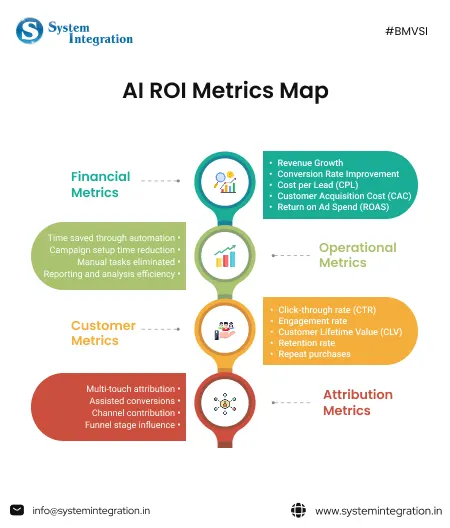
In AI digital marketing, gains are not limited to revenue alone. AI delivers value in three major ways:
✅ Revenue impact – higher conversions, better targeting, improved personalization
✅ Cost efficiency – reduced ad wastage, lower CAC, fewer manual hours
✅ Operational speed – faster execution, quicker decisions, scalable campaigns
A realistic ROI framework must include all three.
Step 1: Set the Right Expectations from AI
Before measuring ROI, it’s important to be clear about why AI is being used.
Some common use cases include:
- Automating campaign optimization
- Personalizing user journeys
- Predicting customer behavior
- Improving lead quality
- Reducing manual reporting and analysis
Each use case demands different success metrics. For example, automation success should be measured in time and cost savings, while personalization success should focus on engagement and conversion rates.
Step 2: Capture Performance Before AI Is Implemented
To understand improvement, you must first know your starting point.
Before using digital marketing using AI, record:
- Conversion rates
- Cost per lead (CPL)
- Customer acquisition cost (CAC)
- Revenue per campaign
- Average campaign setup time
- Monthly marketing spend
This baseline ensures that ROI calculations are data-backed rather than assumptions.
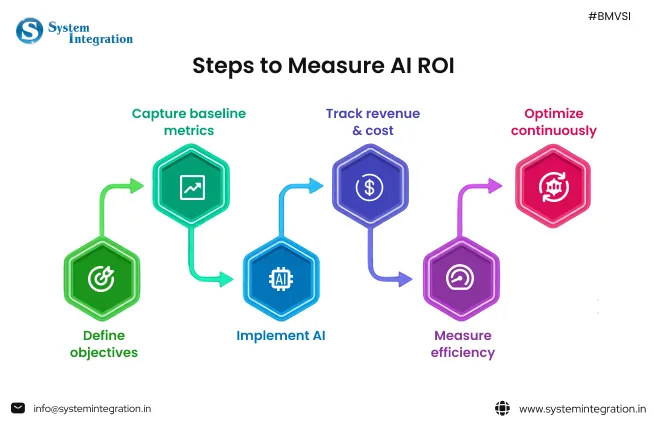
Step 3: Measure Revenue Uplift from AI
AI improves decision-making by analyzing patterns humans often miss. This leads to better targeting and higher conversions.
Track:
- Revenue from AI-driven campaigns
- Conversion rate changes
- Increase in average order value (AOV)
Step 4: Evaluate Cost Savings and Efficiency Gains
One of the strongest arguments for AI tools for digital marketing is efficiency.
AI reduces:
- Manual campaign optimization
- Repetitive reporting tasks
- Human errors in targeting
- Time spent on data analysis
Step 5: Track Customer Engagement and Experience
AI does not just improve performance, it improves relevance.
Key engagement metrics to track:
- Click-through rate (CTR)
- Website engagement time
- Email open and response rates
- Repeat purchases
- Customer lifetime value (CLV)
Step 6: Use Attribution to Understand AI’s True Contribution
AI often influences multiple touchpoints in a customer journey.
Instead of relying only on last-click attribution, use:
- Multi-touch attribution
- Data-driven attribution
This helps you measure how AI assists across awareness, consideration, and conversion stages, giving a more accurate ROI picture.
Step 7: Include Total Cost of AI Ownership
ROI is incomplete if costs are underestimated.
Include:
- AI platform subscriptions
- Integration and setup costs
- Data infrastructure
- Training and onboarding
- Ongoing optimization and maintenance
Step 8: Track ROI as a Continuous Process
AI performance improves with time and data.
Recommended evaluation cycle:
- Monthly: Campaign performance and efficiency
- Quarterly: ROI trend analysis
- Yearly: Strategic investment decisions
This ensures AI remains aligned with evolving business goals.
Final Thoughts
AI delivers value when it is measured correctly. Measuring ROI of AI in digital marketing is not about chasing perfect numbers, it is about understanding impact across revenue, cost, and efficiency.
When tracked systematically, digital marketing using AI becomes a predictable growth driver rather than an experimental expense.
FAQs
By comparing revenue growth, cost savings, and efficiency improvements against the total cost of AI tools and implementation.
Revenue uplift, CAC reduction, time savings, engagement rates, and customer lifetime value are the most important indicators.
Yes. When aligned with clear objectives, AI tools can improve efficiency and performance even with limited budgets.
Operational gains appear early, while revenue-driven ROI usually becomes clear within 3–6 months.