
Introduction
Somewhere in every enterprise, there’s a bot working at light speed, and there’s a compliance officer quietly panting. This is an RPA, where the vision is speedy automation, and the reality is a 27-step approval process. On one side, business teams are demanding that they have automated bots. On one hand, governance teams want documentation that’s detailed enough to survive an audit issue.
That is where the RPA Center of Excellence (CoE) comes in, part traffic controller, part referee. The real challenge? And doing so without making innovation grind to a halt or allowing automation run loose in the wild.
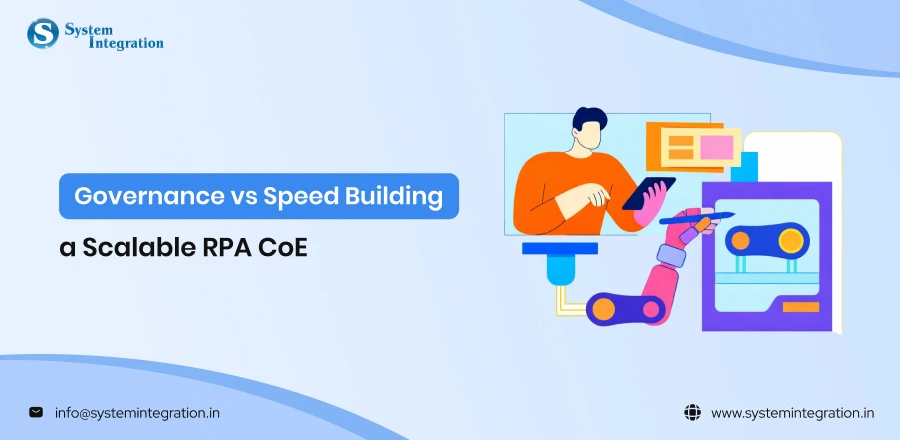
In this blog, we discuss how to create the right balance between governance and speed, enabling a scalable RPA CoE that makes your bots happy and equally keeps your bosses happy.
What is the RPA Center of Excellence
Before we delve deep, let’s make sure that we are on the same page!
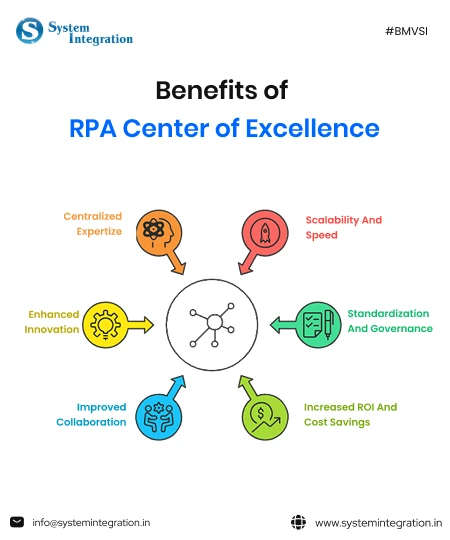
A CoE is a way to embed and implement RPA deeply and effectively into the organization. It enables organisations to gather, access, and manage the necessary knowledge and capabilities needed to effectively implement RPA.
By bringing together people from different disciplines, a CoE can combine learning and oversight around a specific area, driving the organisations to align multiple disciplines together.
While RPA automates the workflow tasks that consumes valuable time of humans otherwise, the CoE chooses exactly which business processes get automated and which automation tools to use.
| Part of the governance includes 👉 Identifying, accessing and prioritising the process of automation. 👉 Designing, building and running the process of automation 👉 Training staff for the best practice. |
The CoE ensures the automation infrastructure meets the needs of the business and that it continues to run reliably once in operation.
Why do Business Need an RPA Center of Excellence(CoE)?
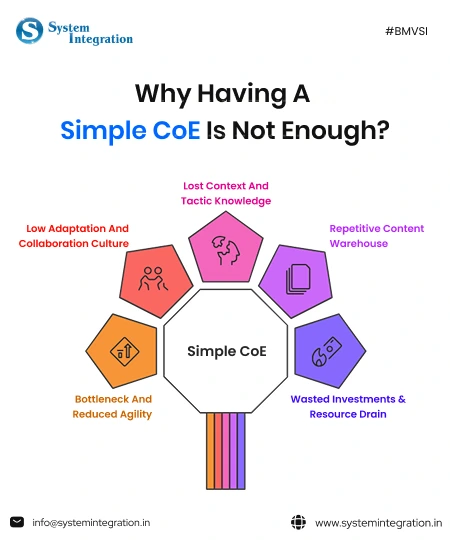
- Process Ideation: the CoE identifies suitable processes for automation, ensuring optimal utilization of RPA technology to enhance overall productivity.
- Education: The CoE is responsible for training and upskilling team members with the best practices, fostering a strong culture of continuous learning and improvement.
- Governance and Standard Owners: By establishing and maintaining standards for automation, the CoE ensures consistency and quality across the entire organization.
- Risk Mitigators: the CoE helps identify and manage risks associated with automation projects, ensuring that potential issues are addressed proactively.
- Innovators: the CoE encourages innovation and fosters a collaborative environment where new ideas can thrive, driving continuous improvement and growth within your organization.
The Governance vs Speed Dilemma
| Aspect | Governance in RPA | Speed in RPA |
|---|---|---|
| Definition | Governance practice involves establishing and enforcing policies, compliance standards, security protocols, and structured automation processes throughout the organization. | Speed is all about fast build and deploy of automation bots for enhanced efficiency and to deliver immediate business value. |
| Primary Objective | Avoid automating anything which is not in compliance with the regulatory requirements, security practices or standardized development guidelines. | Accelerate automation initiatives in order to decrease manual work and provide quicker operational enhancements. |
| Approach | It is structured, policy-driven and controlled with many checkpoints and approvals. | Quick, agile, experimental not weighed down by too many layers of procedure. |
| Benefits | Mitigates risks, reduces compliance issues, and ensures reliability and long-term sustainability of automation programs. | Accelerates digital transformation, increases productivity, and enables organizations to react quickly to changing business requirements. |
| Potential Challenges | When there is too much rules and approvals, it could slow down automation development and innovation has been limited. | Without governance, bots can fail to deliver results, security vulnerabilities may arise, processes may be duplicated and automation sprawl can be left unmanaged. |
How to get Most out of Center of Excellence(CoF)
1. Define Clear Scope & Mandate: Start by defining specific, measurable, attainable, relevant, and time-bound(SMART) goals. Initially, focus on a narrow scope to validate value before expanding.
2. Establish Strong Governance Framework: Establish clear policies, standards and approval processes for automation initiatives. A governance model provides standardization, management oversight, compliance (including security) and consistency across all automation projects.
3. Prioritise High-Impact Use Cases: Identify the automation use cases that contribute quantifiable business value, preferably, high-volume, rule-based, repetitive tasks. By focusing on automation opportunities with significant impact, you can realise quick ROI and build confidence in your CoE strategy.
4. Build a Skilled Automation Team: Build a cross-functional team including RPA developers, solution architects, business analysts and process experts. The upskilling and continuous training programs help keep the teams ahead of the changing automation technologies.
5. Measure and Communicate Impact: Use dashboards and reporting to regularly share progress and ROI with stakeholders. Actively review and improve processes to eliminate bottlenecks.
Best Practices: How do you build a Future-Ready RPA CoE?
★ Start Small and Scale Gradually: Start with a couple of higher-impact automation projects to validate value and refine processes. Once you feel comfortable, scale the scope progressively as teams are gaining more experience to allow for a sustainable pace of growth and less operational risk.
★ Connecting automation goals with business outcomes: Align automation initiatives directly to broader business strategies like cost optimization, operational efficiency and better customer experience. Aligning these teams helps establish direct business value and increases organizational adoption.
★ Concentrate on Quantifiable KPIs & ROI: Establish key performance metrics such as cost savings, processing speed, error reduction and productivity gains. Tracking these and other metrics is important to assess automation success, justify investments, and plan future improvements.
★ Ensure Executive Sponsorship: The executive support ensures that sufficient resources are allocated and the strategic direction is focused on compliance objectives by ensuring that everyone in the organization works towards achieving these goals.
★ Foster a Culture of Automation: Put AI up for it as an enabler of productivity without any fear for the future. Enhance cross-department collaboration, training and innovation to create an automation-first mindset.

Key Components of Scalable RPA CoE
- Framework for Governance
Clear policies, compliance requirements, and security procedures for automation projects are defined by a robust governance framework. It permits controlled scalability across enterprise-wide RPA deployments while guaranteeing consistency, lowering operational risks, and maintaining audit readiness. - Model of Operation
Whether the RPA CoE is centralised, decentralised, or hybrid depends on the operating model. It establishes roles and responsibilities, coordinates business and IT cooperation, and guarantees effective decision-making while striking a balance between flexibility and methodical supervision. - Stack of Technology
RPA tools, orchestration platforms, and monitoring systems are all part of a strong technology stack. It supports sophisticated features like AI-driven automation and real-time performance tracking while enabling smooth automation, scalability, and integration with current systems. - Skills and Capabilities
To be successful, an understanding RPA CoE will have the requirement of qualified individuals. Developers, analysts and architects are required for an RPA CoE. By investing in upskilling employees and citizen developer programs, you can drive innovation in your organization, decrease time to deploy automation solutions and drive continuous growth of automation initiatives across business units. - Process Selection and Pipeline Management
Effective process selection and pipeline management enable the identification of the highest-impact automation opportunities as well as provide a steady stream of automation projects to the pipeline to ensure maximization of ROI and alignment between business objectives and initiatives.
Winding Up Thoughts
Most enterprises engage RPA, where the vision is speedy automation, and the reality is a 27-step approval process. On one side, business teams are demanding that they have automated bots.
Being the best AI software development company, our approach to building an RPA CoE prioritises a governance-first operating model, clear decision rights, and lifecycle ownership. We assist businesses in introducing AI responsibly using expainably, and human oversight.
FAQs
An enterprise-grade RPA CoE is a centralised governance and operating structure that defines how automation is designed, approved, deployed, and supported at scale. It goes beyond delivery to include ownership models, security controls, audit readiness, performance measurement and alignment across the business.
Enterprise-scale RPA by embedding governance into the operating model rather than adding it later. This includes clear decision rights, standardised intake and prioritization, platform-enforced controls and escalation paths.
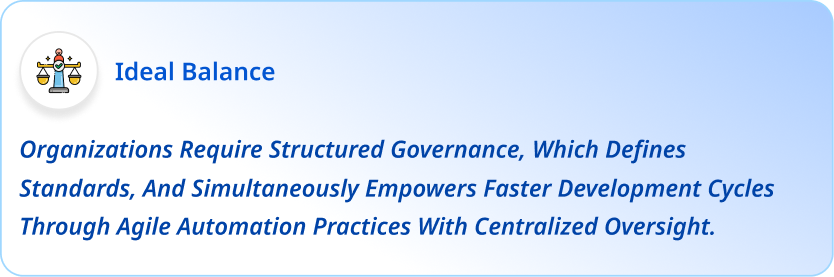
When balancing speed and governance, it allows for the deployment of automation projects in a timely manner while ensuring compliance, security and quality of the project. Too much governance may prevent innovation from occurring, and too much speed may create automation risk or inefficiencies in operations.
The implementation of an RPA CoE will allow an organization to scale their automation efforts effectively while maintaining proper governance, enabling it to operate at improved levels, reduce operating costs, keep all departments within an organisation to the same level of automation standards, support faster innovation, and provide long-term automation success.