
Introduction
As we close out 2025, we’re taking a close look at one of the most talked-about developments in artificial intelligence: OpenAI’s GPT 5.2. After years of rapid innovation, this new version isn’t just another upgrade, it’s a meaningful step toward making AI more useful in everyday work, especially for professionals who rely on AI to speed up complex tasks.
A Quick History Of OpenAI’s Progress
OpenAI started in 2015 with a mission to build safe, useful artificial general intelligence (AGI). From its beginnings as a nonprofit to today’s suite of AI tools, one thing has remained constant: each new model pushes boundaries.
- GPT-1 (2018): Introduced the transformer architecture that made modern language models possible.
- GPT-3 (2020): Brought scale, massive improvements in understanding and generating language.
- GPT-4 (2023): Expanded those capabilities with better reasoning and later vision understanding.
Then came GPT 5.2, released on Dec 11, 2025, designed not just for creativity or conversation, but for real work, the kind that professionals do everyday.
What Makes GPT 5.2 Stand Out?
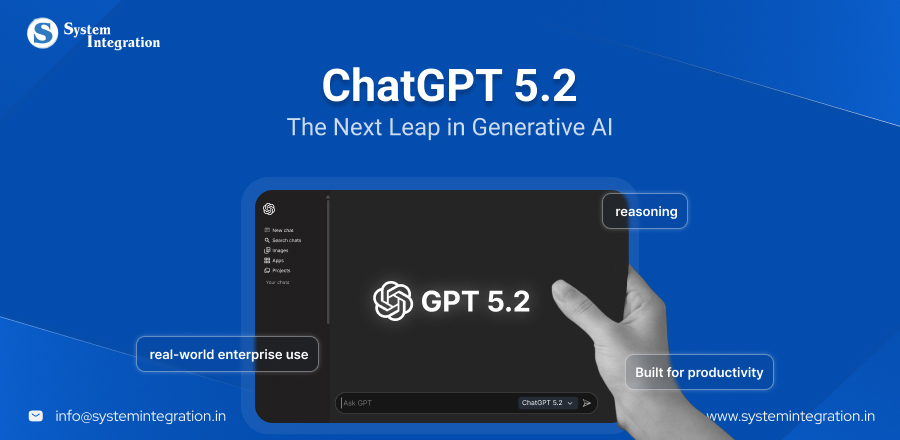
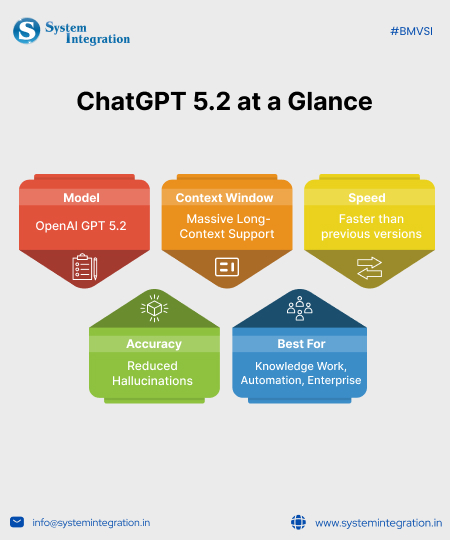
Unlike previous versions that were primarily focused on general improvement, GPT-5.2 is specially tuned for practical, day-to-day productivity. Instead of just being “bigger,” this model is smarter at handling real tasks that knowledge workers care about.
Here’s what’s notable:
📈 Less Time Wasted, More Work Done
Users report saving 40–60 minutes each day on work like spreadsheets, coding projects, and multi-step workflows — with power users gaining more than 10 hours of time back every week.
📉 Fewer Mistakes
Compared to GPT-5.1, GPT-5.2 generates 30% fewer hallucinations — meaning it makes fewer confident but incorrect statements. It also performs extremely well when interacting with tools like calculators and data interfaces.
⚡ Faster and More Efficient
At speeds that are around 11 times faster than a human, and at lower cost for most knowledge work tasks, GPT-5.2 helps users work more efficiently without sacrificing quality.
How GPT 5.2 Is Changing The Workflow Landscape?
GPT-5.2 is already being used in partnerships with major tech products:
- Notion can analyze and summarize long documents.
- Shopify uses it to understand customer flows.
- Databricks leverages it for data science tasks.
These integrations show that GPT-5.2 isn’t just for chat — it’s a backend engine for tools professionals use daily.
What’s New Compared To GPT-5.1?
GPT-5.2 isn’t just a small step up, it introduces several structural improvements:
- Effort Parameter:Developers can adjust how deeply the model thinks, choosing between speed and reasoning depth.
- Huge Context Window:It supports up to 256,000 tokens meaning it can understand extremely long documents without losing context.
- Agentic Tools: More than 20 tools can be integrated and chained for workflows, enabling complex multi-step automation.
- Safer Responses: Enhanced safety systems block harmful or misleading outputs almost entirely.
In simple terms: GPT-5.2 doesn’t just read input, it understands it more deeply and works with other systems more intelligently than before.
Performance And Benchmark That Matter
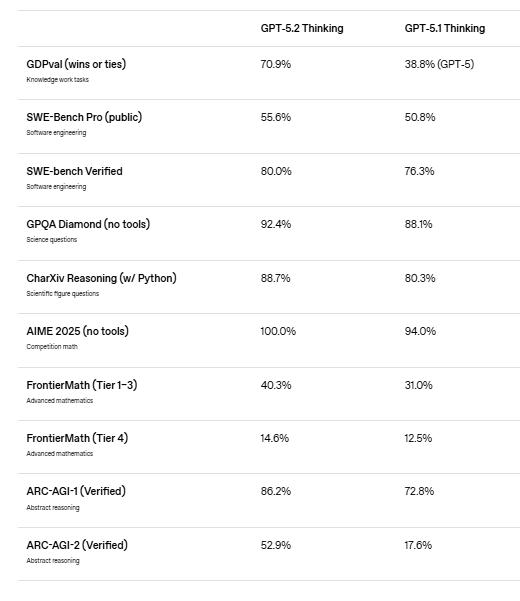
GPT-5.2 isn’t just theoretically better, the numbers back this up:
- Knowledge Work:
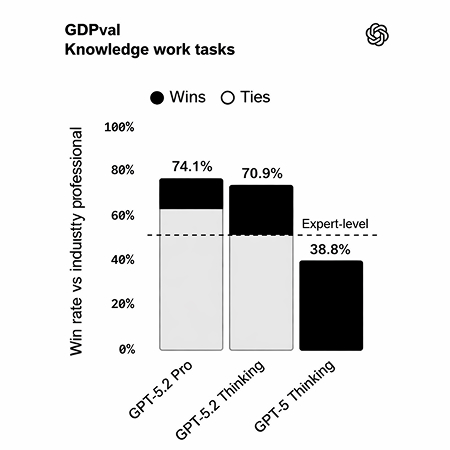
It matches or beats human performance in a majority of structured work tasks. - Reasoning:
It significantly improves abstract reasoning and mathematical problem solving. - Coding:
Scores higher on coding benchmarks, handling multi-file debugging more effectively. - Vision Tasks:
Vision accuracy like reading charts or analyzing interfaces improves by over 80%. - Safety Ratings:
Across categories like mental health awareness and emotional sensitivity, GPT-5.2 performs dramatically better than its predecessors.
These enhancements make the model more reliable and practical for daily professional use.
Real-World Example: From Hours To Minutes
Imagine a mid-sized company planning its workforce for the next year. Previously, an HR planner might spend 8–12 hours manually collecting data, building formulas, and formatting reports.
With GPT-5.2, the same task can be completed in about 25 minutes:
- Prompt Setup: Ask the model to build a workforce forecast including attrition, budget impact, and departmental breakdowns
- Automated Analysis: GPT-5.2 imports data, projects future staffing needs, and organizes calculations.
- Visual Insights: It uses vision processing to extract and analyze org charts.
- Output Ready: A polished Excel dashboard with tables, summaries, and risk indicators is delivered automatically.
In this scenario, GPT-5.2 not only speeds up the technical work, it also reduces errors and allows the planner to focus on strategic decisions rather than repetitive tasks.
Conclusion
GPT-5.2 stands out because it prioritizes practicality, reliability, and efficiency. Rather than simply generating text, it excels at understanding context, reasoning through complex problems, and interacting with tools like spreadsheets or documents. For professionals across domains, from data science to HR planning, GPT-5.2 is shifting AI from a “nice to have” assistant to a core collaborator in everyday work.
FAQs
ChatGPT 5.2 is OpenAI’s latest generative AI model designed to handle complex reasoning, long-context understanding, and enterprise-grade productivity tasks. It improves accuracy, speed, and workflow automation compared to earlier versions.
ChatGPT 5.2 offers advanced reasoning capabilities, a significantly larger context window, reduced hallucinations, faster response times, and improved support for professional workflows such as spreadsheets, coding, and document analysis.
Unlike earlier models, ChatGPT 5.2 is optimized for real-world productivity. It provides deeper reasoning, handles longer documents without losing context, and integrates better with tools and workflows used by enterprises.
ChatGPT 5.2 is commonly used for enterprise automation, data analysis, software development, document processing, business reporting, strategic planning, and workflow optimization.
Yes, ChatGPT 5.2 is built with enterprise use in mind. It supports complex workflows, offers higher reliability, and delivers consistent performance for business-critical tasks across industries.
Absolutely. ChatGPT 5.2 can automate repetitive and multi-step workflows such as report generation, data summarization, task planning, and process documentation, helping teams save time and reduce manual effort.
By automating routine tasks, reducing errors, and accelerating decision-making, ChatGPT 5.2 allows professionals to focus on high-value work. Many users report saving hours each week using the model.
Yes. ChatGPT 5.2 offers improved reasoning for debugging, refactoring, and handling multi-file codebases, making it more effective for developers compared to previous versions.
ChatGPT 5.2 significantly reduces hallucinations compared to earlier models, providing more reliable and accurate responses, especially in structured tasks like data analysis and professional documentation.
ChatGPT 5.2 includes enhanced safety and alignment measures. However, enterprises should still implement proper data governance, access controls, and compliance practices when using AI for sensitive data.