
Introduction
What if writing software felt more like explaining an idea than coding it? In 2026, that’s no longer hypothetical.
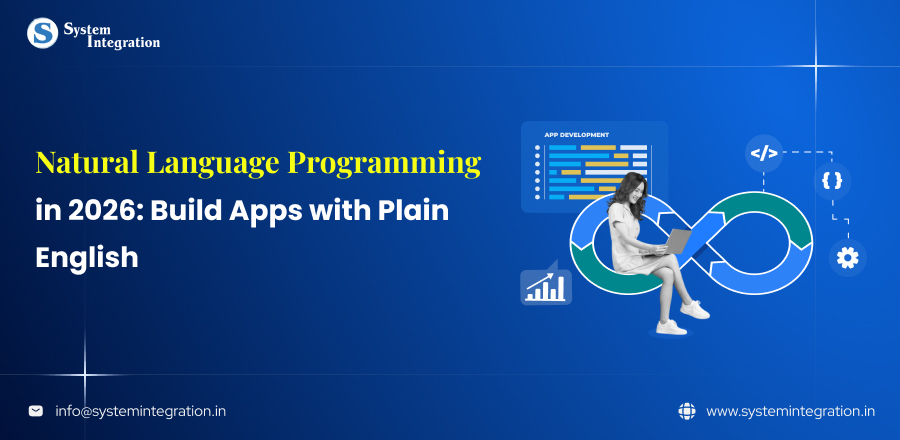
Natural Language Programming (NLPg) is reshaping how applications are built, allowing developers, analysts, and even non-technical teams to create functional software using Plain English Instructions. This shift isn’t just a productivity upgrade; it’s a fundamental change in how humans collaborate with machines.
Let’s unpack what natural language programming really means in 2026, why it matters, and how it’s reshaping developer skills permanently.
What is Natural Language Programming (NLPg)?
Natural Language Programming is the ability to build, modify, and deploy software by communicating with systems using human language instead of traditional code syntax.
Unlike traditional programming where precision is enforced through syntax, NLPg systems interpret intent, context and constraints expressed in natural language.
Example (2026-style):
Instead of writing hundreds of lines of code, the system:
- Interprets the request
- Maps it to backend logic
- Generates workflows, APIs, UI components, and tests
- Continuously refines output through conversation
This is made possible through advancements in:
- NLP in artificial intelligence
- NLP machine learning
- Large Language Models (LLMs)
- Agentic AI systems
Why Natural Language Programming Matters in 2026?
-
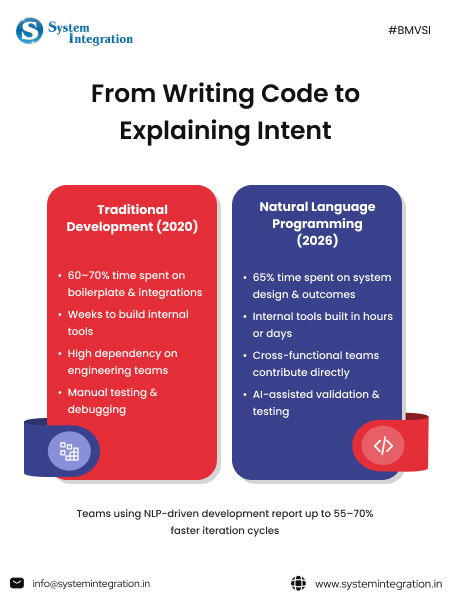
Software demand has outpaced developer supply
By 2026, every company is a software company but not every company can hire enough engineers.
Natural language programming:
- Reduces dependency on large engineering teams
- Speeds up MVP and internal tool development
- Enables faster experimentation and iteration
-
The Rise of Conversational Development
Development is no longer a “write once, debug forever” process. Instead, it’s: Conversational, Iterative and Collaborative.
Developers now talk to systems, refine logic in real time, and let AI handle repetitive implementation work.
Applications of Natural Language Programming in 2026
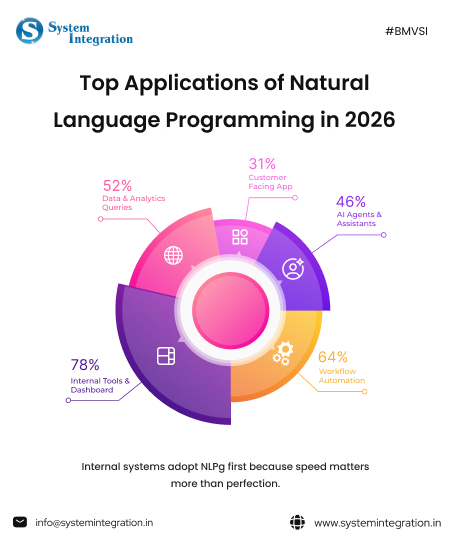
Natural language programming is already deeply embedded across industries. Here are some high-impact applications of natural language programming:
-
Rapid Application Development (RAD)
Teams can build: Dashboards, Internal tools, CRUD applications, Data pipelines by simply describing functionality.
Impact:
Time-to-market drops from weeks to hours. -
AI-Powered Workflow Automation
Business users describe workflows like: “When a lead fills this form, score them, assign to sales, and follow up in 2 days.”
NLPg systems translate this into: Event triggers, Conditional logic & API integrations.
Impact:
Operations teams build automations without writing code.
-
Enterprise Software Customization
Instead of rigid SaaS configurations:
➡️Enterprises customize tools using natural language
➡️AI adapts software behavior dynamicallyImpact:
Software finally fits the business not the other way around. -
Data & Analytics Applications
Users ask: “Show churn rate for enterprise customers in Q3 and explain why it increased.”
Behind the scenes:
➡️NLP machine learning models generate queries
➡️AI analyzes patterns
➡️Results are visualized with explanationsImpact:
Analytics becomes accessible beyond data teams. -
AI Agents & Autonomous Systems
Natural language programming is the backbone of AI agents:
➡️Multi-step reasoning
➡️Task delegation
➡️Decision-makingAgents don’t just execute commands, they understand objectives.
How NLP in Artificial Intelligence enables this shift?
At the core of natural language programming is NLP in artificial intelligence, which allows systems to:
-
- Understand intent, not just keywords
- Maintain context across long conversations
- Handle ambiguity and partial instructions
Modern NLP systems combine:
-
- Transformer-based language models
- Reinforcement learning
- Symbolic reasoning layers
This hybrid approach enables reliable execution, not just text generation.

NLP Machine Learning: The Engine Behind Plain-English Code
NLP machine learning plays a critical role in turning language into logic.
Key advancements by 2026 include:
-
- Intent-to-code mapping models
- Self-correcting feedback loops
- Code validation via simulations
- Automatic edge-case detection
These systems learn from: Millions of codebases, Real-world execution outcomes, & Human feedback.
Result: Safer, smarter, and more predictable natural language-driven systems.
The Developer Skill Shift: What Changes in 2026?
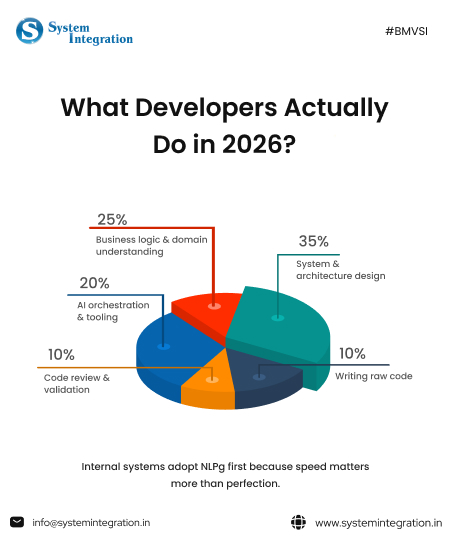
Natural language programming doesn’t eliminate developers, it redefines them.
Old Focus (Pre-2024)
- Syntax mastery
- Framework-specific expertise
- Manual debugging
- Boilerplate-heavy coding
New Focus (2026 & Beyond)
-
System Thinking Over Syntax
Developers now:
➡️Design architectures
➡️Define constraints
➡️Think in flows, not files -
Prompt Engineering → Intent Engineering
Clear thinking matters more than clever code.
Bad instructions = bad software.
-
AI Orchestration Skills
Developers manage:
➡️AI agents
➡️Tool chains
➡️Guardrails and validations -
Domain Expertise Becomes Critical
Understanding business logic is now a technical advantage.
-
Code Review Becomes Logic Review
Instead of reviewing syntax, developers validate:
➡️Outcomes
➡️Edge cases
➡️Security assumptions
Is Natural Language Programming “No-Code 2.o”?
Not Exactly.
| No-Code | Natural Language Programming |
| Rigid Blocks | Flexible Langauge |
| Limited Scale | Enterprise - Ready |
| Tool - Dependent | Model - Driven |
| UI - First | Intent - First |
NLPg doesn’t replace code, it abstract it.
Risks and Challenges to Watch
To be realistic, NLPg isn’t magic.
Key challenges:
- Hallucinated logic
- Security vulnerabilities if guardrails are weak
- Over-reliance without understanding fundamentals
- Compliance and explainability in regulated industries
This is why human oversight remains essential.
What this means for business?
Organizations adopting natural language programming gain:
- Faster innovation cycles
- Lower development costs
- Cross-functional collaboration
- Scalable automation
Those who don’t risk being outpaced by teams that build 10x faster with fewer resources.
The Future: From Programming to Problem-Solving
By end of 2026, the question is no longer: “Can you code?”
It’s “Can you explain the problem clearly?”
Natural language programming shifts software creation from technical execution to strategic thinking. And that may be the biggest revolution yet.
FAQs
No. NLP in artificial intelligence is the underlying technology. Natural language programming is an application layer built on top of it.
No. It will abstract and accelerate it. Core programming concepts remain essential.
Yes, especially internal tools and workflows but complex systems still need professional oversight.
Yes, when combined with: Guardrails, Validation layers & Human-in-the-loop systems.
- System design
- AI orchestration
- Domain expertise
- Clear communication and intent modeling
Chatbots generate text. NLPg systems execute logic, create software, and integrate systems.
Not just the future, the present. And it’s evolving fast.