
Introduction
AI doesn’t need a coffee break and neither does it say that “let me get you back on this in a moment”.
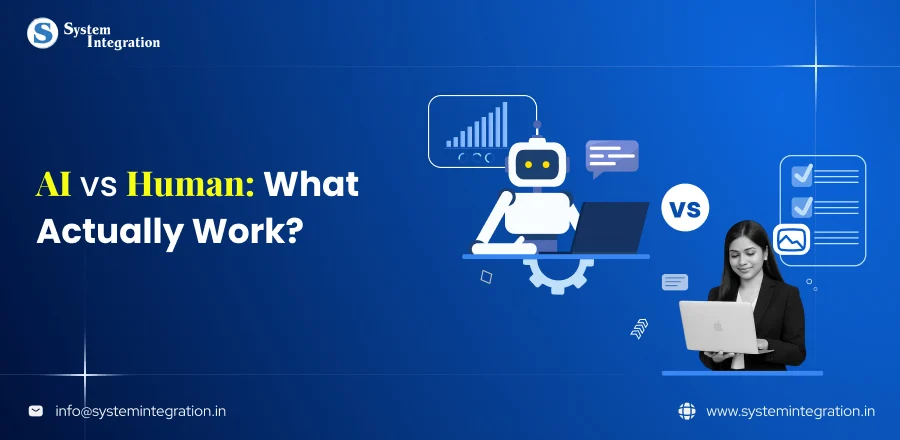
Jokes aside, productivity has become the ultimate arena of contest for today’s workplace. AI VS human thing is no longer just a theory. From writing code and structuring data to managing customer service and automating workflows, AI systems today are working with human teams.
The true question is not whether AI is faster it’s when, how, and to what degree it does in fact outpace humans in the world. In this blog, we will dive into AI vs. Human Productivity using actual performance data, real world examples and more.
We’ll see how AI speeds things up, cuts mistakes and scales output across industries and where human creativity, judgment and context still prevail.
The Rise Of AI In Business Operations
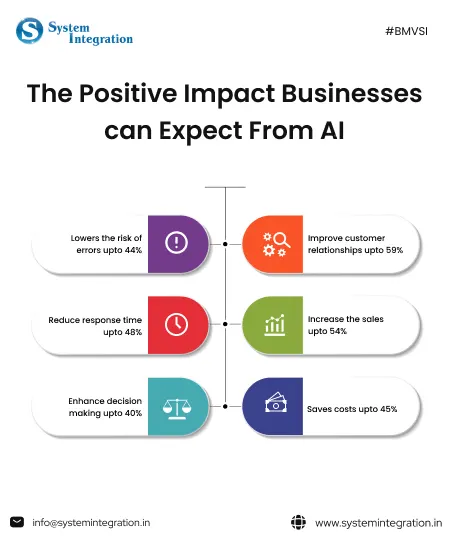
Until recently, “AI in business” was the stuff of tech giants with deep pockets and other big businesses. Today, it’s operating daily business operations.
While teams are in meetings or buried under emails, AI automation can be analyzing demand forecasts, routing support tickets to the best person and optimizing supply chains. All while spotting uncertain patterns in real time. No spotlight. No breaks. Just results.
AI is no longer just the hype for businesses. Faster decisions, cheaper costs, leaner teams and always-on customer expectations have forced companies to re-evaluate how work is done.
| Here’s The Top Tasks Businesses Are Automating With AI ✔️ The silent workforce of AI - Automating routine operations and running jobs 24/7 around the clock without fatigue or slipping on health and safety. ✔️ Quicker and more data driven decision - AI processes enormous volumes of data on the fly, delivering faster, better operational and strategic decisions. ✔️ Scale operational efficiency - Whether through supply chain or customer support, AI mitigates errors, reduces costs and scales operations without an increase in headcount. ✔️ Human and AI Join Forces - Teams shift towards creativity, strategy, problem solving and leave repetitive tasks to the bots. |
The Change In The Role Of Humans
As AI and automation are integrated into our daily workflows, the human is moving from executor to an elevator. We are no longer chained to mundane jobs, we now teach and improve intelligent machines.
How the human role is changing:
→ Role change to decision makers
Repetitive tasks are automated and people can do judgment based decisions which need context and experience.
→ strategic planing
Hours that were previously dedicated to operations, are now used to plan-ahead, implement improvements and build structures for future business expansion.
→ From actions to orchestrations
Humans create workflows, set rules, and monitor automated workflows instead of doing things manually at every step.
→ Data processing to insight interpretation
AI serves, the data at scale, humans translate insights into tangible actions and strategies.
→ From lone rangers to team players
Humans collaborate with AI agents and automation devices, making certain that the operation remains in line with business objectives and ethical expectations.
AI vs Humans Intelligence: Comparing Capabilities
| Factor | AI Intelligence | Human Intelligence |
|---|---|---|
| Learning Speed | Trains quickly on large data sets and can store easily any new information provided. | Learns slowly depending on the person and the experiences and practice |
| Creativity & Innovation | Brainstorms ideas from existing patterns and data. | Generates new ideas using a unique and creative approach. |
| Emotional Intelligence | Doesn't actually feel anything. | Perceives, feels, and responds to emotions in a human way |
| Decision-Making | Able to quickly make decisions, with a data-driven approach and at scale | Balances data with intuition, values and context dependence |
| Accuracy & Consistency | Favorable scale-out consistency and accuracy | prone to fatigue and bias, but self-correcting |
| Ethical & Moral Reasoning | Follows programmed rules and constraints | Utilizes values, ethics, and consider and feel emotions |
Tips For Enhancing Business by Balance AI Vs Human Productivity At The Workplace
- Automate Jobs, Not Human Judgment
Bring in AI for rule based, repetitive work such as data processing, reporting and scheduling all while ensuring decision making and critical thinking are led by a human. - Design Human in the Loop Workflows
Rely on humans to review, validate and guide AI outputs, especially when they relate to customers, compliance or strategy. - Ensure AI Tools Align With Well Defined Business Objectives
Use AI to solve actual productivity problems and not just for research. Train it with your business data which will help it in knowing the business objectives better and make decisions accordingly. - Train Employees to Collaborate With AI
Teach teams how to interpret AI insights, govern automated workflows and grasp AI limitations making employees AI supervisors, not operators. - Measure Productivity Beyond Speed Alone
Quality measure such as quality, accuracy, customer satisfaction and innovation add balanced to the efficiency gains from AI.
Real world examples of successful balance in AI vs. Human Productivity
1) Healthcare
And AI speed up diagnostics by processing medical images, patient records and risk factors in a matter of seconds. These insights are how physicians finalize diagnoses, use clinical judgement and preserve the trust of their patients leading to the faster, safer delivery of care.
2) Manufacturing
AI power equipment failures in manufacturing, monitor quality, and find defects in real time. Human engineers interpret these signals, rationalize processes, and ensure safety while increasing uptime without removing human control.
3) Banking & Financial Services
AI custom software track transactions in real time to spot fraud and evaluate risk instantaneously. Financial pros scope out the flagged cases, oversee compliance and strategic decisions, trying to strike a balance between a quick resolution and accountability.
4) Retail & E-Commerce
AI predicts demand, personalizes recommendations and helps optimize inventory planning. Retail teams leverage these insights to build campaigns, manage branding and drive customer experiences that results in higher conversion rates and less waste.
5) Customer Support & IT Services
AI chatbots and automation tools manage to process of repetitive queries and ticket routing 24/7. For complex matters, escalations and just human to human exchanges, a representative can intervene in real time so you get to resolution more quickly.
The Future of AI vs Human Efficiency
The future of productivity will be defined by man machine collaboration at a deeper level, with machines picking up execution and automation at speed and scale leaving individuals free to think creatively, produce strategically, even choose how best to behave ethically.
- Emergence of AI co workers to augment human performance and decision making
- Human in the loop set to become the norm for accuracy, trust and governance
- Move toward creative and strategic tasks allocated for human staff
- Outcome not hours based productivity
- More intelligent automation with context awareness and self-learning
- Ongoing reskilling as a business as usual initiative for AI ready teams
Concluding words
One thing is evident from the real world performance data, AI will greatly increase human productivity rather than replace it. AI driven solutions are speeding up processes, lowering error rates, and freeing up teams to concentrate on high impact, strategic, and creative tasks.
However, how good AI solutions are created, integrated, and matched with corporate objectives will determine whether or not to expect these outcomes. Thus at this point working with the best AI software development company becomes essential.
Businesses can transform AI from a promising technology into a quantifiable productivity engine with the correct knowledge, resulting in better decisions, quicker execution, and long term competitive advantage in the real world.
FAQs
No. AI is great at speed and data processing, but humans are better at creativity, emotional intelligence and complex decision-making. They perform most productively in tandem.
Automation, predictive analysis and AI-driven decision support systems are driving significant enhancement in sectors such as healthcare, finance, manufacturing, retail and customer service.
Yes. With scalable AI solutions, SMBs can reduce costs and employee numbers while automating daily tasks, improving day-to-day operations and competing in the market with large companies.
The productivity impact is generally measured via KPI (Key Performance Indicators), for instances task completion time, cost savings, error rates, employee productivity and customer satisfaction etc. as well as ROI after the adoption of AI.
An AI software development company assists enterprises in determining the correct use cases, developing tailored AI models for their company’s edge implementations, integrating with existing systems and infrastructure, and evolving these solutions to ensure that they continue producing tangible productivity gains.