
Introduction
The future of artificial intelligence (AI) in the United Arab Emirates (UAE) is accelerating as rapidly as a supercar would accelerate down the racing track.
Government agencies at all levels within the country and various businesses are quickly implementing new way to use AI; however, before you push the button to scale your business with AI and expect instant results, there’s one critical question – Are you ready for it?
You wouldn’t buy a new sports car without knowing if you can drive it.
Similarly, trying to scale AI without determining if you’re ready may get you to your destination; however, your destination may be the wrong destination. Poor quality data, unclear data strategy, and lack of proper data and governance can quickly turn your exciting AI project into an expensive AI experiment.
This is where AI readiness comes into the picture. This guide will help UAE-based companies determine how mature they are with respect to implementing AI, identify gaps, and produce a real-world practical roadmap for implementing AI within their business. So that when you scale your business using AI, you will have confidence in your results, and your ability to quantify the results (rather than just crossing your fingers).
Overview of the UAE AI Market Report Scope
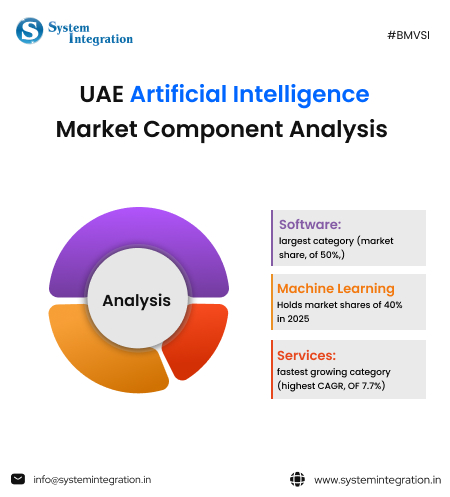
The software category holds the largest market share, of 50%, in 2025, driven by the critical role of AI algorithms, machine learning models, and application software in driving business transformation across sectors.
The services category will have the highest CAGR, OF 7.7%, propelled by rising demand for AI consulting, implement and managed services.
UAE AI Market Report Scope
| Market size value in 2024 | USD 5.22% billion |
| Revenue forecast in 2030 | USD 46.33% billion |
| Growth rate | CAGR of 43.9% from 2024 to 2030 |
| Segment covered | Solution, technology, end-use |
| Report coverage | Revenue forecast, company ranking, competitive landscape, growth factors, and trends. |
AI technologies holds the immense economic power to bring a paradigm shift in the UAE’s business landscape. This report forecasts revenue growth at country levels.
How does AI Readiness Works?
Eagerness to adopt AI technologies isn’t same as AI readiness!
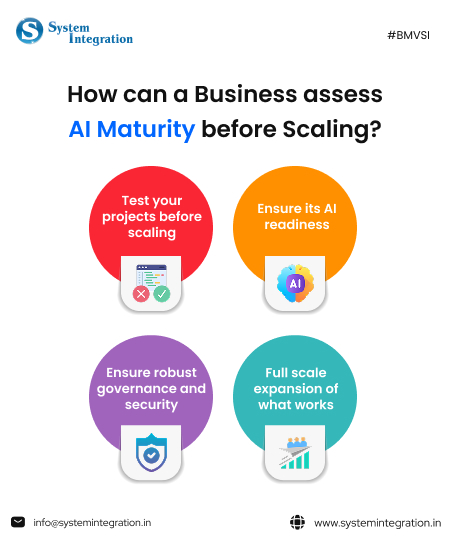
AI readiness involves several steps, starting with conducting an AI readiness assessment, identifying the AI tools that best fit an organization’s demands, opting the right strategies, and training staff to use AI for best output.
A biggest part of AI readiness demands shifting the company culture toward accepting the digital transformation that comes with AI.
Top checklist for AI readiness:
- Having strong data foundation.
- Having clear aim on where to use AI.
- Implementing scalable and latest tech stack.
- Training your employees on using AI.
- Having robust security for data safety.
What is AI Maturity?
An AI maturity model is a formalised way for organisations to assess where they are in the AI journey from early awareness to being a fully mature, AI-driven organisation.
It adds insight into current capabilities and gaps, as well as the actions required to scale AI responsibly and strategically. Not “Are we ready for AI?”, the maturity model provides a path to develop and sustain growth.
Phases of AI Maturity
➔ Awareness Phase
Companies are finding uses for AI and seeing its potential.
➔ Experimentation Phase
Companies conduct pilot projects and proof of concept efforts to validate feasibility.
➔ Phase of Operationalisation
AI integrates with business workflows, governance frameworks are developed.
➔ Optimisation Phase
Businesses use automation and performance data to improve AI models.
➔ AI-Powered Enterprise Phase
AI becomes a key component of corporate strategy across all departments.
Industry Specific AI Readiness Considerations in the UAE
★ Healthcare: protects sensitive data of patients
AI readiness in healthcare sector in the UAE requires robust patient data protection, secure cloud infrastructure and adherence to health regulations. Organizations need to focus on privacy, encryption and ethical AI implementation to ensure this sensitive medical data is protected.
★ Finance: strict governanace as per the law
Banks demand governance frameworks, regulation and see-through on the models. Two etc. Preparation means strong risk management audit trails, cybersecurity controls and compliance with financial laws and data protection regulation in the UAE.
★ Manufacturing: robust sensors and IoT setup
The readiness of AI in manufacturing is contingent on dependable sensors, IoT network access and instant data capture. Enterprises need to bring in equipment integration, predictive maintenance features and robust infrastructure for smart factory automation.
★ Logistics: smooth integration with legacy system
Logistic operators demand frictionless AI integration to existing ERP & supply chain infrastructures. Because readiness depends on such factors as live tracking data, systeminoperability between competing services, scalable cloud platforms and route-optimizing infrastructure.
★ Retail: robust data accuracy and utility
Retail AI readiness centres on customer, inventory and sales precision. Businesses need clean data sets, the ability to forecast demand, personalized marketing engines, and integrated business process automation across omnichannel in order to extract true value from AI.
AI Readiness Challenges in the UAE
1. Legacy Systems and Data Silos
Still in many sectors, businesses throughout the UAE do not have a common platform to share their data. There may be data stored in many different areas (e.g., finance, operations, marketing) of the business that cannot be accessed by other departments.
What Can Be Done:
Include the development of a data integration plan, modern data platforms, and API-based architecture in your technology budget. Start with the development of a central data lake or warehouse, then follow with the migration of the legacy networks with an eye for ensuring the data governance/policies.
2. Talent Shortage
There is a high demand for general and specific skill sets related to AI in the UAE; however, there is a significant lack of skilled data scientists, AI or machine learning engineers available to fill the positions required. In addition, most organizations in the UAE have relied on external consulting for AI project development without creating the internal capabilities necessary for long-term success.
What Can Be Done:
Take a hybrid approach; consider engaging expertise at the start of your AI initiative and continue to develop the ability of your internal resources. Provide additional education in the form of AI training programs, certification programs, as well as hands-on pilot projects that lead to the development of in-house capability over time.
3 Budget Constraints
AI projects may seem costly, particularly because of the cost of infrastructure, software and talent. Leadership may be hesitant to scale without clear ROI projections.
What Can Be Done:
Begin on a modest scale, with pilot projects that are high impact but low risk. Clearly measure the ROI, focus on use cases that will impact the business/servce etcCollaborate Cloud-based AI solutions (use those primarily to bring down infrastructure cost if you ware going for large scale services) to minimize upfront infrastructure costs.
4 Change Management Resistance
Workers may worry that A.I. will replace jobs or upset the status quo. This resistance may also delay adoption and hinder collaboration between teams.
What Can Be Done:
Focus on communication and transparency. Depict AI as a facilitator, not a usurper. Involve teams early, train people and show how AI can make repetitive tasks easier and help to be productive.
How BMV System Integration can Assist your Business in AI Readiness Journey
BMV System Integration can help you determine how prepared your organization is for AI by providing you with a structured assessment of where you are now in terms of AI usage, developing a strategic roadmap for the future, and offering scalable, industry-specific AI automation services that meet your compliance and growth requirements.
Consider BMVSI for the following reasons:
– Framework to evaluate AI maturity within your industry
– Comprehensive evaluation of your existing strategy, data, and infrastructure related to AI
– Emphasis on ensuring compliance with GDPR and EU AI regulations
– Expertise in scalable methods of automating and integrating processes
– Continuous optimization and implementation support
Conclusion
UAE’s various businesses across the country are quickly implementing new way to use AI. This is where AI readiness comes into the picture. Its vital to determine how mature your firm is in terms to implementing AI, identify gaps, and produce a real-world practical roadmap.
Partnering with a best automation company in India, will give UAE’s businesses a great boost in AI readiness as India has proficient AI experts who can help you scale your business and give you competitive leverages.
FAQs
The process of evaluating entire business when a company is thinking about adopting the AI into their business, like making sure of the accuracy of the data to train AI model, have clear aim on why they want AI in their workflows, and adopting the scalable and latest AI model.
Predictive AI has the highest deployment rate(48%), while while generative AI is emerging rapidly adopted by businesses. However, businesses who takes AI and apply it to their workflow gets better results and competitive edge.
- Not providing proper data to train AI.
- Outdated and poor infrastructure.
- Staff not trained to use AI for best performance.
- Not having powerful security measures.
The UAE aims to become the world’s most ai ready nation by 2031, focusing on leveraging AI to increase GDP, enhance government services, and create a sustainable, tech driven economy.