
Introduction
For decades, Germany has been synonymous with precision manufacturing. From automotive giants to advanced machinery producers, the country has built a reputation on efficiency, reliability, and engineering excellence. But today, something deeper is changing beneath the surface.
Artificial Intelligence is not just improving processes, it is fundamentally transforming how factories operate. The traditional idea of industrial automation, where machines simply follow pre-programmed instructions, is giving way to something far more dynamic. Machines are now capable of learning from data, adapting to changes, and making decisions in real time.
This evolution marks a significant shift within the industrial automation industry, moving from static systems to intelligent ecosystems. In many ways, Germany is not just participating in this shift, it is leading it.
Germany’s Automation Landscape: A Market in Transition
Germany’s industrial backbone has always been strong, but AI is accelerating its transformation at an unprecedented pace. The country’s industrial automation market is projected to grow from around $14 billion in 2025 to nearly $25 billion by 2033, reflecting steady expansion despite short-term economic fluctuations.
Globally, the picture is even more striking. The broader industrial automation industry is expected to surpass $400 billion within the next decade, fueled largely by AI adoption, robotics, and connected systems.
What makes Germany unique is not just the scale of adoption, but the depth. Many factories are already highly digitized, meaning AI doesn’t have to start from scratch, it can build on existing infrastructure. This gives German manufacturers a significant advantage in deploying intelligent systems faster and more effectively than many of their global counterparts.
Traditional vs AI-Powered Automation
| Traditional Automation | AI-Powered Automation |
|---|---|
| Rule-based systems | Self-learning systems |
| Reactive maintenance | Predictive maintenance |
| Manual optimization | Real-time optimization |
| Fixed workflows | Adaptive workflows |
From Automation to Intelligence: What’s Really Changing?
To understand the impact of AI, it helps to look at how industrial automation traditionally worked. Systems were rule-based. Engineers would define every possible scenario, and machines would execute accordingly. While efficient, these systems lacked flexibility.
AI changes that completely. Instead of relying solely on predefined rules, machines now learn from data. They recognize patterns, predict outcomes, and continuously improve their performance.
This shift is subtle but powerful. It means factories are no longer just automated, they are becoming self-optimizing environments.
Predictive Maintenance: Fixing Problems Before They Exist
One of the most immediate and measurable impacts of AI can be seen in maintenance. In traditional setups, machines are either serviced at fixed intervals or repaired after they fail. Both approaches are costly either due to unnecessary maintenance or unexpected downtime.
AI introduces a smarter alternative. By analyzing sensor data, such as vibration, temperature, and performance metrics, AI systems can detect early signs of wear and failure. Instead of reacting to breakdowns, companies can act before they happen.
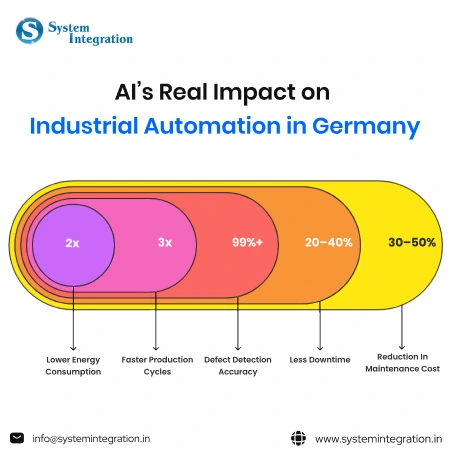
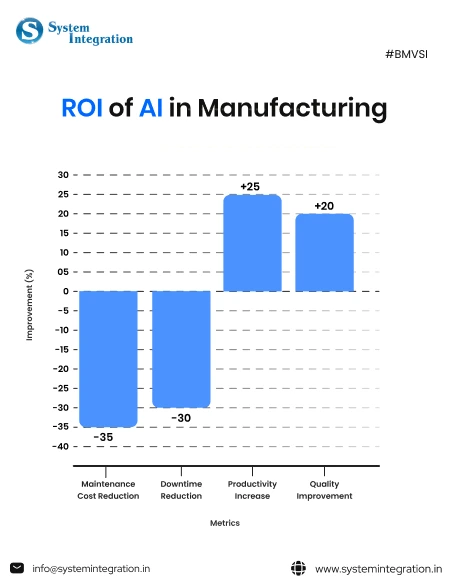
In practical terms, this has led to maintenance cost reductions of up to 50% and downtime reductions of 20–40% across many industrial environments. For high-value manufacturing lines, even a small reduction in downtime can translate into millions of euros saved annually.
Smart Factories: The Rise of Self-Optimizing Systems
The concept of the smart factory has been discussed for years, but AI is what makes it truly viable. In Germany, many production facilities are now moving toward systems that can adjust themselves without human intervention.
Imagine a factory where production schedules automatically adapt based on demand fluctuations, supply chain delays, or machine availability. Energy consumption is optimized in real time, reducing costs and supporting sustainability goals. Bottlenecks are identified and resolved automatically.
This is no longer theoretical. It is already happening and it is redefining what industrial automation services look like. Instead of simply installing machines or software, service providers are now helping businesses build fully integrated, intelligent ecosystems.
AI-Powered Robotics: Beyond Repetition
Germany has long been a leader in industrial robotics, but AI is taking robotics to a new level. Traditional robots are highly efficient but limited, they can perform repetitive tasks with precision but struggle with variability.
AI changes this dynamic by enabling robots to adapt. They can learn new tasks, respond to changes in their environment, and even collaborate safely with human workers. These collaborative robots, or cobots, are becoming increasingly common on German factory floors.
In logistics and warehousing, AI-driven robots are streamlining operations by handling sorting, packaging, and transportation with minimal human input. The result is faster operations, lower costs, and improved scalability.
Quality Control Reinvented with Computer Vision
Quality has always been a defining characteristic of German manufacturing. AI is raising that standard even further.
Computer vision systems, powered by AI, can inspect products with a level of accuracy that surpasses human capabilities. These systems can detect microscopic defects, inconsistencies, and anomalies in real time.
In industries like automotive and electronics, where even minor defects can have significant consequences, AI-driven inspection systems are achieving accuracy rates exceeding 99%. This not only improves product quality but also reduces waste and rework.
Digital Twins: Testing Before Doing
Another area where AI is making a significant impact is in simulation through digital twins. A digital twin is a virtual replica of a physical system, such as a machine, production line, or entire factory.
With AI integrated into these models, companies can simulate different scenarios before implementing changes in the real world. They can test new production strategies, identify potential issues, and optimize performance without any physical risk.
This capability is particularly valuable in complex manufacturing environments, where even small changes can have cascading effects.
Real-World Momentum: Industrial AI at Scale
Germany’s commitment to AI-driven automation is not limited to individual companies. Large-scale initiatives are also underway to build the infrastructure needed for the next generation of manufacturing.
For example, collaborations between major technology and telecom players are focused on creating industrial AI cloud platforms. These platforms are designed to provide the computational power and data capabilities required to support smart factories across the country.
This signals a shift from isolated implementations to a more connected, ecosystem-driven approach to industrial automation.
Challenges Along the Way
Despite its advantages, the transition to AI-driven automation is not without challenges.
- The cost of implementation can be significant, particularly for companies with legacy systems that need to be upgraded or replaced. Cybersecurity is another growing concern, as connected systems create new vulnerabilities.
- There is also a clear skills gap. As automation becomes more intelligent, the demand for AI specialists, data engineers, and advanced technicians continues to rise.
- Additionally, economic uncertainties have recently impacted the sector. Germany’s automation industry experienced a temporary slowdown, highlighting how global factors can influence even the most advanced markets. However, most experts view this as a short-term fluctuation rather than a long-term setback.
The Expanding Role of Industrial Automation Services
As AI adoption grows, the role of industrial automation services is evolving rapidly. Businesses are no longer looking for standalone solutions, they need partners who can guide them through complex digital transformations.
These services now extend far beyond installation. They include system integration, AI model development, predictive analytics, digital twin creation, and continuous optimization.
In many cases, companies are relying on external expertise to bridge the gap between traditional automation and AI-driven systems.
What the Future Holds
Looking ahead, the direction is clear. The industrial automation industry in Germany is moving toward a future defined by intelligence, autonomy, and sustainability.
Factories will become increasingly autonomous, capable of making decisions and executing actions without human input. At the same time, human workers will play a more strategic role, focusing on creativity, innovation, and oversight.
Sustainability will also become a central focus. AI will help optimize energy usage, reduce waste, and lower carbon emissions, aligning industrial operations with environmental goals.
In essence, Germany is transitioning from automated production to intelligent manufacturing ecosystems and setting a global benchmark in the process.
Conclusion
AI is not just another technological upgrade for Germany’s manufacturing sector. It is a fundamental shift in how industrial systems are designed, operated, and optimized.
The transformation of industrial automation into intelligent, adaptive systems is already delivering measurable benefits from cost savings and efficiency gains to improved quality and resilience.
For businesses, the message is clear: those who embrace AI will not only stay competitive but will lead the next era of industrial innovation.
FAQs
Industrial automation refers to the use of machines, control systems, and software to perform industrial tasks with minimal human involvement.
AI enables systems to learn from data, predict outcomes, and optimize operations, turning traditional automation into intelligent, adaptive processes.
Germany combines strong manufacturing expertise, early adoption of Industry 4.0, and continuous investment in advanced technologies like AI and robotics.
These services help businesses design, implement, and manage automation systems, including AI integration and smart factory development.
Automotive, electronics, pharmaceuticals, and logistics are among the biggest beneficiaries of AI-driven automation.
A smart factory is a highly digitized facility where machines, systems, and processes are connected and optimized using AI and data.
High costs, cybersecurity risks, and a shortage of skilled professionals are the primary challenges.
AI is transforming roles rather than replacing them, shifting focus toward higher-skilled and strategic tasks.