


Introduction
January 2026 wasn’t just another month in the history of artificial intelligence; it was the month that delivered an explosive blend of innovation, regulation drama, and industry shakeups. From Google’s bold AI model launch to stormy ethical battles in Hollywood, this month has rewritten the early chapters of AI’s future.
What we saw wasn’t incremental change, it was a significant shift.
In this blog, we’ll break down the most critical AI insights from January 2026, delivered with clarity, context, and a human touch.
1. Breakthrough AI Model Releases – The Giants Strike First
In the opening days of January 2026, the biggest names in tech unleashed next-level intelligence.
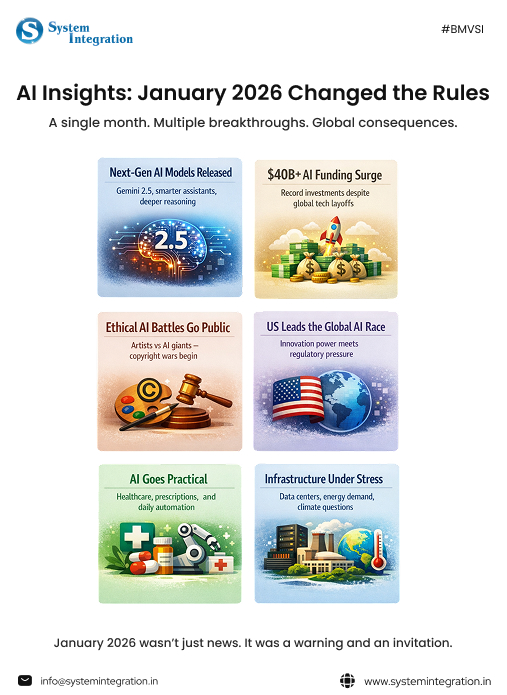
Google’s Gemini 2.5, hyped as its most advanced “thinking machine” yet, pushed the boundaries of performance on complex reasoning, coding, and multi-modal tasks. Meanwhile, Apple and Google collaborated to revamp Siri, blending massive AI models with private cloud compute for smarter, privacy-first personal assistance.
Drama alert? Google dropped Gemini 2.5 like a mic. Rivals were left scrambling and pundits whispered that the next era of AI will no longer be about what models can say, but what they can reason about.
2. Record-Setting Funding Frenzy – Money Talks, Loudly
Funding in AI didn’t just grow, it boomed. OpenAI broke records with a massive $40B funding round, while other major players like Anthropic and xAI raised billions to expand compute infrastructure and research.
But here’s the twist: this funding surge came amid widespread layoffs across global tech. Companies trimmed nearly 25,000 jobs in an industry that is simultaneously hiring for AI and firing everywhere else.
That’s the paradox of 2026 – capital pours into AI innovation even as traditional tech roles evaporate.
3. The Ethical Storm: Artists vs. AI Giants
In a dramatic cultural moment, over 800 artists including Scarlett Johansson and Vince Gilligan publicly protested against AI training on copyrighted works without permission, lighting up debates around ownership, fairness, and AI’s artistic integrity.
This is more than a celebrity spat, it’s a turning point in how society views AI creativity, training data ethics, and compensation rights.
4. US Dominance But Regulation Looms
A new study showed the United States clearly leading the global AI race, outpacing Europe and China in innovation, commercialization, and ecosystem strength.
But leadership comes with pressure. Across Washington and Silicon Valley, policymakers are debating how to regulate AI responsibly, balancing innovation with safety, privacy, and national competitiveness.
AI is not just a tech sector anymore, it’s a national strategic priority.
5. Practical AI Goes Mainstream: From Doctor’s Offices to Pharmacies
While headlines flash about billion-dollar models and funding wars, AI in daily life quietly matured.
From Stanford Medicine’s predictive health models analyzing sleep data to state-level AI partnerships that automate prescription renewals, AI delivered real, measurable improvements in health and wellness.
This is where the magic truly happens: AI that genuinely helps people instead of just dazzling them.
6. Side Effects: Infrastructure Strain & Climate Costs
But innovation came with a cost, literally. The rapid proliferation of data centers to support AI demand has sparked a surge in energy use, particularly gas-powered generation in the U.S., raising alarms about climate impact and sustainable computing.
This isn’t just a technical challenge, it’s now a social and environmental battleground.
Conclusion: January 2026 – A Month We’ll Remember
If history judges 2026 on the strength of January alone, it will call this the month AI shattered its infancy and entered full adulthood.
We saw:
- Technical leaps that redefined what AI can do
- Capital booms mixed with job market contractions
- Ethical debates breaking into mainstream culture
- Policy and public discourse growing louder than ever
These are real AI insights, not buzzwords.
Welcome to the new era of intelligence.
FAQs
January was marked by major model launches like Gemini 2.5, huge funding rounds, ethical protests against AI training practices, and practical deployments in healthcare and governance.
Investors are betting heavily on long-term AI infrastructure and specialized AI startups, even as companies cut traditional tech roles to refocus on AI efficiency and automation.
AI is reshaping jobs: while roles in legacy tech shrink, demand for AI-specific positions, like machine learning engineers and AI governance experts, is rising.
Major concerns include use of copyrighted content for training without permission, accountability for AI decisions, and equitable access to AI technologies.
Yes, according to recent studies, the U.S. holds a strong global position in AI innovation and commercialization, though global competition remains fierce.