
Introduction
The demand for content is overwhelming e-commerce brands. Email campaigns, blog posts, social media posts, and product descriptions all require frequent updates across multiple platforms. The speed that contemporary consumers demand cannot be met by manual content creation.
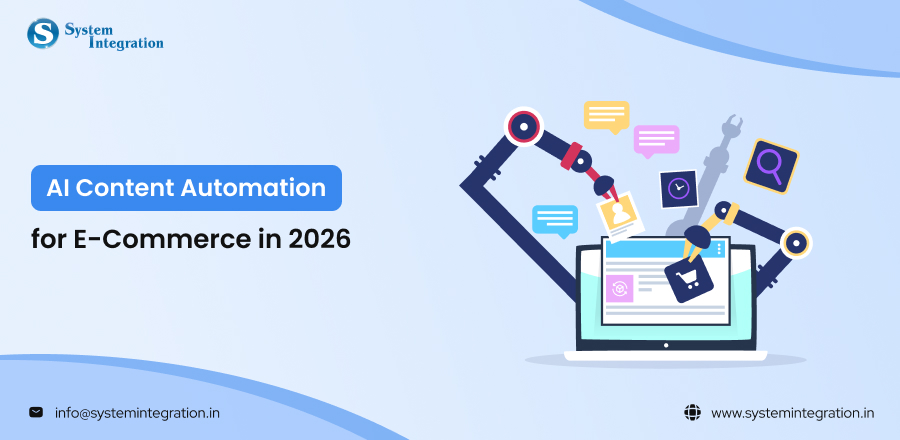
In 2026, content automation driven by AI will revolutionise e-commerce brands. This technology frees up your team to work on strategic projects while handling repetitive writing tasks and personalising content at scale.
In this guide, we will explore how content automation can help E-commerce brands, brand managers, and e-commerce marketers who wish to optimise their content operations without compromising quality.
What is AI Content Automation?
Centent automation refers to the utilization of AI(artificial intelligence) and software to connect every stage of the content lifecycle into a coordinated process.
Manual content creation is time-consuming, often requiring you to repeat the same actions for different campaigns or formats. Automation handles these repetitive tasks and saves your hours of doing that repetitive and productive work, and helps in enhancing your performance.
Humans are still needed for:
- Setting the brand voice guidelines for consistency.
- Defining templates.
- Connecting the CRM system or analytics dashboard
Why AI Automation is The Missing Link?
Let’s understand how an AI automation service plays a major part in a content automation strategy. AI-powered content automation can look something like this:
Ideation: It includes the process of brainstorming the idea of creating an engaging piece of content into something new.
Automation: AI tools automatically convert your raw data into new content for multiple platforms.
Personalization: It can generate and send personalized campaigns and emails to users.
Automated post: it can schedule the post in advance on multiple platforms to avoid manual hassle.
Summarization: as the name suggests, providing a short summary of a long format.
Content generation: as per your prompts, it can generate a fresh piece of content in any format as needed.
The Core Process Behind the Automated Content Creation
1) Define and strategize: before any automation process starts, one needs to map out and strategise the whole process and the tasks they want to automate and what system is actually suppose to do.
2) Input data and prompts: after knowing and strategizing the tasks which are supposed to be automated, it’s time to translate those into instructions that the system can understand. You can help AI to understand the data you enter by incorporating keywords, tone, and references to existing content.
3) Research and ideation: During research and ideation, you can use automation to scan search data, trending topics, and audience behaviour to generate human-guided AI content that people actually care about.
4) Refinement and optimization: after the draft are generated, automation doesn’t stop. The refinement phase fine-tunes the structure and keeps your messages aligned with search intent. AI can check grammar, sentence flow, and meta description, and flag weak sections before publishing.
5) Human review and editing: for accuracy, depth, and to check for brand voice, human review and editing is essential. Editors fact-check every statement, verify statistics, and remove phrases that sound generic or off-brand.
6) Publish and distribute: once the editor has checked everything, the automation process starts again. The publishing software or tool posts the content across websites, social media platforms and more without any manual uploading. This is automation’s biggest time saver.
7) Performance tracking and analysis: each post, email, or ad creates data that helps you understand what’s working. Automated analytics tools collect metrics like traffic conversions and customer engagement rates.
Key Ways E-Commerce Use Content Automation
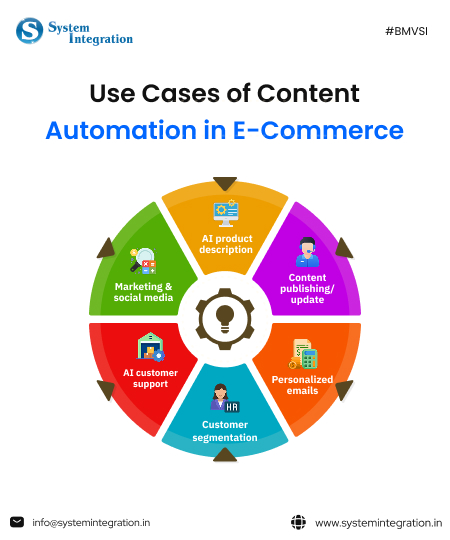
- AI product description: tools can analyse any product’s description and image, and its raw data to generate its SEO friendly description and title, and its large, detailed catalogues.
- Marketing & social media: automated tools can schedule social media posts, blog posts, and newsletters, ensuring consistent branding and engagement without manual daily intervention.
- Content publishing/update: it can automatically repurpose content and publish on any one or multiple platforms without wasting any manual efforts for such unproductive tasks.
- Personalized emails: software automatically sends the personalized email for promotional purposes or cart reminder and more without having to do it manually.
- Customer segmentation: data tools automatically groups the similar types of queries of users by their keywords, location and many filters and automatically send the rewards or coupons and more.
- AI customer support: chatbot automation is used for answering the customer’s real-time queries related to any service or product, or even to track their courier. An automated system provides instant support for such tasks.
Before You get Started
Know Your Requirements
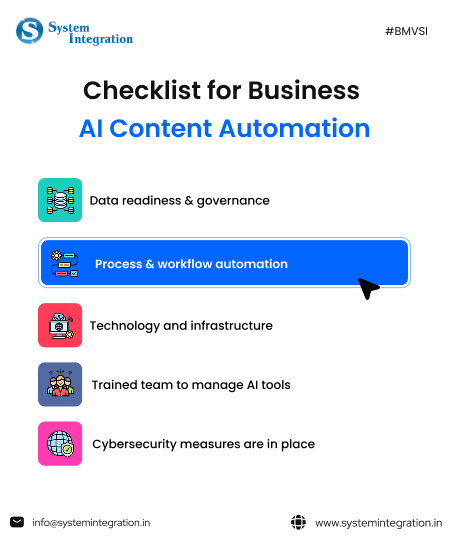
➾ Define your “core goal” clearly. Are you repurposing for reach, engagement, SEO, or lead generation? This clarity will help you choose the right AI workflow and tools from day one.
➾ List the tasks you want AI to automate for you, such as summarization, altering the format of your content, tone adjustment, or scheduling, to avoid hassle in the system.
➾ Ensure you have a clean, “well-structured” source of content, because actually, the most intelligent AI will also blunder with chaotic inputs.
Understand Its Limitations and Considerations
➾ AI speeds up automation, but it nevertheless requires human oversight for brand voice, precision, and context-sensitive content.
➾ You have to be mindful of “platform guidelines”, data privacy, and over-automation, as unchecked AI outputs can hurt your business credibility instead of scaling it.
Wrapping up Thoughts
As the e-commerce industry evolves in 2026, the demand for content is overwhelming brands. Email campaigns, blog posts, social media posts, and product descriptions all require frequent updates across multiple platforms.
Content automation driven by AI will revolutionise e-commerce brands. This technology frees up your team to work on strategic projects while handling repetitive writing tasks and personalising content at scale.
To get the best automation tool, collaborate with the best AI software development company. This helps in getting a scalable automation tool that reduces the manual hassle, while boosting productivity and conversion of your business.
FAQs
One of the best and most common examples of content automation in e-commerce is blog posting. From drafting the blog, checking it, sending it for approval, publishing it and finally sending it to promote automatically without manual work.
Yes, absolutely. It works when backed by a robust strategy and clear human direction. It helps in saving time and increasing output, and helps the team to stay consistent. When used correctly, it automates the manual parts of content creation while maintaining creative control.
The three type of common automation tools are fixed automation, programmable automation, and flexible automation. Fixed follows the set process. Programmable lets the changes for some specific tasks and is flexible and adapts quickly to new workflows.
AI can generate product descriptions from the raw data available, AD copy, SEO metas, social media uploads and captions, blog generation and publishing and can also handle customer queries.