
Introduction
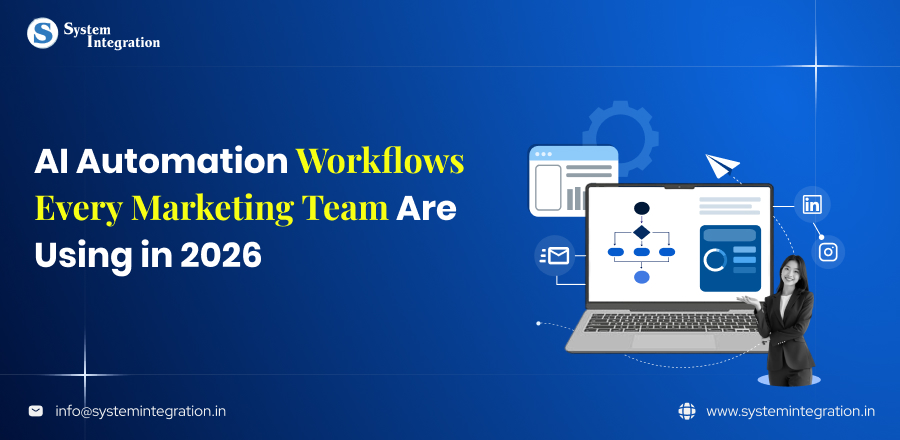
Digital marketing in 2026–27 is driven by speed, precision, and intelligence. As customer journeys become more complex and data volumes grow exponentially, manual processes are no longer sustainable. This is where AI automation becomes a game-changer.
From campaign optimization to customer engagement, artificial intelligence automation allows marketing teams to operate smarter, faster, and with measurable impact. Today, businesses are increasingly relying on AI workflow automation to streamline operations, reduce costs, and improve ROI.
This blog explores what AI automation is, how AI in marketing automation is evolving, and the most critical AI automation workflows every digital marketing team should adopt in 2026–27.
What is AI Automation?
AI automation refers to the use of artificial intelligence technologies to automate tasks, decisions, and workflows that traditionally required human effort.
Unlike basic automation, AI systems:
- Learn from data
- Adapt based on performance
- Make predictive decisions
- Improve outcomes over time
In marketing, the use of artificial intelligence in marketing goes beyond scheduling or rule-based triggers. It includes predictive analytics, personalization, intent analysis, and real-time optimization.
Why Digital Marketing Teams Need AI Workflow Automation in 2026-27?
The future of marketing is not about doing more work, it’s about orchestrating smarter workflows.
Key reasons marketing teams are adopting AI workflow automation:
- Rising customer acquisition costs
- Demand for hyper-personalization
- Multi-channel attribution complexity
- Faster go-to-market expectations
- Data-driven decision-making requirements
This shift has also led to the rise of the AI automation agency model, where specialized agencies offer end-to-end AI automation services tailored to marketing needs.
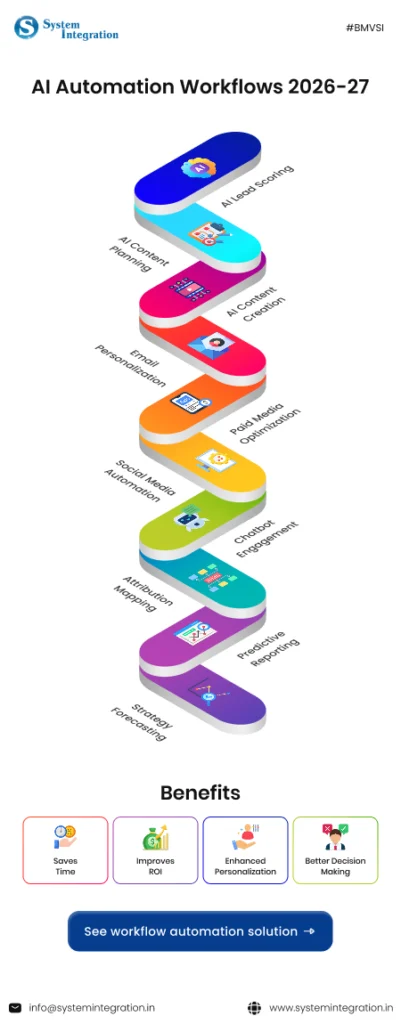
1. AI Automation Workflow for Lead Qualification & Scoring
The Problem:
Not every lead is sales-ready, yet marketing teams often pass unqualified leads to sales.
The AI Automation Solution:
AI evaluates behavioral, demographic, and intent-based signals to prioritize high-quality leads.
Workflow Breakdown
- Lead enters via ads, forms, or chatbots
- AI analyzes:
- Website behavior
- Engagement history
- Content interaction
- Leads are auto-scored and segmented
This is one of the most common AI automation services offered by an AI automation agency.
2. AI Workflow Automation for Content Ideation & SEO Planning
The Problem:
Manual keyword research and topic planning are time-consuming and often outdated.
The AI Automation Solution:
AI analyzes search trends, competitor data, and audience intent to suggest content ideas.
How AI Helps
- Identifies keyword gaps
- Builds topic clusters
- Predicts content performance
This workflow directly improves AI in marketing automation, especially for SEO-driven teams.
3. AI Automation for Content Creation & Optimization
The Problem:
Scaling content while maintaining quality and SEO consistency is difficult.
The AI Automation Solution:
AI assists with drafting, optimizing, and refining content using performance data.
Key Capabilities
- SEO optimization
- Readability improvements
- Metadata generation
- CTA suggestions
This is a practical example of artificial intelligence automation enhancing productivity without replacing human creativity.
4. AI in Marketing Automation for Email Campaigns
The Problem:
Generic email campaigns fail to engage modern audiences.
The AI Automation Solution:
AI personalizes email campaigns in real time.
Workflow Includes:
- Dynamic audience segmentation
- Predictive send times
- Personalized subject line
- Behavior-triggered emails
The use of artificial intelligence in marketing here leads to higher open rates, CTRs, and conversions.
5. AI Automation Workflow for Paid Advertising Optimization
The Problem:
Manual ad optimization wastes time and budget.
The AI Automation Solution:
AI continuously optimizes bids, creatives, and targeting.
AI-Driven Actions:
- Auto-bid adjustments
- Creative performance testing
- Budget reallocation
This workflow is now a core offering of many AI automation agencies managing paid media at scale.
AI in Marketing vs Traditional Marketing
| Feature | Traditional Marketing | AI Automation |
| Speed | Slow | Real-time |
| Personalization | Low | High |
| Decision Making | Manual | Predictive |
| Optimization | Reactive | Automated |
| Efficiency | Medium | High |
6. AI Workflow Automation for Social Media Management
The Problem:
Managing multiple platforms consistently is resource-heavy.
The AI Automation Solution:
AI schedules posts, analyzes engagement, and recommends improvements.
Benefits:
- Optimal posting times
- Platform-specific content insights
- Engagement pattern analysis
This highlights how AI workflow automation improves both efficiency and performance.
7. AI Automation for Customer Journey Mapping & Attribution
The Problem:
Marketers struggle to understand which channels actually drive conversions.
The AI Automation Solution:
AI maps multi-touch journeys and assigns accurate attribution.
How It Helps
- Identifies high-impact touchpoints
- Improves budget allocation
- Enhances funnel optimization
Tools like Yext play a key role here by ensuring accurate brand data and consistent digital presence across platforms, feeding cleaner data into AI-driven attribution models.
8. AI Automation Workflow Using Chatbots & Conversational AI
The Problem:
Website visitors expect instant responses.
The AI Automation Solution:
AI chatbots handle queries, qualify leads, and guide users.
Workflow Capabilities
- 24/7 engagement
- Lead qualification
- Meeting scheduling
- Seamless handoff to humans
This is one of the fastest-growing AI automation services in digital marketing.
9. AI Automation for Reporting & Performance Insights
The Problem:
Manual reports are slow and often outdated.
The AI Automation Solution:
AI pulls data from all channels and generates insights automatically.
Outputs Include:
- Real-time dashboards
- Performance summaries
- Optimization recommendations
This level of artificial intelligence automation enables faster, smarter decision-making.
10. Predictive AI Automation for Marketing Strategy
The Problem:
Most marketing decisions are reactive.
The AI Automation Solution:
AI predicts outcomes based on historical and live data.
Predictions Include:
- Conversion likelihood
- Campaign success
- Customer churn
This advanced AI workflow automation helps teams plan proactively instead of reacting late.
Role of an AI Automation Agency in 2026-27
As workflows become more complex, businesses increasingly partner with an AI automation agency to design, implement, and optimize AI systems.
An experienced agency provides:
- Custom AI automation workflows
- Tool integration
- Ongoing optimization
- Scalable AI automation services
This approach allows marketing teams to focus on strategy while AI handles execution.
Conclusion: The Future of Marketing is AI Automation
AI automation is no longer optional, it’s foundational.
By adopting AI workflow automation, leveraging AI in marketing automation, and partnering with the right AI automation agency, digital marketing teams can:
- Scale faster
- Reduce operational costs
- Improve personalization
- Drive predictable growth
The use of artificial intelligence in marketing will define winners and laggards in 2026–27. Teams that invest today will lead tomorrow.
FAQs
Traditional marketing automation follows fixed rules, while AI workflow automation adapts based on real-time data, user behavior, and predictive insights. AI-powered workflows can optimize campaigns automatically, personalize experiences, and make intelligent decisions without manual intervention.
AI automation in digital marketing refers to the use of artificial intelligence to automate marketing tasks such as lead scoring, content optimization, campaign management, personalization, and performance analysis. Unlike basic automation, AI systems learn from data and continuously improve results over time.
AI automation services include designing, implementing, and managing AI-driven workflows for marketing, sales, and operations. These services are ideal for:
- Digital marketing teams
- B2B and SaaS companies
- E-commerce brands
- Agencies managing multiple clients
Businesses looking to scale efficiently benefit the most from these services.
AI in marketing automation is used for:
- Predictive lead scoring
- Personalized email marketing
- Paid ad optimization
- Content recommendations
- Customer journey mapping
- Performance forecasting
This allows marketers to focus more on strategy and creativity rather than execution.
Yes. Artificial intelligence automation is especially valuable for small teams as it reduces manual workload, improves efficiency, and enables scalability without increasing headcount. Cloud-based AI tools make automation accessible even for growing businesses.
The most critical AI automation workflows include:
- Lead qualification and scoring
- Content ideation and SEO optimization
- Email personalization
- Paid ad optimization
- Social media automation
- Chatbots and conversational marketing
- Predictive analytics and reporting
These workflows help marketing teams stay competitive in a data-driven landscape.
No. AI automation enhances marketers’ capabilities rather than replacing them. While AI handles repetitive tasks and data analysis, marketers remain essential for strategy, creativity, storytelling, and decision-making.
Most modern AI automation platforms are designed with data security and compliance in mind. However, businesses should ensure proper configuration, consent management, and alignment with regulations such as GDPR and other regional data protection laws.