
Introduction
Artificial intelligence adoption is accelerating across industries. From marketing automation and fraud detection to predictive analytics and customer support, AI is now part of everyday business operations. However, as organizations deploy more AI systems, the need for responsible oversight becomes critical.
This is where AI governance plays a major role.
AI systems can sometimes produce biased results, operate without transparency, or make decisions that are difficult to audit. Without clear governance processes, businesses may face compliance risks, security issues, and loss of trust from customers.
At BMVSI, we work closely with organizations building AI-powered automation systems. Based on real-world implementations and evolving regulations, here are 10 AI governance best practices we recommend organizations follow in 2026.
What is AI Governance?
Before discussing best practices, it is important to understand what is AI governance.
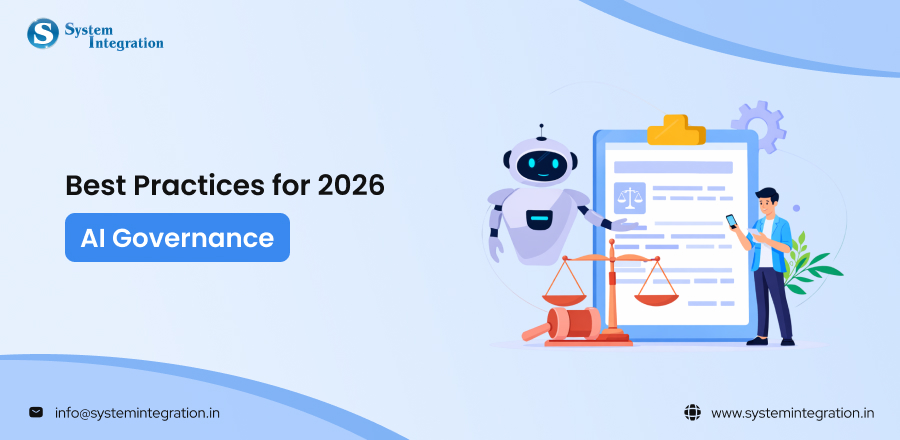
AI governance refers to the policies, processes, and oversight mechanisms that ensure artificial intelligence systems are developed and used responsibly. A strong AI governance framework helps organizations manage risks, maintain transparency, and ensure compliance with emerging AI regulations.
According to industry studies, over 75% of organizations now use AI in at least one business function, but fewer than 30% have formal AI governance frameworks in place. This gap highlights why governance will become one of the most important priorities for companies implementing AI in the coming years.
The AI Governance Gap
| AI Adoption | AI Governance |
|---|---|
| 78% companies using AI | Only 25–30% companies have governance frameworks |
| 35% using AI across multiple departments | Less than 20% conduct regular AI audits |
Top 10 AI governance Frameworks
▣ Establish a Clear AI Governance Framework
Every organization implementing AI should begin with a well-defined AI governance framework.
This framework acts as the foundation for how AI systems are managed across the company. Instead of allowing different departments to experiment with AI independently, the framework provides standardized guidelines.
A governance framework typically defines:
- AI development policies
- Risk assessment procedures
- Compliance and regulatory guidelines
- Model monitoring processes
When organizations create this structure early, they can scale AI projects without losing oversight or accountability.

▣ Define Clear Ownership for AI Systems
AI systems often involve multiple teams such as data scientists, engineers, product managers, and business leaders. Without clear ownership, it becomes difficult to manage responsibility when something goes wrong.
Organizations should ensure every AI model has designated stakeholders responsible for:
- Model performance
- Data quality
- Risk monitoring
- Compliance requirements
Many enterprises are now appointing AI governance leads or Chief AI Officers to oversee these responsibilities.
Clear ownership ensures that AI initiatives remain aligned with both business objectives and governance policies.
▣ Strengthen Data Governance
AI models are only as reliable as the data used to train them.
If datasets contain errors, bias, or outdated information, the resulting AI system may produce inaccurate or unfair predictions. This is why strong data governance practices are a critical part of any AI governance strategy.
Key data governance measures include:
- Maintaining high data quality standards
- Tracking data sources and lineage
- Protecting sensitive information
- Ensuring proper data labeling and documentation
For example, organizations implementing AI in recruitment often audit historical hiring data to remove patterns that could lead to algorithmic bias.
▣ Prioritize Transparency and Explain ability
One of the biggest concerns surrounding AI is the lack of transparency in decision-making.
Many AI systems operate like a “black box,” producing predictions without clearly explaining how those decisions were made. This can create problems when organizations need to justify decisions to regulators, customers, or internal teams.
To address this challenge, companies should focus on improving explainability by:
- Documenting how models make decisions
- Implementing explainable AI tools
- Maintaining logs of AI-driven decisions
Transparency increases trust in AI systems and makes it easier to detect potential issues early.

▣ Conduct Regular AI Risk Assessments
AI systems evolve continuously as they learn from new data. Because of this, risks can also change over time.
Organizations should periodically evaluate their AI systems to identify issues related to:
- Algorithmic bias
- Security vulnerabilities
- Unexpected outputs
- Regulatory compliance risks
Some organizations conduct quarterly AI risk reviews, where governance teams assess whether deployed models are still performing as expected.
Regular risk assessments ensure that AI systems remain reliable even as business conditions change.
▣ Maintain Human Oversight
Even though AI can automate complex tasks, human supervision remains essential.
Certain high-impact decisions should always include human-in-the-loop review, especially in areas like:
- Financial approvals
- Hiring decisions
- Healthcare recommendations
- Fraud detection systems
Human oversight ensures that AI recommendations are validated before final decisions are made.
This balance between automation and human judgment is an important element of responsible AI in governance.
▣ Document AI Models and Processes
Documentation is one of the most overlooked but essential governance practices. Every AI system should maintain clear documentation covering:
- Training datasets used
- Model architecture
- Testing and validation results
- Performance benchmarks
- Updates or model changes over time
Proper documentation becomes extremely valuable during audits, compliance reviews, or when troubleshooting unexpected model behavior.
▣ Monitor AI Systems After Deployment
Many organizations focus heavily on building AI models but neglect monitoring them once deployed. However, AI models can degrade over time due to data drift or changing real-world conditions.
Continuous monitoring helps detect issues such as:
- Declining prediction accuracy
- New bias patterns
- Unexpected outputs
Organizations implementing large-scale AI deployments often use monitoring dashboards that track model performance in real time.
▣ Align With Emerging AI Regulations
Regulations around artificial intelligence are evolving quickly worldwide. Companies must ensure their AI systems comply with emerging governance standards and industry regulations.
In India, discussions around artificial intelligence India government initiatives are already focusing on responsible AI development, regulatory oversight, and public sector AI deployment.
Organizations that proactively align with these frameworks will find it easier to adapt to future regulatory requirements.
▣ Build an Ethical AI Culture
Governance cannot rely only on policies and technical frameworks. It must also become part of the organization’s culture. Businesses should educate employees about responsible AI usage, ethical considerations, and data privacy practices.
This can include:
- Internal AI ethics training
- Governance workshops for teams
- Guidelines for responsible AI experimentation
When employees understand the importance of responsible AI development, governance practices become much easier to implement across the organization.
AI Adoption vs AI Governance (Data Insight)
You can include a simple graph in the blog to highlight the governance gap.
| Category | Percentage |
|---|---|
| Organizations using AI | 75–80% |
| Organizations with AI Governance Frameworks | ~25–30% |
Source: Industry AI governance research reports.
This clearly shows that many companies are adopting AI faster than they are implementing governance frameworks.
AI in Governance: Growing Role of Governments
Governments worldwide are also exploring AI in governance to improve public services.
Applications include:
- Fraud detection in public financial systems
- Traffic and urban planning analytics
- Predictive healthcare models
- Agricultural forecasting
India has also been investing in AI through national programs and research initiatives focused on responsible and scalable AI adoption.
These efforts demonstrate how governance frameworks can help governments use AI responsibly while still driving innovation.
Conclusion
Artificial intelligence is becoming a core component of modern business operations. However, as organizations rely more on AI-driven systems, they must also implement strong governance frameworks to manage risks.
By establishing clear policies, strengthening data governance, maintaining transparency, and ensuring continuous monitoring, organizations can deploy AI systems that are both powerful and responsible.
At BMVSI, we believe that AI governance is not a barrier to innovation, it is the foundation that enables organizations to scale AI safely and sustainably.

FAQs
AI governance refers to the policies, frameworks, and processes used to ensure that artificial intelligence systems operate responsibly, ethically, and transparently.
AI governance helps organizations manage risks related to bias, data privacy, security, and regulatory compliance while ensuring AI systems remain trustworthy.
An AI governance framework is a structured approach used by organizations to manage AI development, deployment, monitoring, and compliance.
Companies typically implement AI governance through policies, risk assessments, model monitoring, data governance practices, and oversight teams.
Industries such as finance, healthcare, government services, insurance, and e-commerce require strong AI governance because AI systems directly influence critical decisions.
Governments use AI for fraud detection, healthcare analysis, traffic optimization, public safety monitoring, and predictive policy planning.