Introduction
Did your Instagram just suggest the product you were talking about?…🤯
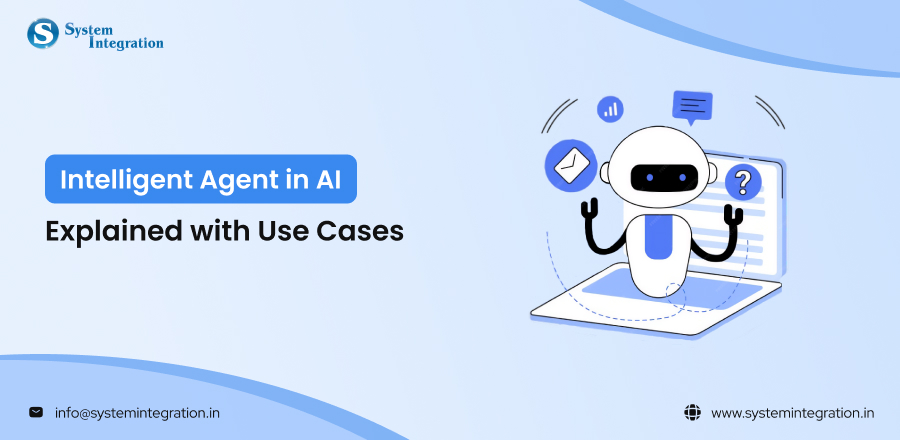
Well, that’s not any magic or any coincidence, that intelligent agent in AI is quietly doing its job.
Basically, an intelligent agent is a smart digital assistant that monitors its environment, makes decisions and executes actions to reach an objective, sort of like that one overachieving colleague who somehow does their work before the meeting even begins. The difference? AI agents have no use for coffee breaks or quotes about motivation.
From chatbots and recommendation systems to self-driving cars, intelligent agents are everywhere, working behind the scenes to make technology smarter and life easier. In layman terms, if AI were a head, intelligent agents would be the hands and legs helping it get things done. And honestly, they’re kind of getting good at it. 🤖
What are AI agents?
AI agents are intelligent software applications created to carry out tasks on their own by evaluating data, coming to conclusions, and acting to accomplish particular objectives.
AI agents can learn from data, adjust to changing circumstances, and gradually improve their performance, in contrast to traditional software that adheres to set instructions.
They are extensively utilised in applications that help businesses boost productivity and decrease manual labour, such as chatbots for customer service, virtual assistants, automated whatsapp tools, and intelligent recommendation systems.
| Key characteristics of AI agents: ⭐ Autonomous operation: the ability to engage in activities that require little human oversight ⭐ Ability to make decisions: Assess data and select the optimal action for achieving predetermined objectives. ⭐ Learning ability: improving behavior over time through machine learning and feedback. ⭐ Environment interaction: Gather data from users, systems or sensors for proper response. ⭐ Task Automation: Manage repetitive or complex processes across multiple applications. |
How do intelligent agents think, learn, and act?
➢ Information Perception: Agents gather information about their environment using inputs like user queries, sensors, databases or APIs.
➢ processing the Data: they gather it using analytical systems and read algorithms to extract meaning by understanding context.
➢ Data Learn: Agents are trained to learn from their mistakes continuously improving in how accurate they are and the decisions they make.
➢ Determine Actions: The agent decides which action is most appropriate to achieve its goal depending on the analysis.
➢ Act and Learn: The agent performs the task, measures its success, then learns how to improve performance on future attempts.
The Rise Of AI In Business Operations
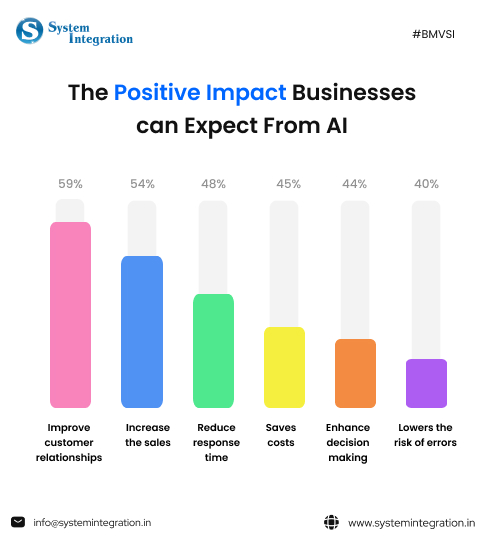
Here’s The Top Tasks Businesses Are Automating With AI ✔️ The silent workforce of AI - Automating routine operations and running jobs 24/7 around the clock without fatigue or slipping on health and safety. ✔️ Quicker and more data driven decision - AI processes enormous volumes of data on the fly, delivering faster, better operational and strategic decisions. ✔️ Scale operational efficiency - Whether through supply chain or customer support, AI mitigates errors, reduces costs and scales operations without an increase in headcount. ✔️ Human and AI Join Forces - Teams shift towards creativity, strategy, problem solving and leave repetitive tasks to the bots. |
What are the Types of Agents in AI
Simple reflex agents
These agents operate on a straightforward principle: if a specific condition is met, it takes predefined actions. They don’t store past experiences or learn from them. Simple reflex agents work well and smoothly in predictable situations and environments. However, they may struggle with more complex decisions.
Model based reflex agents
These agents differ from simple reflex agents in that they keep an internal model of their environment. It also considers both current and historic conditions and datas to make more informed and accurate decisions.
Goal based reflex agents
These agents analyse the user demand and strategies before reacting. It doesn’t take decisions based on fixed rules; it considers different possibilities and selects the one that fits the user’s demand most perfectly to achieve a specific aim.
Utility based reflex agents
In any situations where multiple outcomes are possible, utility based agents analyse pros and cons of each to determine the best course of action. Unlike goal-based agents, which simply aim to achieve an objective, utility based agents also consider factors such as safety and customer satisfaction.
Learning agents
These agents take adaptability to the next level. They start with the minimal knowledge, learn from experience and improve their performance over time. Machine learning models, such as fraud detection systems, fall into this category. In short, the more data they analyse the better they become.
Business use Cases of Intelligent Agents
- Customer support automation: chatbots and virtual assistants powered by intelligent agents assist with customer inquiries, troubleshoot common problems, and offer 24/7 assistance that enhances response time and customer satisfaction.
- Sales and lead qualifying: AI agents can analyze customer behavior, automatically pre-qualify leads and guide potential buyers through the sales funnel with personalized recommendations.
- Process automation: Businesses use intelligent agents to automate routine tasks involving data entry, report generation, scheduling and workflow management.
- Fraud detection and risk analysis: Intelligence agents monitor transactions, find unusual weights of transactions through extracting real-time data of transactions by financial institutions.
- Tailored marketing: AI agents evaluate customer data to provide bespoke promotions, product recommendations, and customized marketing strategies.
- Supply chain optimization: Intelligent agents are used to predict demand, monitor inventory, and maximize inventory.
The Future of Intelligent Agents
1. AI will be a mostly adopted element in every business to boost customer conversion rates. Even small or medium sized businesses will operate AI for their daily use.
2. More focus on Ethics as people worry that AI will be biased or can use their sensitive data wrongly. In future, governance rules and laws will be strick for users safety.
3. AI tools will get cheaper so that everyone can use it for their business without having to worry about budget, as AI projects are getting expensive every year.
4. Increasing Adaptation of agentic AI services for a fully automatic workflow where human oversight is not needed, and AI can learn on its own for a smooth workflow.
5. Increased Adoption of domain specific AI instead of one general AI, an AI system which is highly capable of adapting to any specific domain the business needs.
Winding-up Thoughts
Intelligent agents are transforming how businesses work by simplifying financial reconciliations and changing the way businesses interact with customers. They help businesses scale in real time, reduce manual and human dependency on execution or decision processes, and begin to maintain improved decision success rates.
However, it is vital to connect with the best AI software development company to get the best AI services, as it can furnish robust solution which is scalable and assist in increasing your business productivity.
FAQs
An AI agent is a more advanced system that’s autonomous, aim and goal oriented and capable of reasoning. Unlike chatbots, AI agents can perform multiple and complicated tasks smoothly and adapt to user preferences.
Intelligent agents differ from traditional automated systems by acting as adaptive, cognitive “brain” rather than rigid and just rule-based systems. Whereas intelligent agents can learn from each user conversation and learn and adapt accordingly.
The combination of large language models for reasoning, reinforcement learning for decision making, and neural networks for perception.
Absolutely, multiple intelligent agents can collaborate, and this approach is a rapidly evolving area of AI known as a multi-agent system. This collaborative approach is considered a major advancement over a single-agent system.