
Introduction
Consider purchasing a “one-size-fits-all” T-shirt for a marathon. It may fit, technically speaking, but halfway through the run you’ve realized it’s either too tight, too loose or just… awkward. That’s just how a million businesses feel after adopting off-the shelf software. It works until it doesn’t.
Ready-made solutions promise easy setup and lower upfront costs, which is great in theory. But as your business expands, those hidden constraints start to surface: absent functionality, costly website integrations and ultimately you get the app that doesn’t scale as your business grows.
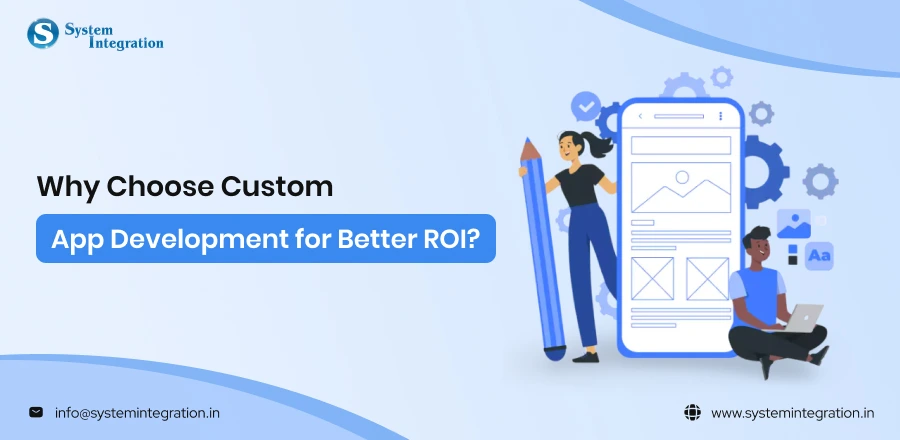
That’s where custom app development comes into play. Built around your goals, users and scalability needs. Sure, it might involve a larger upfront spend, but the lifetime yield typically returns a far higher return on investment (ROI).
What is Ready made App Solution?
It’s a pre-built application also known as “white label software” and “off the shelf”. This type of application offers a ready set of features and functionalities that offers better user experience. One of the most popular example of ready made applications is, education app, which enables inttitutions to deliver quality education to students anytime and anywhere.
Readymade solutions are cheaper as they are pre-built and has fixed features init. However, it might not suit all the type of businesses as they are not tailored to any type of specific business needs. Thus, migh need to make further changes in the app as per your requirements.
What is Custom App Development?
Custom mobile app development means building an app from scratch, depending on your company’s demands and goals. The app is first planned, then designed and developed, and finally quality tested and launched in the market. It can be built for any platform like Android, iOS, or both platforms, using cross platform development method.
This approach gives full control over features, data flow, and updates. Throughout the whole development process, the business can add any kind of feature or functionality into the app.
How does Custom App Development Drive ROI?
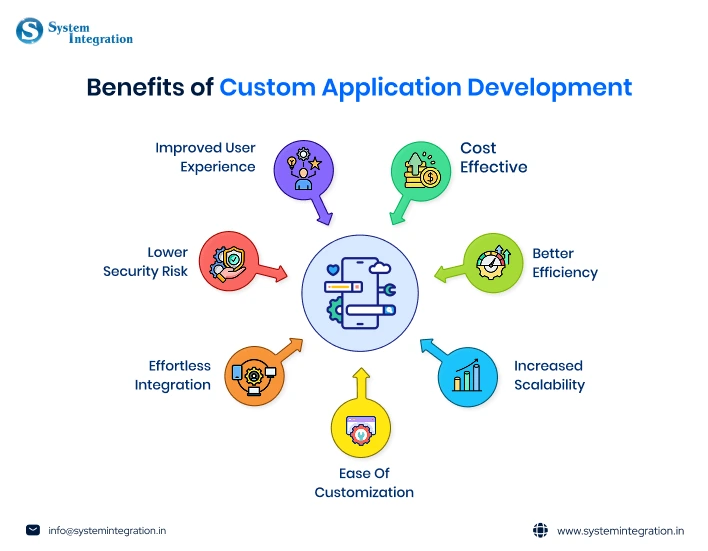
➜Customised for Your Unique Business Requirements: Custom software is also developed around your workflows, goals, and challenges. It builds on itself, getting rid of the bloat common in generic tools and only focuses on what your team actually needs increasing productivity overnight.
➜Automation of Repetitive Tasks: Custom solutions automate routine processes from data entry to reporting and approvals. It cuts down on manual errors, frees up time, and enables your team to work on higher-value strategic projects.
➜Seamless System Integration: Whether in CRM, ERP or accounting tools, integrations of third-party APIs are easy with custom software. This allows seamless flow of data across departments and breaks down the information silos.
➜Better Scalability as You Grow: As your company grows, so can your software. Custom solutions offer configurability, enabling new features, user roles, and integrations without disrupting ongoing operations.
➜Enhanced Security & Data Control: Custom software adds stronger security measures that meet your industry requirements, ensuring sensitive business data remains secure and compliant with full control over architecture and hosting.
Ready-Made App VS Custom Development: Key Differences
| Element | Ready-Made App | Custom Development |
|---|---|---|
| time -to-market | Ready-made apps can be deployed in days or weeks, making it ideal for rapid launch | Custom development involves lengthy process of planning and coding taking months to launch |
| Customization Level | Offers limited customizations following its rigid structure. | Complete customization that fits the unique business need |
| Cost | Ready-made apps have lower initial costs and often subscription based | More costly from the start but no platform dependency fees |
| Scalability & Performance | It may struggle to scale; performance is limited | Designed for distributed and real-time processing. |
Real World Businesses Where Custom App Development Delivers Maximum ROI
- Logistic and supply chain management app
- It reduces operational and fuel expenses by analysing real time data.
- Enhances efficiency by automating the workflow and providing instant updates.
- Improves inventory management by enhancing the stock managements.
- Increases the customer satisfaction and exprience and boosts retention rate.
- Financial services platform
- Custom app allows including features like personal recommendations like investments.
- Gives superior experience on mobile devices and increases retention rates.
- Financial apps can embed advanced security features such as biomatics, data encryption and more.
- Custom app development can be designed to meet the changing regulations automatically.
- Healthcare patient managment platform
- Custom apps helps in automting routine tasks like appointment scheduling, billing, and claims processing.
- Custom patient portals allow for 24/7 access to information which results in custoemrs satisfaction.
- Custom solutions are built with compliance in mind which reduces the financial risks of data breaches.
- Custom solutions are designed to adopt as the healthcare ogranization grows.
- Manufacturing inventory management app
- Custom systems enables just in time inventory management preventing over stocking.
- It reduces operational and fuel expenses by analysing real time data.
- Gives superior experience on mobile devices and increases retention rates.
- Improves inventory management by enhancing the stock managements.
- E-commerce automation system
- Custom app helps in automating unique business processes by integrating various tools.
- A custom app allows for a personalized user journey checkout flow for better experience.
- Unlike ready-made app, custom ones are trained and developed to scale with increasing users.
- Gives superior experience on mobile devices and increases retention rates.
How to Choose the Right Development Approach in 2026
⬘Define core functionalities: determine if the app relies on high-level device hardware(camare, sensors) or if it is content-focused.
⬘Evaluate team skills: check and train your team to work with the latest technologies which are needed for custom app development.
⬘Scalability and future proofing: the chosen architecture must allow for easy, long-term growth and handle increased user loads without requiring massive, expensive redesign.
⬘Security and compliance: with increasing security concerns, the approach must support top-tier security, including end-to-end encryption, multi-factor authentication, and compliance with regulations like GDPR, 2 factor authentication and more.
⬘Development team capabilities: the expertise of your team (in-house vs out-source) in specific technologies (e.g., native kotlin/Swift) will heavily influence the success of the chosen approach.
Why Custom App will Dominate the Next Decade?
The global custom software development market size was estimated at USD 43.16 billion in 2024 and is projected to reach USD 146.18 billion by 2030, growing at a CAGR of 22.6% from 2025 to 2030.
- Custom apps allow businesses to solve specific customer pain points that generic or ready made apps can address.
- Utilizng AI custom apps analyze real time user behaviour to offer personalized recommendation.
- With users unlikely to return to a bad and unpleasant app experience, custom built, intuitive interfaces are crucial for retention.
- Custom app seamlessly integrates with IoT, wearables, AI, and blockchain, allowing companies to innovate rather than merely operate.
Ending Thoughts
Custom app development is more than just a technology decision it’s a growth strategy. An AI software development company enables businesses to develop scalable solutions that can adapt to meet future needs, resulting in infinite efficiency, flexibility and long-term ROI that generic software cannot keep up with.
FAQs
Pick ready made app, if you do not have complex app development requirements and also want to complete in a specific time. However, if you have any unique requirements for the development process than custom development would be better.
Major drawbacks include limited customization abilities, can’t develop a complex features application and also potential performance issues which effects scaling of the app.
Start by incorporating AI into not-so-complicated tasks, and also use pre-trained AI models instead of making one from scratch. Adopt a low/no-code development process.
By reducing the manual workarounds, doesn’t slow down when users are increased on the platform and it onl6y requires the initial cost while investment and low on cost to maintain.