Introduction
Just imagine if content were laundry: most teams are still washing one sock at a time by hand and wondering why they’re always behind🤷. A blog post here, a social update there and your “content strategy” starts to feel a lot more like your content panic.
That’s where an AI content repurposing system comes into play. Instead of having to manually cut, rewrite and reformat content (and losing hours in the process), AI can help you convert a single central piece into the several platform-ready assets on autopilot.
This blog explains how to create a useful AI automation content repurposing system that will make your best ideas work harder, scale farther, and appear everywhere without exhausting your team or your creativity. It covers everything from organising your source content to automating distribution.
What is Content Repurposing?
Content repurposing, which is also known as content recycling, is the process of reusing the already existing piece of content instead of creating a new one for each platform every time.
Also, you don’t have to worry about the duplication of content issues when repurposing content as you’re reformatting and editing the existing content for a new platform.
| “Content repurposing gives new life to old content, helping you reach new audiences and scale your content production efforts.” |
You can repurpose almost any sort of content, which incorporates:
- Blog article
- E-books and whitepapers
- Social media post
- YouTube videos
- Webinars
- Podcasts
- Infographics and images
- Templates
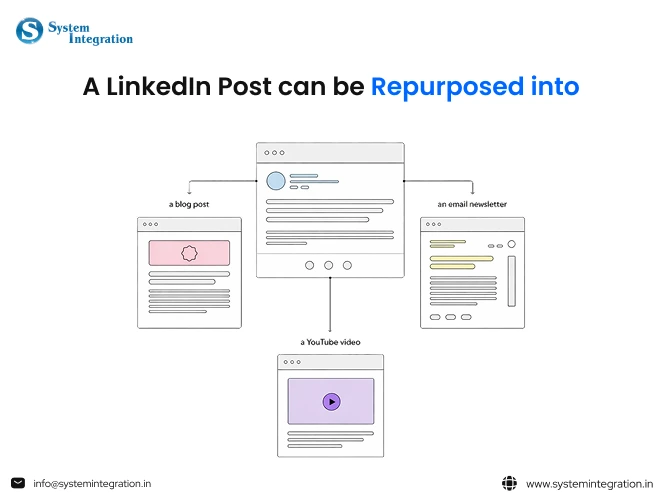
For instance, you can even repurpose one of your blog posts into various social media posts or a video.
Why AI Automation is The Missing Link?
Let’s understand how AI automation plays a major part in a content repurposing strategy. AI-powered content repurposing can look something like this:
✅ Ideation: It includes the process of brainstorming the idea of creating an engaging piece of content into something new.
✅ Automation: AI tools automatically convert your existing content into new content for other platforms.
✅ Adaptation: now it’s time to change the tone of content that perfectly suits various channels.
✅ Translation: for a more personalized experience, changing the content into different languages.
✅ Summarization: as the name suggests, providing a short summary of long formate.
✅ Content Generation: as per your instructions, it can generate a fresh piece of content as needed.
Before You get Started
Know Your Requirements
➾ Define your “core goal” clearly. Are you repurposing for reach, engagement, SEO, or lead generation? This clarity will help you choose the right AI workflow and tools from day one.
➾ List the tasks you want AI to automate for you, such as summarization, altering the format of your content, tone adjustment, or scheduling, to avoid hassle in the system.
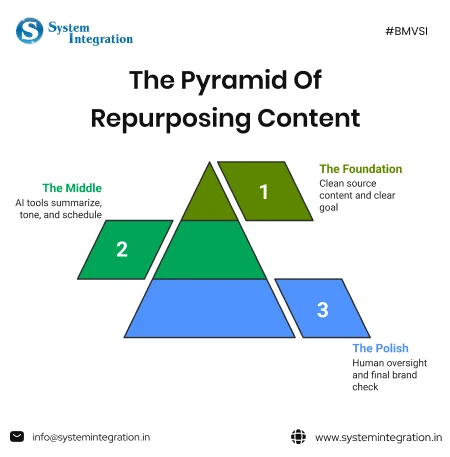
➾ Ensure you have a clean, “well-structured” source of content, because actually, the most intelligent AI will also blunder with chaotic inputs.
| Is Your Business Ready For Content Repurposing? Goal clearity ⭐⭐⭐ Content quality ⭐⭐⭐ Automation readiness ⭐⭐⭐ Review process ⭐⭐⭐ |
Understand Its Limitations and Considerations
➾ AI speeds up repurposing, but it nevertheless requires human oversight for brand voice, precision, and context-sensitive content.
➾ You have to be mindful of “platform guidelines”, data privacy, and over-automation, as unchecked AI outputs can hurt your business credibility instead of scaling it.
Workflow of an AI Content Repurposing System
Step 1: Ingestion and analysis of the content
- The AI system consumes your “pillar content” which could be blogs, videos, podcasts, whitepapers, or webinars.
- AI tool will then begin a read-through of your content through data visualization process to “get” the topic, intent, tone, structure and major insights.
- Your content’s headlines, statistics quotes and CTA’s are automatically extracted.
Step 2: The Division of Content & the Extraction of Insights
- The text is then separated into logical parts and sub-parts by AI.
- Extracts essential data from your content, subpoints, FAQs, and other data points better suited for repurposing.
- Considers which pieces of your content could fit in perfectly for short-form vs longform formats.
Step 3: Transforming the Format and Mapping it to a given Platform
- All your content is repurposed into a platform-specific ones:
-
- Social media posts, threads, and carousels
- Short-form videos, “reels”, and captions
- Email newsletters and blog summaries
- “Infographics” and visual content
- AI then moderates length, tone, and type depending on specific platform requirements.
Step 4: Optimization & Personalization
- SEO work including keywords, meta titles & description and internal links.
- Platforms specific customization of content using different hashtags, emojis, and changing the structure.
- Customization based on your “customer”, industry, and buyer stage.
Step 5: Evaluation, Scheduling & Learning of Performance
- Your brand voice, accuracy, and compliance can be maintained with oversight by the human eye.
- Then your content is scheduled and posted across “multiple channels” using automation tools.
- AI has access to engagement metrics and learns from what works to do better with the next piece of repurposing.

Real Life Examples of Content Repurposing
1) Transforming the written content into audio
This is one of the most repurposed forms of content, as readers find it very time consuming to read a whole piece of content. Creators are now using various automation tools to convert their written content into audio to make it quicker for them as they can listen to audio while also doing other stuffs.
2) Turn your long video into an audio podcast
This one’s a pretty popular use case. As users are now habituated to watch short-form videos on reels and YouTube shorts, they can sit and watch long form of video at one go.
Thus, businesses and creators have come up with a solution and are repurposing their long form video into audio podcasts. This way, users can listen to their favourite podcast while also doing their routine stuff.
3) Turn your social media posts into LinkedIn and vice versa
LinkedIn’s professional audiences are different from other social media platforms. Thus, in this use case, repusposing tool helps you to revamp your existing and good performing content on one platform for another one with the same intent and meaning.
This way, you can also increase the reach and save your time instead of creating a whole new piece of content, which could consume a lot of time.
How we can help you get Started with your Own Content Repurposing System
BMV System Integration is best AI software development company that gives you the opportunity to reuse your content with a custom AI based content repurposing system that’s built for your brand, audience and growth objectives. While the rest of the internet provides generic-looking dashboards or tool sets, we create a platform that seamlessly integrates with your already software and where only your best content is being published on all platforms.
We help you integrate various AI models, and our expert n8n developers help you create your workflow automation, and human-in-the-loop review to build a scalable repurposing engine from strategy to automation. The result is quicker content creation, robust brand soundness and increased performance – all without adding more work to your plate.
How BMVSI Supports in Creating your own Tailored AI content Repurposing Tool
- Design AI-based workflows for automatically extracting, transforming and deploying content
- Create brand voice and tone-specific outputs for platforms
- Integrate with your CMS, social platforms and analytics systems
- Audit your content and determine which of the higher-ROI pillar assets you already have.
- Iterate the system with additional performance findings and feedback
- We help you integrate various AI models, to automate content repurposing workflow.
Future of Content Repurposing with Agentic AI
➟ Agentic AI will independently self-plan, execute, and improve content repurposing workflows with few human intervention.
➟ Content repositories move from static reuse to goal-based repurposing in support of traffic, leads and revenue targets.
➟ AI agents will flexibly optimize content on the fly by taking into account current platform trends, audience interactions and performance feedback.
➟ Repurposed content will be extremely personalized to industries, personas,m and stages of the buyer journey.
➟ Iterative learning loops will enable AI agents to continually refine tone, formats and timing with each campaign.
Summarising Words
Creating engaging content for multiple platform audiences will always need creativity and strategic thinking. But this task is now made easy with useful AI automation content repurposing system that will make your best ideas work harder, scale farther, and appear everywhere without exhausting your team or your creativity.
With BMV System Integration, you can now automate your content repurposing process and produce engaging piece of content for multiple platforms and also help your team to do more of a creative and strategic work instead of rewritting the same content.
FAQs
Every 2 or 3 months, perform analysis of your existing content on all the platforms to identify your best and low performing content. Later, update the content you want to as per the requirements.
- Check the traffic driven by each repurposed content
- Engagement rates compared to the original content
- View the conversion rates if its applicable
- Time and cost you saved by repurposing
To repurpose content means to take piece of your existing content[like blogs or social media post or video and more] and rework on it as required and repurposing it into new content with AI tools for various platforms you want to upload it.
You can repurpose almost any sort of content, which incorporates:
- Blog article
- E-books and whitepapers
- Social media post
- YouTube videos
- Webinars
- Podcasts
- Infographics and images
- Templates