Introduction
Digital advertising didn’t become intelligent overnight.
What we see today, platforms that automatically adjust bids, creatives, audiences, and budgets in real time, is the result of years of experimentation, mistakes, and gradual evolution. The journey from manual experiments to self-optimizing systems tells a deeper story about how ad optimization matured from guesswork into data-driven intelligence.
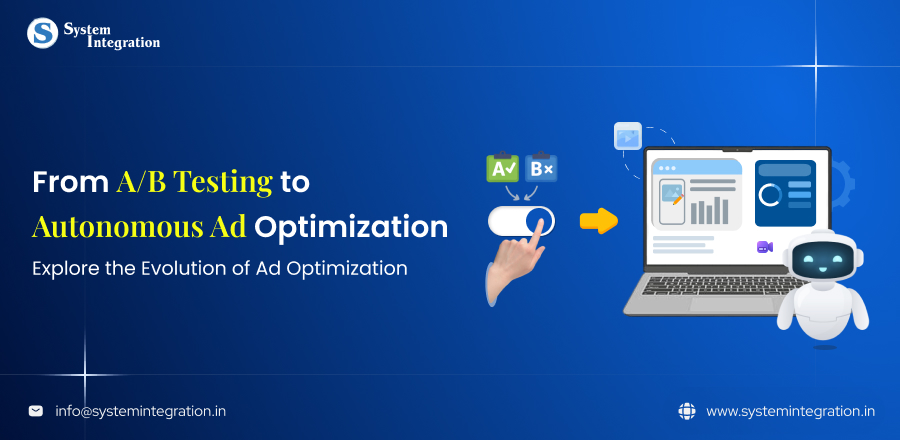
This blog walks through that evolution from understanding what is A/B testing, to scaling with ad automation, and finally arriving at autonomous ad optimization systems that continuously learn and improve without constant human intervention.
The Early Days: When Ad Optimization Was Mostly Instinct
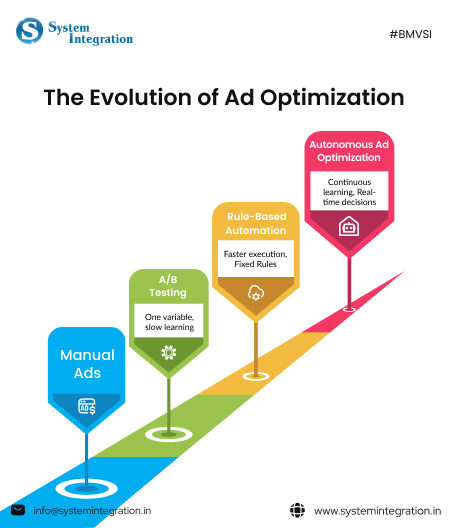
Before dashboards, machine learning models, and predictive algorithms, ad optimization relied heavily on human judgment.
Marketers would:
✓ Write multiple ad copies based on intuition
✓ Choose targeting options based on assumptions
✓ Adjust budgets after campaigns had already underperformed
Optimization cycles were slow. Decisions were reactive, not proactive. A campaign could waste weeks (and budgets) before anyone realized what was actually working.
This limitation led to the first structured approach to improving performance: A/B testing.
- A Simple Real-World Example
A SaaS company running Google Ads tests two headlines:
Ad A: “Automate Your Sales Process”
Ad B: “Reduce Sales Effort by 40% Using Automation”After 10,000 impressions:Ad A CTR: 1.9%
Ad B CTR: 3.1%The conclusion is clear: Ad B resonates more strongly. The winning variant becomes the new control.
This was revolutionary.
For the first time, ad optimization had a measurable, scientific foundation.
The Limitation of Traditional A/B Testing
While A/B testing improved decision-making, it came with constraints that became more visible as advertising scaled.
- It Was Time-Consuming
Running statistically significant tests required thousands of impressions. For smaller budgets, tests could take weeks, sometimes months, to reach meaningful conclusions.
- It Tested One Variable at a Time
Classic A/B testing focuses on isolating a single variable. But real campaigns involve multiple interacting elements: Audience, Creative, Placement, Bid strategy, Time of day. Testing all combinations manually was nearly impossible.
- It Was Still Human-Driven
Humans decided:- What to test
- When to stop a test
- Which variant to scale
As ad platforms grew more complex, human-led optimization started becoming a bottleneck.
This gap paved the way for ad automation.
The Rise of Ad Automation: Scaling Beyond Manual Control
Ad automation introduced systems that could handle repetitive optimization tasks faster and more consistently than humans.
Instead of manually adjusting campaigns, marketers began using rules, scripts, and platform-native automation.
⟫ What Ad Automation Looks Like in Practice?
- Automatically pausing ads with CTR below 1%
- Increasing budgets for campaigns with CPA under target
- Adjusting bids based on device, location, or time
- Rotating creatives dynamically
Platforms like Google Ads and Meta Ads accelerated this shift.
By 2023, Google reported that campaigns using automated bidding strategies delivered up to 20% better conversion value at similar CPA compared to manual bidding.
Ad automation transformed ad optimization from a daily manual task into a system-driven process. But automation still followed predefined rules. It didn’t truly think.
Why Automation Alone Wasn’t Enough?
Rule-based automation is powerful but rigid.
It can:
✅ Execute instructions efficiently
✅ Respond to predefined thresholds
But it cannot:
❌ Understand new patterns without guidance
❌ Adapt to changing user behavior automatically
❌ Optimize across thousands of micro-signals simultaneously
For example, a rule might increase the budget if CPA drops below ₹500, but it won’t understand why the CPA dropped, or whether the trend will hold tomorrow.
As ad ecosystems became more dynamic, platforms needed systems that could learn continuously.
That’s where autonomous ad optimization entered the picture.
From Testing to Learning: The Shift Toward Autonomous Ad Optimization
Autonomous ad optimization moves beyond testing and rules.
Instead of asking:
| “Which version performs better?”
The system asks:
| “What combination of creative, audience, bid, and timing will maximize results right now?”
It uses machine learning models trained on massive datasets to predict outcomes before they happen.
How Autonomous Ad Optimization Works
Autonomous systems analyze:
- User intent signals
- Historical performance
- Real-time behavior patterns
- Contextual factors (device, time, location)
Then they continuously:
✅Adjust bids
✅Allocate budgets
✅Swap creatives
✅Expand or narrow audiences
✅All without waiting for a test to end.
Real examples of Autonomous Ad Optimization in Action
Example 1: Google Performance Max Campaigns
Google’s Performance Max campaigns use autonomous optimization across Search, Display, YouTube, Discover, and Gmail.
Advertisers provide:
- Assets (headlines, images, videos)
- Conversion goals
The system handles everything else.
According to Google, advertisers see an average 18–25% uplift in conversions after switching from standard campaigns to Performance Max, without increasing CPA.
This isn’t A/B testing in the traditional sense, it’s continuous learning.
Example 2: Meta’s Advantage+ Shopping Campaigns
Meta’s Advantage+ uses AI-driven ad optimization to:
- Test thousands of creative and audience combinations automatically
- Shift spend toward high-performing segments in real time
Brands like Shopify merchants and D2C companies have reported:
- 15–30% lower cost per purchase
- Faster creative fatigue detection
- No manual split tests required.
What Happened to A/B Testing?
A/B testing didn’t disappear. It evolved.
Today, what is A/B testing means something broader:
- It’s embedded inside algorithms]
- It runs continuously at scale
- It tests micro-variations humans can’t manually manage
Instead of two versions, autonomous systems might test:
- 50 headlines
- 20 images
- Multiple audience clusters
All simultaneously.
Human marketers no longer manage tests, they design systems that learn.
How This Evolution Connects to Real-World AI Automation
This shift from A/B testing to autonomous ad optimization is not theoretical, it’s already being applied through modern AI automation and AI integration services.
At System Integration, this evolution shows up in how ad data, user behavior, and workflows are connected end-to-end:
- AI Automation Services help businesses move beyond manual campaign tweaks by automating decision-making across ads, CRM, analytics, and lead handling. When ad optimization becomes autonomous, automation ensures every conversion is acted upon instantly not hours or days later.
- AI Integration Services play a critical role in connecting ad platforms with internal systems like CRMs, ERPs, and analytics tools. Autonomous ad optimization only works when data flows seamlessly between platforms.
This approach turns ad optimization into a closed-loop system where learning, execution, and improvement happen continuously.
Real Automation Case Studies That Support Autonomous Optimization
The impact of intelligent ad optimization becomes far more visible when paired with workflow automation:
- In one project, a smart lead capture automation using n8n ensured that high-intent leads generated from optimized ad campaigns were instantly validated, enriched, and routed—reducing lead leakage and response time dramatically.
- Another AI-driven workflow focused on automated file sorting and classification, enabling faster campaign analysis and reporting once ad data started flowing in at scale. This reduced operational overhead and improved optimization feedback loops.
Together, these implementations show how autonomous ad optimization delivers its full value only when supported by intelligent automation across the business.
In Nutshell: From Experiments to Intelligence
The journey from A/B testing to autonomous ad optimization reflects the maturity of digital advertising.
- A/B testing gave us structure
- Ad automation gave us scale
- Autonomous ad optimization gives us adaptability
The future of advertising isn’t about choosing between human creativity and machine intelligence.
It’s about building systems where both amplify each other.
And for brands that embrace this shift early, ad optimization stops being a struggle and starts becoming a competitive advantage.
FAQs
A/B testing is a method of comparing two versions of an ad element, such as headlines, creatives, or landing pages, to determine which performs better based on a defined metric like CTR or conversions.
Yes, but it has evolved. Today, A/B testing is often embedded within AI-driven systems that test multiple variations simultaneously and continuously.
Ad automation uses predefined rules or AI-driven logic to manage bids, budgets, creatives, and targeting automatically reducing manual effort and improving consistency.
Ad automation follows rules. Autonomous ad optimization learns from data, predicts outcomes, and adapts strategies in real time without human input.
Platforms like Google Ads (Performance Max) and Meta Ads (Advantage+) use machine learning to optimize campaigns across audiences, creatives, and placements automatically.
No. It replaces repetitive execution, not strategy. Marketers still define goals, brand messaging, and creative direction.
AI automation connects ad platforms with CRMs, analytics, and workflows ensuring every optimized conversion is captured, enriched, and acted upon instantly.
When campaign scale increases, data volume grows, and manual testing becomes slow or inefficient autonomous optimization delivers better results faster.