
Introduction
You’ve read those articles before, poorly formatted and stuffed full of keywords, managing to say a lot… but nothing at the same time. They are out there, but they do not rank.
As AI tools have gotten faster and smarter, Google’s algorithm has changed right along with them. Today, the question isn’t about who wrote what, human or machine, but how it was written.
Content that combines AI efficiency with human understanding, context, and experience always rises to the top of search queries because it’s actually useful to readers as opposed to just crawlers.
This blog will further explore why human guided AI content ranks higher on Google, how it adheres to Google’s E-E-A-T principles, and why the future of SEO won’t be “AI vs. humans,” but rather AI collaborating with humans to produce content that truly deserves to rank.
What Is Human Guided AI Content?
AI guided human content is a balanced approach where the AI integrated models does its job with speed and structure of the content, and humans do their job on infusing the content with strategy, context, creativity, editing, and accuracy.
This helps in maintaining the brand voice, depth to meet the quality of the content, and also connects with audiences. It’s AI efficiency + human knowledge, working together, for creating high-quality search friendly content.
Difference Between Content Approaches
| Fully AI-generated content | Human guided AI content | Fully human-written content |
|---|---|---|
| 100% AI content with little or no human input. It’s fast and scalable but can lack originality, depth and real world insight, as well as it often sounds generic and not a formula for sustained Google rankings. | AI contributes to research, outlines, structuring or optimization and humans draft, edit, refine, fact check, contribute expertise and align with user intent. This is relevance, trust, and value, the combo that Google likes. | Written end-to-end by humans. It affords strong originality and voice but is time-consuming and difficult to consistently scale, especially for large content strategies. |
How Human-Guided AI Content Functions in the Real World
In the real world, generative AI like chatbots are utilized for brainstorming, keyword clustering, outlines, and even drafts. That’s where humans come in to craft the story, drafting with examples and experiences, optimizing content for search intent, ensuring accuracy, and sprinkling on a brand voice. The end product is content that’s efficient, useful for readers, and search-optimized for ranking.
What Google Really Thinks About AI Content?

Google has made its stance clear: it’s not about how your content is created, it’s about how it helps readers and what it is.
In other words, Google doesn’t care about how the content is created, like “human written” or “AI written.”
E-E-A-T Still Rules the Rankings
Google’s EEAT framework (experience, expertise, Authoritativeness, and trustworthiness) is still the gold standard.
⤷ Experience: Have you actually done before what you are writing about?
⤷ Expertise: Do you demonstrate subject matter knowledge?
⤷ Authoritativeness: Are you a trusted voice in your space?
⤷ Trustworthiness: Can readers rely on what you publish?
| Common Myths About AI Content And Google Ranking 👉 “Google panalize all AI content” 👉 “AI content is naturally low quality” 👉 “using AI for content is against Google guidline” 👉 “AI will completely replace human writers” |
Raw AI output often struggles here. It can sound so confident while being completely wrong and having no idea about what output it has generated.
But with human editing, fact checking and your personal voice, AI assisted writing can hit all four corners.
The Real Question: Why Pure AI Content Fails to Rank
Everyone‘s using AI to write content, but 90% of that content never ranks.
The reason?
It’s because most people use AI like a shortcut and don’t use it properly as a tool. And that’s why their content dies before it even reaches page one.
Furthermore, here are key reasons why Pure AI content fails to rank:
➣ Reason 1: lack of experience in E-E-A-T
AI models are trained on existing data, meaning they cannot draw upon unique, frist hand experiences, or proprietary, real world testing.
When comparing two products or detailing a personal journey, AI produces a generic summary of what is already online.
➣ Reason 2: low information density and fluff
AI often produces “thin” content, which means it uses many words to say very little, repeating the same points in different ways to meet a word count goal.
This results in high bounce rates and low time on page, signaling to Google that the content is not useful.
➣ Reason 3: lack of unique value and Hook
Because AI agents predicts the most statistically likely next word, it rarely provides a fresh angle, a bold opinion, or a unique insight.
In a crowded search engine results page(SERP), content must be different and valuable to stand out. Pure AI content often blends into the crowd.
➣ Reason 4: factually inaccurate and hallucinations
AI can generate information that sounds highly confident but is entirely inaccurate(hallucinations). It sometimes generates misinformation.
This can be dangerous if the topic is sensitive, such as money, life, health, or finance. And also leads to de-indexing and low rankings.
➣ Reason 5: Poor understanding of search intent
AI often focuses on matching keywords rather than understanding the true intent behind a user’s search query.
An article might be perfectly optimized for a keyword, but it fails to answer the user’s specific question, leading to a poor user experience.
Why Human Guided AI Content is “Good” in Google’s Eyes?
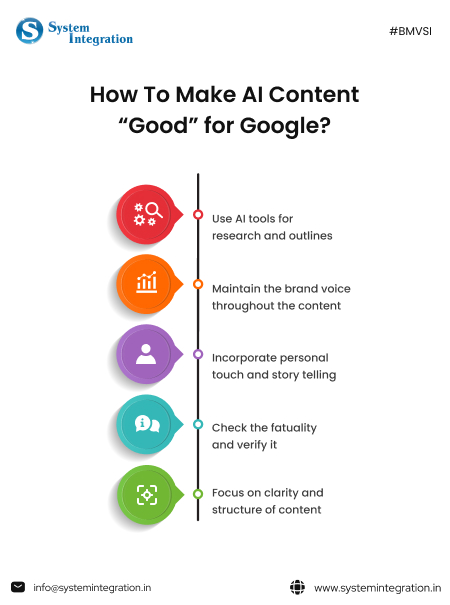
Better-performing human guided ai for content creation is better because it’s created for actual people and not just algorithms. AI can predict patterns, but humans know why people search and this enables a measurable performance difference in SEO.
- Improved keywords and topic targeting: AI integrated tools identifies relevant keywords, helps with semantic clustering, and ensures content aligns with search intent, enhancing visibility.
- Enhanced Engagement through natural language and storytelling: Human maintains conversational flow, storytelling and examples to make content more interesting and readable as something Google is putting more value on.
- Better E-E-A-T: Human inputs adds critical experience, expertise, and unique perspectives AI often lacks, crucial for Google’s quality guidelines.
- Stronger behavioral signals: Well-designed, engaging content results in longer dwell times, lower bounce rates, and higher CTRs all of which are strong signals to Google that the content has value and should rank well.
How Human Guided AI Content Wins The SEO Game
Intent driven content creation: Human feedback ensures drafts created by the AI actually reflect search intent, rather than keywords only.
SEO focused optimization: Human expertise adds experience, keywords placements, authority and trust that Google considers for it’s rankings.
Natural language tone: human refinement their tone, storytelling and readability are all enhance user experience by increasing the readability with the sound of a human voice.
Use AI for research and structure: use AI find the topics, does a detailed online research, cluster keywords and structure it as per the topic and in reader friendly manner.
Originality and Depth: humans add unique perspectives, first hand experience and the originality in analysis that AI can’t replace.
The Future Is Hybride Content Creation
As the search evolves, and AI tools have gotten faster and smarter, Google’s algorithm has changed right along with them. Today, the question isn’t about who wrote what, human or machine, but how it was written.
For ranking better in the search engine of Google, depending on online AI tools is not very great option. Create your own custom AI tool by collaborating with the best AI automation company in india and increase your content ceration efficiency.
FAQs
Copy writers always struggles to write outlines and take more time. However, with the help of AI tools you can just place the keywords or the title and all the related details accurately and get the proper outlines withing a few seconds.
No, it can’t replace content writers as Google has clearly stated that AI content as being target of web spam team. Writing content through AI without human review and originality touch can be very risky for your website.
Google’s stance on AI content is clear: quality and authenticity outweigh automation. While various AI tools can speed up the content creation process, Google still spams fully automated content.
As long as it is useful, original, and user centric, AI generated content is good for SEO. Google does not pay much attention on how the content is created but the originality and the quality of it.
The best way to ensure that the AI content is SEO friendly is to read it thoroughly and check if its accurate, and refine it if necessary and follow all the SEO guidelines and insert the Keywords related to the topic.