

Introduction
If AI were a brain, chips are the coffee that keeps it awake, and in 2026, AI chip and its uses have grown. From data centers gorging on GPU’s to edge devices quietly flexing their neural muscles, the AI chip market is surging faster than ever before.
The global AI chip market will reach an inflection point in 2026, reflecting growth from escalating equipment sales, aggressive regional investments and a need for faster, more power-efficient computing. This blog will delve into how the market is growing, where it’s coming from, and what forecast data tells us about where AI chip market is going next.
Global AI Chip Market Overview
First of all, let’s understand that, What Are AI Chips? And its basic concept.
AI chips are application-specific processors optimized to accelerate AI workloads, particularly those associated with ML large scale computing, which is intensive.
AI chips are not general purpose processors; they are wired for advanced processing, and that means decisions can be made quickly without much latency.
AI chips are in charge of key functions such as perception, sensor fusion and path planning, processing data from cameras, sensors and radar on the fly inside autonomous vehicles.
The AI chip market is experiencing rapid expansion, fueled by its high demand in various industries.
This growth is driven by its massive data needs, cloud computing, edge AI, and applications in various sectors. In fact, in 2023, North America dominated the market with a revenue share of 43.8% according to the grandviewresearch.
In only the first quarter of 2025, the market witnessed over $2 billion raised as multiple big and small companies invested in various AI chip technologies.
This rising adoption of AI backed softwares and devices across various industries has led to exponential growth in demand for AI chips globally.
Key Factors That Are Reshaping AI Chip’s Competitive Landscape in 2026
Here are some key factors that are reshaping the AI chip’s competitive landscape in 2026.
Here are those key factors:
→ Rise of Generative AI & Large Models
Generative AI applications and large language models need training procedures and serving that involve significant amounts of compute power. This growth has skyrocketed demand for high-performance accelerators and domain-specific AI silicon optimized for these workloads.
→ Enterprise & Data Center AI Uptake
Enterprises in all industries are deploying AI automation, analytics, customer experience and decision support running on high-performance data centers equipped with AI accelerators. This long-lasting investment path is a fundamental market driver.
→ AI Expansion
AI is spreading from data centers to billions of devices such as smartphones, IoT sensors, automotive sectors, robots and AR/VR goggles. NPUs and small ASICs enable real time updates.
| why AI is Accelerating Rapidly❓ ✔️ Ultra-low latency decisions ✔️ Privacy-first AI processing ✔️ Energy-efficient intelligence ✔️ Offline AI capabilities ✔️ Scalable ecosystems |
→ Competitive Innovation & Ecosystem Investments
More is better: Startups and legacy players alike are racing into new chip architectures (neuromorphic, photonic, in-memory compute), backed by billions of dollars in funding that create a more crowded competitive field.
AI Chip market size and Forecast data in 2026
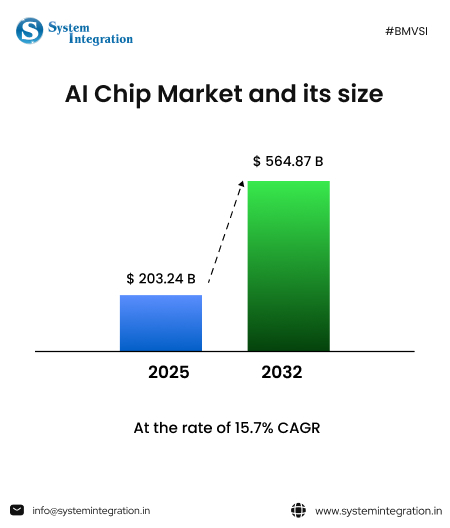
The AI chip market is experiencing rapid expansion, driven by increasing demand for high-performance computing in various applications. As we can see in the above figure, the forecast for the AI chip is consistently strong.
2025 market size is USD 203.24 billion
It is approximately projected to hit USD 55.28 billion by the end of 2026.
In the long term, the market is expected to grow at a compound annual growth rate of 15.7% and hit USD 564.87 billion by 2032.
Regional AI Chip Market Analysis

⇒ North America is the largest AI chip market.
⇒ Asia Pacific regions are the fastest-growing market.
⇒ China, India, and Brazil are among the emerging countries in the AI chip market.
⇒ future outlook
- The investments have increased in sectors like specialized AI automation, lower latency designs, and robust AI architectures feuling the market growth and rapid expansion.
- High-performance GPUs, AI accelerators, and specialized processors enable machine learning and deep learning across datasets for better accuracy in autonomous systems globally.
- Accelerating the neural networks for fast inference, as CPUs and even GPUs enable the rapid responses essential for safety, like applying breaks adaptive crucial control in no time.
Competitive Landscape and Top Market Players
⇒ NVIDIA is the top market player
⇒ Other top players include
– Intel
– AMD
– Qualcomm
– MediaTek
⇒ competitive edge among the Top 2 players
- NVIDIA is a leading player in the AI chip market, it’s popular and known for its high performance GPUs and AI accelerators, which are capable of managing high level complex tasks of multiple steps. It uses the latest technologies for better performance in low latency, increasing efficiency.
- Intel holds a very strong position in the market by furnishing the robust CPUs, AI accelerators and on-device processing chips. The firm very actively invests in machine learning, AI integration, and its supporting applications, robotics, and various other latest AI technologies, driving more AI adoption.
Trends Shaping the AI Chip in 2026
1) Rising demand in the automotive industry
AI chips are used in autonomous driving, in-vehicle scanner applications , and predictive maintenance. Car manufacturers are increasingly using high performance/low-latency processors that support real-time decision making, safety improvements, and smarter connected vehicle environments.
2) Increasing adoption of smart homes
Smart home products use an AI chip to acknowledge voice recognition, energy efficiency and security monitoring, personalized automation. Processing at the edge is enabling quicker reaction times, better privacy and easier interfacing with connected home ecosystems independent from uninterrupted access to the cloud.
3) Adoption of AI in smartphones and IoT devices
NPUs in Modern Smartphones and IoT Devices. With NPUs, on-device AI software such as image processing, voice assistant services or contextual awareness can be executed more efficiently than by a cloud server, resulting in better performance, longer battery life time and an improved user experience.
4) Automation in various industries
Multiple industries are adopting automation into their daily operations to automate their unproductive or repetitive tasks. This sets them free from repetitive tasks and helps them focus more on the strategic ones.
Investment and growth opportunities in AI chip market
One of the things that makes this market so attractive is its wide demand base. AI chip adoption extends across cloud computing, automotive, healthcare, manufacturing and consumer devices and isn’t reliant on a single sector. This variety, along with a fast pace of innovation, is driving significant investment interest and potential long-term growth.
As AI models become increasingly complex and computationally demanding, conventional systems are no longer sufficient, prompting demand for specialized AI accelerators that can deliver more speed, low latency, and better energy efficiency across markets.
High-Growth Segments to Watch
Datacenter & Cloud AI Accelerators: Hyperscalers and enterprises are training and these giant language models, recommendation engines and computer vision systems. It’s driven explosive demand for GPUs, TPUs and custom AI accelerators designed for training and inference.
AI Chips: AI is becoming one of the largest growing sector. These chips perform AI models directly on, for example, a smartphone, camera, or wearable device (or other industrial sensor or medical equipment). Smart city, IOT, and consumer electronics now require edge chips that are low-power and high-efficiency.
Automotive AI & Autonomous Systems: AI chips are driving ADAS, in-cabin monitoring, predictive maintenance and autonomous driving. With safety-critical standards and multifaceted, long product lifecycles, automotive AI chips are stable, growing, high-value opportunities for chip industry participants and investors alike.
ASICs and NPUs are specialised AI chips: Not all AI workloads can be effectively handled by general-purpose chips. Demand for neural processing units (NPUs) and application-specific integrated circuits (ASICs) designed for tasks like recommendation systems, speech recognition, and vision processing has increased as a result.
AI Chips for Industrial Robotics: AI-driven robot systems are being quickly adopted by factories, warehouses, and logistics hubs. Real-time vision, motion planning, and machine-level decision-making are made possible by AI chips. This sector promises consistent, long-term growth supported by improvements in operational efficiency.
Future outlook in the AI chip market
➟ The demand for AI chips is set to fly as generative AI, autonomous machines and real-time analytics become a vital thing in all businesses.
➟ Power efficient and low latency compute chips will succeed, due to an increase in power costs and sustainability goals.
➟ The chips that power on-device processing, also called edge AI chips, will flood the market as more intelligence moves away from the cloud and into devices.
➟ Custom AI accelerators and domain-specific chips win out over general‐purpose processors for growth.
➟ Automotive sector, robotics and industrial automation will be significant longer term sources of revenue.
➟ The space will be dominated by alliances between chipmakers, cloud service providers and AI software development company.
Wrapping up thoughts on AI chip market
The AI chip market is fueled by tremendous demand for generative AI, edge computing, and industry specific accelerators. Innovation is no longer only about raw performance, it’s about energy efficiency, scale, and tightly integrated hardware and software ecosystems that can allow for real-time intelligence at scale.
Enterprises will be judged on how they balance performance, price and sustainability as investment in AI grows and competition strengthens. Looking ahead, regardless of data centers or self-driving cars, AI chips will continue to be one of the key drivers behind global digital transformation.
FAQs
The growth is being driven by various elements like by increasing adoption of generative AI, growth of data centers, AI powered edge devices, autonomous vehicles and greater enterprise AI investment globally.
Here are the top trends to look out for:
- Growth of energy-efficient AI accelerators
- Increasing need for AI chips
- Increased use of custom AI softwares
- Expansion of AI data centers
- Heavy adoption of AI chips in automotives
GPUs, AI units drivers and application-specific integrated circuits (ASICs) are expected to account for the largest share of sales by type because of demand for cloud computing and AI model training.
North America and Asia-Pacific will be the frontrunners, thanks to advanced semiconductor manufacturing and AI adoption in countries like the U.S., China, Taiwan, South Korea, and India.