
Introduction
Self driving cars are built not just on sensors and software, their core intelligence is rooted into AI chips. Plus, any delay in the decision and estimation can result in danger, making it very compulsory that its accurate and takes decision on time.
In addition, AI chips are not general purpose processors, they are wired for advanced processing, and that means decisions can be made quickly without much latency. This is still the technical challenge in autonomous vehicles.
All of which pales beside the safety issue. AI chips need to adhere to strict automotive safety standards, and provide support for fault tolerance and deterministic behavior in critical situations. This blog discusses how latency, power and safety requirements are influencing the design and choice of AI chips in autonomous vehicles.
What is an AI chip?
An AI chip, or artificial intelligence chip, is a microprocessor designed for fast processing of complex calculations, including acceleration of machine learning algorithms and accelerating artificial neural networks. AI chips are not general-purpose processors, they are wired for advanced processing, and that means decisions can be made quickly without much latency.
AI chips are in charge of key functions such as perception, sensor fusion and path planning processing data from cameras, sensors and radar on the fly inside autonomous vehicles. Their proper functioning is important for automotive industry businesses’ safety, energy consumption and response attribution.
Types of AI chips
Central processing unit: System control, logic execution and a link between vehicle subsystems.
Graphics processing units: Speeds up parallel AI workloads like image recognition and sensor data processing.
Tensor processing units: improves power efficiency and provides fast neural network inference.
Neutral processing units: Provides on device, low power AI processing for edge intelligence.
Field programmable gate arrays: Provides real-time, customisable processing for automotive systems that are crucial to safety.
Application specific integrated circuit: Offers production grade autonomous platforms optimal performance and efficiency.
Key Function of AI Chip In Self Driving Cars
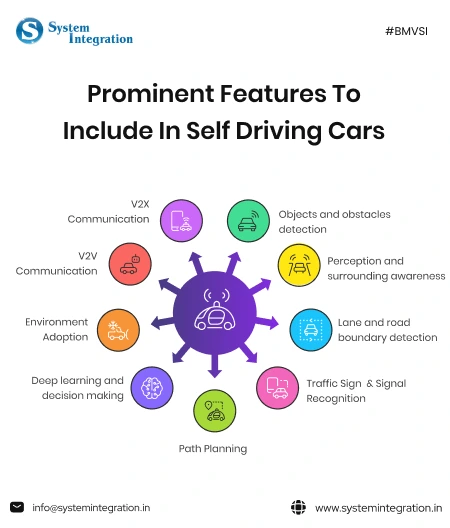
The implementation of AI software in autonomous vehicles are opening the various possibilities for AI applications across different industries. The capabilities of AI are enhancing the safety, accuracy, and productivity.
AI can be considered as the brain of the autonomous vehicle, providing the immense processing power needed to interpret sensor data in real time for perception, prediction and decision making. Furthermore, here are the key roles of AI chips in autonomous vehicles.
→ AI chip incorporate transistors
It includes a large number of smaller, faster and more efficient transistors. This allows them to perform more computations per unit of energy, resulting in faster processing speeds and lower energy consumption.
→ object recognition and prediction
It uses the deep learning to recognize objects and predict its movement as it is very vital for avoiding the colliding of that object and also for understanding the complex traffic scenarios.
→ sensing and perception
Fusing the data from the multiple sources to build a comprehensive understanding of the whole environment like knowing the vehicles around, pedestrians and more.
→ decision making and path planning
AI chips are crucial for decision making as it catches the surrounding environment data for scanning and understanding the objects near it or the path it has to drive on via maps.
→ low latency processing
Accelerating the neutral networks for fast inference, as CPUs and even GPUs enable the rapid responses essential for safety like applying breaks adaptive crucial control in no time.

Real Life Examples Of AI Chips In Autonomous Vehicles
Tesla Autopilot
Source: Tesla
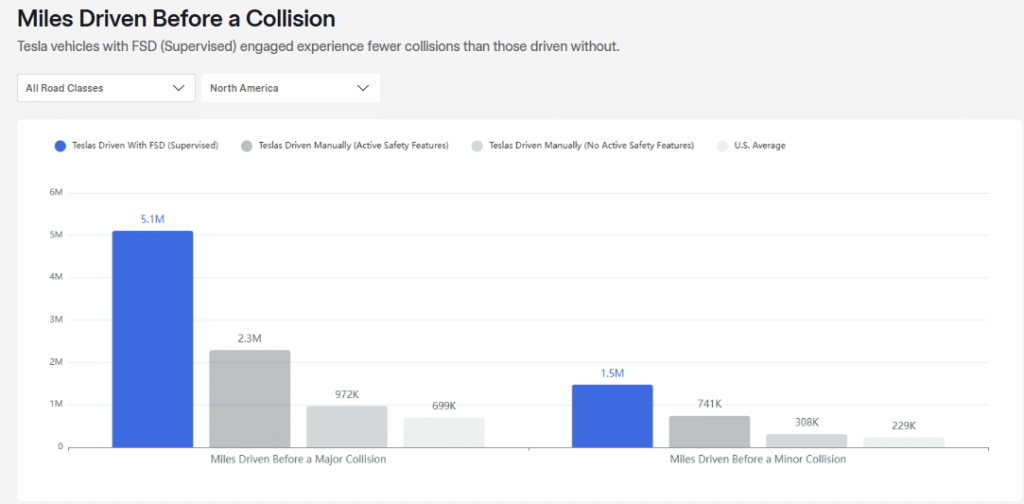
Who doesn’t know Tesla, one of the most trusted autonomous vehicles companies in the market globally. The above statistics show that FSD(full self-driving) engaged expriecned fewer collisions as compared to those driven without.
This is because it uses advanced algorithms to make highly accurate decisions and to maintain control over the vehicle. It has the custom AI chip, which is trained to make all the real time driving decisions for safe and smooth driving.
Waymo
Google’s Waymo is one of the most known autonomous vehicles technology AI chip and all credit goes to its AI backed systems. It is proficient in handling complicated route planning. Plus, with the help of AI its sensors scans 360 degrees of view and also processes the data all by itself and furnishes the smooth and safe ride to customers.
NVIDIA
NVIDIA’s AI chips help the car to make all the accurate driving decisions by scanning the real time surrounding data. Its Drive platform serves as a prime example of how advanced AI can be integrated into self driving car systems, setting a benchmark for innovation.
Mahindra’s EV
Mahindra’s latest SUV models offer an automatic driving mode option, however, the driver still needs to be in the driving seat. In this mode, the car can fully drive by itself by detecting the path and the obstacles and observing the lanes and other objects in its way. However, it is also shifted to fully manual mode for the driver’s convenience.
Safety Requirements For AI Chips In Autonomous Vehicles
1) safety of the sensitive data from cybersecurity
There’s a huge amount of data processing required for the training purpose of the AI models to perform better for riders convenience. Due to this reason, there are high chances of cyber attack. Apply robust security for the safety of all types of data. Also keep the technology updated regularly so that it helps in reducing the chances of cyber attack.
2) training and updating the AI models
It’s very vital to keep the AI medals updated in order for them to perform well without any errors. It is also crucial for the reliability and the relevance as it teaches the models the deep learning algorithms that help in identifying the surrounding environments properly and to make decisions.
3) performing the on road testing
After the AI model is ready and launched into the market it is vital to perform the road testing for the surety and safety of the riders. And keep in mind that when you are performing on road testing for the first time, do it with highly trained safety professionals and under continuous monitoring and vehicle behaviour.
4) follow all safety regulatory guidelines
Safety rules and regulatory guidelines are different for each region and they are made for the safety and security of the humans. Therefore, it is vital to follow all the rules and regulations in whichever region you are working and willing to launch.
5) take care of ethical and accountability issues
The AI system in the autonomous cars are responsible for the safety of humans and to make real time and instant decisions. Therefore, it’s vital to take care of all the ethical issues.
Key Trends To Watch For Future Autonomous Vehicles
- Hyper personalized driving experience: AI self driving vehicles will automatically scan the real time data and predictive models to adapt to riders requirements like ride mode, picking the safe and smooth path as per the destination on the map, music control and much more.
- Advanced decision making: in the near future the AI models will adapt to even more deep learning models and advance its learning patterns to adapt to the customers preferences.
- V2X Communication: the main aim is to improve the road safety and enable them to exchange the information of the real time with each other vehicles, infrastructure, traffic signals, pedestrians, sensors and much more.
- Human and AI collaboration: comprehending the humans and their driving patterns better for the smoother adoptivity of partial manual mode for better convenience before AI and autonomous driving becomes the only mainstream.
Wrapping up words
Self driving cars are built not just on sensors and software, their core intelligence is rooted into AI chips. They are in charge of key functions such as perception, sensor fusion and path planning processing data from cameras, sensors and radar on the fly inside autonomous vehicles.
As autonomous vehicle technology evolves it plays a vital role in reshaping the automotive industry. Being the best AI software development company in India, we are helping many firms for an AI driven future. Let’s connect and elevate your automotive business.
FAQs
Self driving cars are built not just on sensors and software, their core intelligence is rooted into AI chips. They are in charge of key functions such as perception, sensor fusion and path planning processing data from cameras, sensors.
Self learning cars include AL in deep learning, Objects and obstacles detection, Perception and surrounding awareness, and much more to provide convenience to the rides.
Yes, it can prevent accidents with the help of advanced AI chips installed. It can predict any unsafe object or risk in advance by scanning the real time data. Not only that, it can save the car from colliding with any object on the road by detecting it in advance, preventing the damage.
While AI is getting more and more advanced and cars are not getting automated, they’re more likely to assist the human drivers in the coming near future instead of completely replacing them.
Key challenges include handling the real world scenario, and for this it requires massive data for training purposes. Integrating the multi purpose sensors for scanning the surroundings.