Introduction
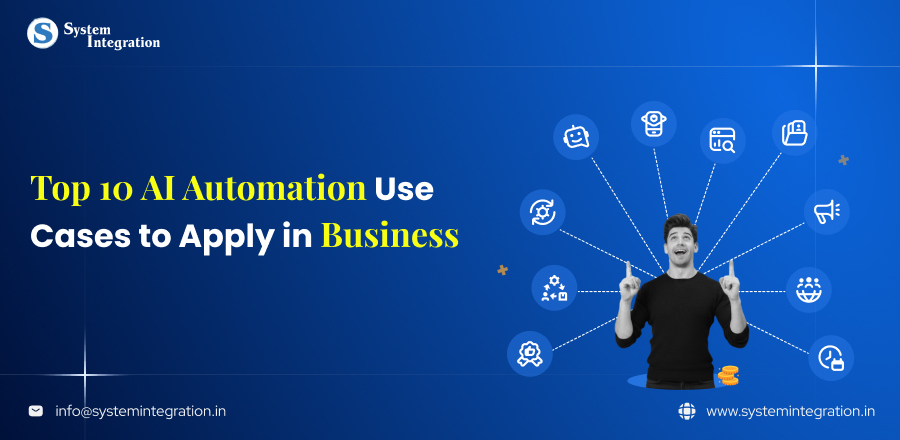
In 2025 &26, AI is automating workflows, making decisions and politely reminding humans to stay in their own lane. Between your third cup of coffee and that fifth status call, AI automation came along and quietly provided efficiency gains while no raise was required, no need for longer lunch breaks.
Businesses of all kinds are no longer casual in automation with their artificial intelligence. They’re increasingly counting on it to reduce costs, expedite operations and retire repetitive tasks that once consumed teams’ time and productivity.
In this blog, we will discuss the top 10 AI automation use cases that saw greater than 30% efficiency improvement in 2025–26 and how to implement them easily into your business.
What is AI Automation?
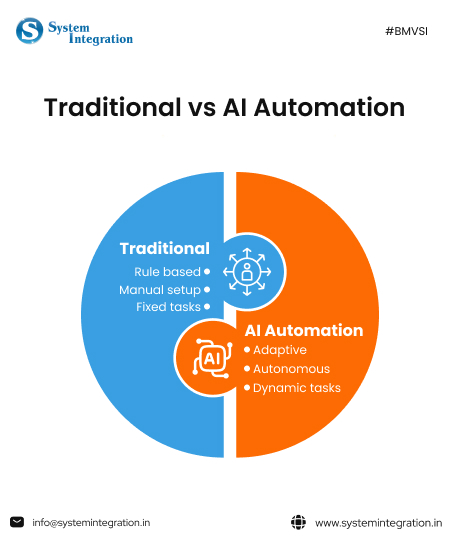
Using AI automation workflow can manage tasks on its own that otherwise requires manual effort. The system automates the whole tasks and does it by itself learning the pattern and the data it is provided.
You can imagine it as an AI assistance that doesn’t require a break and can constantly and also continuous improvement as the data is updated and it processes more data. Here’s a simple breakdown of what AI is capable of doing.
→ it observes: the system scans the history of users and data.
→ it decides: to perform the next step by recognizing patterns of the system.
→ it acts: it sends messages, verify the info and generate leads, creates content, or trigger the action
→ it learns: every cycle improves accuracy over time.
The results?
Work which used to take normally hours to complete, is now done within a few seconds. Therefore, the teams don’t have to do that boring and repetitive tasks and have time to focus on more strategic, creative and productive tasks that needs humans.
These are the factors why more and more companies of all sizes are adopting AI automation.
| Key Advantages of AI For Business Process Automation ✔️ Lower operational cost ✔️ Smarter decision making ✔️ Improved customer satisfaction ✔️ Enhanced security and lower errors ✔️ Better research and data analytics ✔️ Gives competitive edge to business |
How AI Automation Works?
The main objective of AI automation is to combine the traditional system and combine it with the latest technology that can work with a level of intelligence beyond just following fixed rules.
Have a clearer look at the main elements that makes it work smoothly:
1) machine learning: it helps AI tools to learn from historic data. Instead of sticking to the rules, it can take decisions and decide what needs urgent attention.
2) natural language processing: this helps AI systems to understand human language. Due to this, it can respond to users’ query in real time by understanding their language.
3) robotic process automation(RPA) combined with AI: RPA handles all the rule based tasks and when it is integrated with AI, it can also take decisions by its own instead of following the orders.
4) predictive analytics: predictive analytics uses the data it furnishes like current, past and other which is needed for the accurate predictive decision making. With this help it can predict the future demand of customers and also spot the workflow issues before they grow into bigger issues.
Top 10 AI automation use cases that increases business efficiency
1) Intelligent AI chatbot
The use case: AI chatbots respond to the customers in real-time without keeping them waiting – handle queries right away, automate support tickets and capture leads more efficiently which helps customer service get faster, save time all day around including late-night chats.
Best for: e-commerce, retail, banks, healthcare, travel and hospitality
2) Predictive lead scoring
The use case: Predictive lead scoring leverages machine learning to identify and analyze behavior, prioritize high-intent prospects, increase sales productivity, drive more revenue and shorten deal cycles by finding the best-possible leads in marketing and sales databases around the world.
Best for: marketing, B2B businesses, consumer service, financial services
3) Automated invoice processing
The use case: Automatic invoice processing of data extraction verification of invoices Purchase order matching into PDF from users with errors reduction and less processing time and cost cuts for progressive businesses.
Best for: logistic, supply chain, healthcare, finance, retail and e-commerce
4) AI for marketing campaign
The use case: AI driven marketing campaigns make the most of customer data, and personalize messaging across channels in real-time to drive better targeting, engagement and ROI, with automatically generated performance insights on digital spend.
Best for: marketing campaigns, IT companies, Influencers, media and entertainment
5) Supply chain and inventory management
The use case: AI forecasts demand, maximises inventory levels, automates replenishment, minimises stockouts and overstock, enhances supplier planning, lowers logistics costs, and provides real-time visibility across intricate supply networks in multinational corporations.
Best for: manufacturing for raw material, logistics and supply chain, demand forecasting.
6) Human resource and recruitment
The use case: AI helps HR teams make data driven hiring decisions like automated candidate matching more quickly and consistently by screening resumes, matching skills, ranking candidates, automating interview scheduling, lowering hiring bias, improving time-to-hire, and improving workforce planning.
Best for: HR department, financial inquiry department, IT, and Tech
7) Automated portfolio tracker
The use case: AI-powered portfolio trackers keep an eye on assets, evaluate market trends, automatically rebalance investments, control risk, provide real-time alerts, boost returns, and securely assist investors worldwide in making wiser financial decisions.
Best for: Human resource department, Traders, online Crypto trading
8) Real time BMI analysis
The use case: AI-enabled real time BMI analysis systems track health trends, identify risks early, support wellness initiatives, provide instantaneous digital personalised fitness insights, and compute BMI in real time using sensor or image data.
Best for: Healthcare, Clinical diagnostics, Fitness and sports, health insurances
9) AI for personalized recommendations
The use case: The company’s AI personalizes recommendation to users in real-time based on behavior, preferences and context to enhance product, content or service discovery resulting in higher user engagement, conversions, customer satisfaction and long-term brand loyalty for minors on digital platforms worldwide.
Best for: Retail and E-commerce, Financial services, online trading
10) Virtual tour using AR/VR
The use case: Immerse AR/VR-based virtual tours for real-estate, tourism, retail & education deliver mobile or desktop remote exploration with better decision-making and higher sales engagement while it saves companies massive physical visit costs in a corona-ravaged world.
Best for: Real estate, tourism and hospitality, education and training, engineering
Enable Easiest way to Implement AI Automation into your Business
⇒ List out your top tasks you want to automate
Analyse repetitive, time-consuming or error-prone work – across departments Prioritize high-volume, impactful work Set clear goals and objectives with a defined outcome for automation.
⇒ Pick the the right AI tool to automate the task
Choose AI tools that match your use cases, data availability, scale requirements and budget of business objectives, regulatory concerns and long-term operational growth plans.
⇒ Integrate it with your existing system
Integrate the AI solution with third party software, databases and workflows via APIs and middleware to reduce disruption (or data latency), support decision consistency, end-to-end automation while ensuring high quality data.
⇒ Scale your tool by providing relevant data
Provide models with high-quality data on an ongoing basis to further train and adjust AI models over time to be more accurate, flexible, and perform as business scales in operations and automation needs.
⇒ Do regular security checks and updates
Continuously auditing security, monitoring models, and updating systems to help keep data safe and ensure that it complies with regulations while avoiding the vulnerabilities in operating AI automation as efficiently and securely as possible.
Summarizing Words
By 2025–26, AI automation has clearly shifted from experimentation to impact, as they are delivering over 30% efficiency gains across industries in real world use cases. Businesses that used purpose specific, rather than one size fits all solutions were able to work faster, reduce costs and make smarter decisions.
Collaborating with the best AI software development company in India is critical in converting automation plans to measurable outcomes. The companies that take action now while AI is still maturing will maintain a competitive edge in efficiency, innovation, and market positioning.
FAQs
Efficiency increased was highest in manufacturing, healthcare, finance, retail, logistics and customer service, gained the most due to AI automation in 2025-26.
→ Repetitive and rule based processes
→ Data entry and system updates
→ Notifications, approvals, and reporting
→ Customer support and lead handling
Automation is affordable if it is utilized to save manual effort, eliminate errors, and reduce long term operational costs. SMBs can afford the automation as there are various tools which can help in this work.
Through automating manual processes, reducing human errors, and making real-time decisions while leveraging machine learning and predictive analytics to optimize resource utilization.
Yes. A number of AI automation tools are scalable and can be personalized to cater SMB budgets and operations, offering good ROI even on a smaller scale.