Introduction
Agentic AI is that new buzzword everyone’s suddenly talking about, kind of like that one colleague you saw once in a meeting and now seems to appear everywhere. And honestly, why not? The businesses are still using GenAI and enhancing their operations.
But Agentic AI takes this a step further, making decisions, reacting to new conditions and even taking action, all without continuous human oversight (Finally, a member who doesn’t need a follow up email!).
From supply chain systems that react proactively to disruptions, to customer support flows that automatically re route tickets, Agentic AI is changing how enterprises of all stripes operate at each level. This transition is allowing businesses to achieve unparalleled efficiency, to cut operational friction and establish systems that learn, optimise and get better with time.
Further, lets explore in this blog, how Agentic AI is changing the whole business scenario and how it is operated.
What is Agnetic AI?
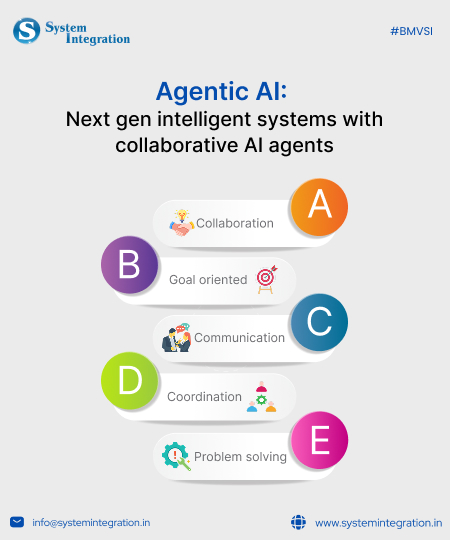
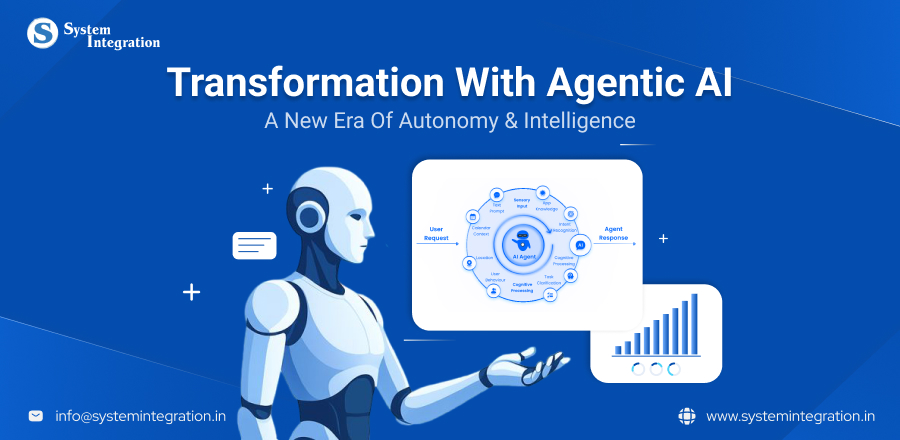
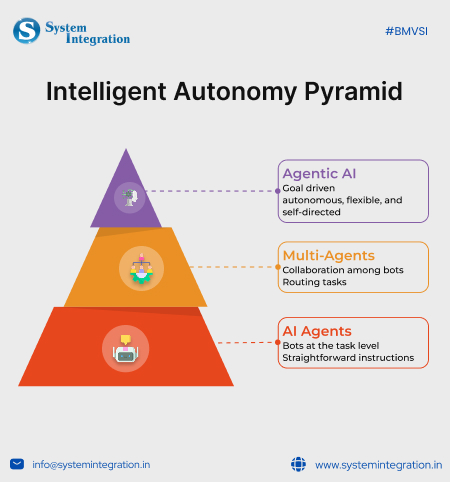
Agentic AI refers to AI systems that can act autonomously, make decisions, and take actions to achieve goals with minimal human intervention. Unlike traditional AI that reacts to input or follows pre defined rules, agentic AI services can plan, adopt, and learn from its environment to handle complex, multi step tasks.
Key Features
- Autonomous execution: it not only recommends actions, they execute them end to end (e.g., find candidates or send proposals).
- Cross functional assistance: across the organization, enforces cohesion and shared data stories.
- Adoptable workflows: created for specific organizations with minimal dev efforts.
- CRM + ATS Integration: integrates with solutions such as salesForce, HubSpot.
Core Difference Between Agentic AI vs AI Agents
| Functionality | Agentic AI | AI Agents |
|---|---|---|
| Autonomy | Fully self governing systems | Semi autonomous |
| Task Complexity | Multiple steps at a time | Single step at a time |
| Learning And Adoption | Autonomous and continuous learning | need manual reconfiguration |
| Proactiveness | Predictive systems and respond | Highly reactive |
| Integration And Scale | Autonomous | Scalable |
Overall, it can be said that the code difference between agentic AI vs AI agents is autonomy and goal complexity. AI agents are tasks focused tools following rules, while agentic AI represents a higher level system with self defined goals, continuous learning for complex outcomes.
How Agentic AI is Reshaping Enterprise Platforms
Automating Multi Step Workflows End to End
One of the drawback in existing enterprise platform is that it is not capable (other than through a human supervision) to navigate complex workflows with multiple steps.
The agentic AI takes this one step further and pretends to be a human who can deal with every process from inception to execution in your ERP, CRM, HR, finance and IT systems.
Agentic AI can:
- Gather, analyze, and interpret applicable data from several sources
- Take decisions intelligently at every step based on context.
- Execute tasks across connected platforms
- Handle exceptions without pausing workflows
- Report results and learn from the results.
Intelligent Decision Making Powered by Context
Enterprise platforms have large data sets, however they all fail at the ability to make intelligent decisions. Agentic AI addresses this by recognizing context, weighing options and recommending or taking actions that are in its best.
Agentic AI can:
- Analyze patterns in large datasets
- Assess risks and opportunities instantly
- Focus on high impact work
- Offer intelligent recommendations to users
- Make autonomous decisions when appropriate
Smarter, Seamless Integrations Across Platforms
Integrating any API seamlessly in an existing software is one of the most significant enterprise challenges. Agentic AI is like a glue between your ERP, CRM, HRMS, ITSM and custom tools.
Agentic AI can:
- Pull information from multiple systems
- Reconcile conflicting data
- Trigger workflows across departments
- Ensure business continuity
Self Learning and Continuous Optimization
Industry systems generally tend to get better over time when the update is manual. Agentic AI creates by learning and adapting from feedback through results, user interaction, and operation patterns.
Agentic AI can:
- Identify flaws in workflows
- Fine tune processes according to the performance as it happens.
- Automatically evolve to accommodate changing business rules
- Refine accuracy as they learn from new data
Top Industries Revolutionized by Agentic AI
Healthcare and Medical Systems
Agentic AI is transforming health care by empowering systems to think, act and respond in the moment beyond the capacity of conventional diagnostic tools. Agentic AI can process data on patients, track vital signs, model the risk of falling ill and even recommend treatment options without having to wait for someone to manually intervene.
Example
- AI Powered Care Coordination: advanced AI agents to facilitate patient bookings, check medical histories and pre processed treatment solutions, enabling doctors to offer better focused care more quickly.
- Virtual Medical Agents: The agentic AI health assistant provides agentive capabilities for assessing symptoms, tracking wellness data and guiding care seekers through self care actions. The system gets better and better as it learns, from the patient interactions.
Financial Services and Banking
Agentic AI in finance brings autonomy to processes long dependent on human intervention and the finance industry is seeing one of its largest changes. Agentic AI can identify fraud in real time, perform risk analysis, automatically enforce compliance and handle sophisticated investment strategies.
Example
- AI for Fraud Detection: AI bots that analyze millions of transactions, identify risk in real time and take automated action to freeze suspicious activities for a risk free banking experience.
- Automated Investing Intelligence: AI automation based on market trends, trade executions and personalised investment suggestions to reflect user defined goals for an autonomous financial advisor.
Retail and E-Commerce
Agentic AI is revolutionizing retail by providing smarter inventory management, demand forecasting and customer personalization. Agentic AI tools are able to monitor purchasing habits, predict stock outages, reorder without user intervention and make personalized product suggestions for the individual customer.
Example:
- autonomous fulfillment and forecasting platform: agentic AI to predict customer demand, automate warehouse operations, optimize delivery routes and personalize the shopping experience for tens of millions of users worldwide.
- Intelligent Inventory & Supply Chain Agents: AI systems are monitoring shelf stock, detecting empty shelves, and initiating the restocking processes with no human required!
Manufacturing and Industrial Automation
And in manufacturing, agentic AI is ushering factories into a new era of fully connected, self optimizing operations. AI agents manage the operations of machines, forecast when a piece of equipment will fail before it does so, optimize production lines and schedule systems of robots.
Example
- AI Enabled Production Lines: agentic AI command factory machines, maintenance OF schedules, and energy use units that can decide to touch up their operating parameters on the fly.
- Autonomous Factory Logistics: AI and robotics from the individual factory to interface Up fund production through prediction, transport of material, early defect detection, and lean production synchronized on a global scale.
Customer Service and Experience Management
Agentic AI is driving a huge step change in customer experience as systems that can understand the context of customer needs and respond immediately, even resolving problems without staff agents.
Example:
- AI Driven Support Automation: agentic AI to route tickets, recommend responses, and enables chatbots that can resolve common issues automatically with AI self service.
- Autonomous Chat Agents: AI bots take as much of the customer query end to end journey as possible and learn from every conversation, getting better at solving problems in a more human like way.
The Impact of Agentic AI on the Business
-
Autonomous Workflow Execution
Agentic AI Chapter 3 Automation of complex, multi-staged workflows led by multiple teams are now automated by Agentic AI. These smart users are performing tasks on their own capturing data, making decisions and completing processes in business systems.
-
Decision Intelligence & Real Time Insights
Agentic AI processes massive volumes of data at lightning speed to identify patterns and recommend the best course of action. This shifts the decision from reactive to real-time. Decision makers get instant visibility into risks, opportunities and performance indicators that allow for smarter, faster strategic choices to improve business results.
-
Customer Support Automation
AI customers relationships, from defining the intent and content of the responses to handling most common issues automatically without human involvement. They don’t escalate more than they need to maintain 24/7 monitoring.
-
Sales & Marketing Personalization
AI Becomes Agentic AI deploys offers and product ideas, as well as engagement tactics, that are specifically suited to each customer. By monitoring behaviour over your touchpoints, AI agents deliver contextually accurate content and activate personalised campaigns.
-
Market & Competitor Analysis
Agentic AI scans market trends, competitor moves, customer sentiments, and economic shifts. It synthesizes insights into actionable intelligence, helping businesses stay ahead of the curve. This empowers leadership teams to adjust strategy, innovate quickly, and maintain a competitive advantage.
4 Reasons Why Agentic AI Will Transform Industries by 2030
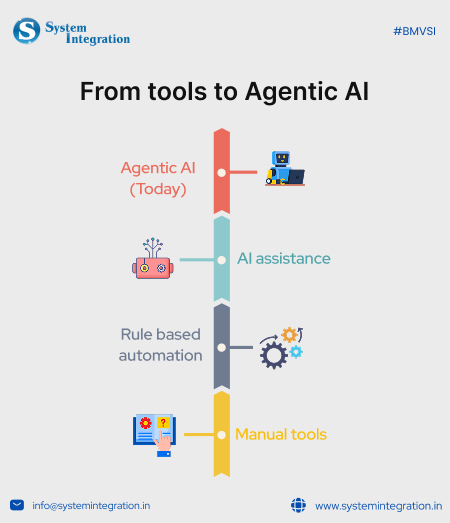
From Automation to Autonomous Decision Making
What changes:
Traditional automation follows scripts; agentic AI chooses the scripts to run, how to correct for mistakes. Rather than having humans encode each rule, agents need only interpret goals and be able to follow a multistep plan.
Business impact:
faster response times, less manual hand offs, and that has led to a huge decrease in operational latency.
Continuous Optimization at Scale
What changes:
Agentic systems don’t merely execute processes, they observe, learn and adapt strategies on the fly. Optimization is not a project; it is constant and endemic to everyday business.
Business impact:
Small incremental benefits add up to huge aids in efficiency and margin over time, by lowering costs while providing quality.
Cross System connectivity
What changes:
Agents Are Smart Connectors, connecting ERP, CRM, logistics, HR and partner systems dealing with APIs triaging data orchestrating cross functional processes without brittle point to point scripts.
Business impact:
Lower integration costs, faster time to value to new digital projects.
New Business Models and Streams of Revenue
What changes:
Agentic AI is the force that allows products to “act” on behalf of customers and companies, agents, subscription based results, and AI managed markets. Outcomes (uptime guarantees, personalized health plans) rather than just products will be sold by companies
Business impact:
More frequent revenue growth and quicker scaling of platform businesses.
Parting words
adoption of agentic AI powered solutions isn’t just a strategic advantage it’s a necessity. Increasing the accuracy of lead scoring, allowing to make informed decisions proactively and optimizing how workflows operate.
AI allows businesses to scale smarter and run faster. Collaboration with an expert AI software development company will get you the knowledge, technology and strategic guidance necessary to achieve measurable impact.
FAQs
here are the ways in which agnetic AI is transforming enterprises’ digital platforms
- Operations and workflow automation
- Better customer experience and support
- Business intelligence and decision making
- Integration across systems
The goal of agentic AI is to augment human capabilities rather than replace them entirely. By doing this, it frees the employees from the repetitive tasks and takes the strategic decisions that require critical thinking.
Unlike traditional AI agents which follow predefined rules that only execute static scripts, agnetic AI continuously learns from the real time and historic data and its goal oriented and autonomous.
To ensure the high quality of data input and managing security and ethics risks. Building trust and managing the cultural shift among employees are also crucial factors.
The future scope involves autonomous software agents handling complex, multi step tasks with minimal human oversight, leading to massive productivity gains across multiple industries and improved personalized services.