Introduction
For decades, large brands had the obvious advantages: capital, infrastructure, manpower, physical presence, distribution and brand recognition. Competing with them required years of effort and deep pockets. But AI has changed that competitive equation forever.
Today, a small startup with only five people can outperform a company with billions using AI-powered strategies, systems and automation. In fact, 71% of startups are already using AI to improve business operations, and companies that integrate AI into core functions grow 2.3x faster than those that don’t.
The shift is so dramatic that analysts predict AI will contribute more than $15.7 trillion to the global economy by 2030 and a significant portion of that value is coming not from enterprise giants but from digitally enabled startups who are using AI more aggressively and creatively.
This is exactly how.
The New Startup Advantage: AI Over Traditional Business
Traditional businesses often rely on legacy systems, large teams, and manual workflows. Decisions may take time, processes get slowed by bureaucracy, and scaling means ramping up resources. Startups using AI service, however, flip this paradigm: they remain lean, agile and data-driven.
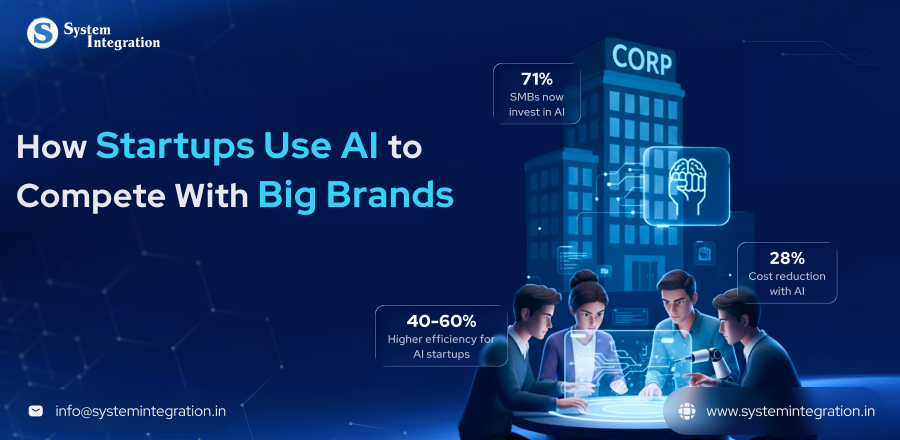
Because AI tools automate much of the heavy lifting from data processing to customer service, startups can deliver enterprise level functionality without enterprise level overhead. According to recent research, small and medium businesses that implement AI solutions report operational cost reduction upto 30% and many note savings of 20+ working hours per month, thanks to AI streamlining tasks that otherwise required manual labor.
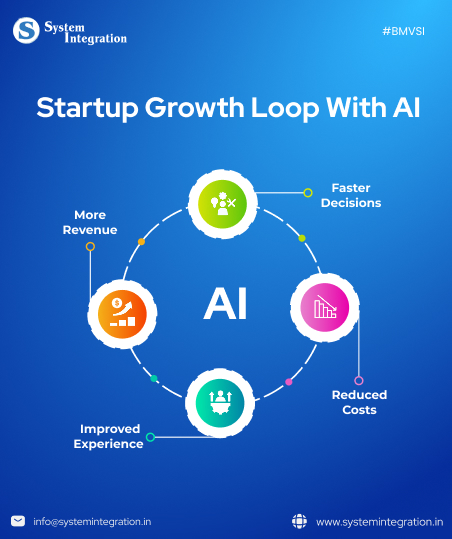
This cost and time efficiency directly translates into competitive advantage: resources like time, money, manpower that would have gone into mundane tasks can now be channeled into growth, innovation, product development or customer outreach.
How Startups Use AI: From Product Features To Operations
Drawing on insights from recent industry analysis alongside the strategies followed by many startups, here are the main ways AI is being used:
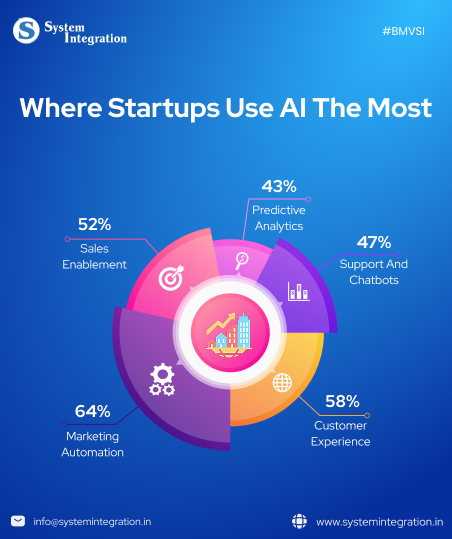
- AI-Powered Product Features & Smart OfferingsMany young companies embed AI directly into their products so users get benefits such as: personalized recommendations, smart search, automated analytics, demand forecasting, and dynamic behavior-based customization. For example: a fitness startup might use AI to tailor workouts based on a user’s history; an EdTech platform may build adaptive learning paths; e-commerce firms deploy AI to recommend relevant products to each user.With these “smart” product features, startups even with limited resources can offer experiences that match or sometimes surpass what big brands provide.
- Marketing & Sales: AI for GrowthStartups leverage AI in marketing and sales via behavior analysis, predictive targeting, content generation, campaign optimization, and automated ad placement. AI helps analyze audience behavior, segment users, and deliver personalized marketing.Several small businesses have reported that AI-enhanced marketing and customer-engagement tools improved their conversions, reduced customer acquisition cost, and delivered measurable business growth.
- Analytics, Big Data & Smarter Decision-MakingStartups rarely have massive data teams. AI changes that by enabling deep analytics, forecasting, trend detection, risk analysis, and rapid A/B testing. Through AI-driven modelling, startups can predict demand, spot market opportunities, and adapt faster than legacy firms encumbered by slower data cycles.This data-driven agility helps startups iterate quickly, refine offerings, and pivot with minimal cost often long before big players react.
- Operational Efficiency & Workflow AutomationAI streamlines operations: automating tasks like data processing, resource planning, customer support, reporting, content generation, and more. With automation, startups save hours, reduce human-error, and maintain high-quality output even with small teams.For many small businesses, AI tools effectively replace several full-time human roles making scaling lean while preserving output quality.
- Customer Service & Personalized User ExperienceAI-powered chatbots, recommendation engines, and smart interaction tools allow startups to offer 24/7 support, instant responses, and personalized experiences. Users get tailored options whether it’s product suggestions, custom content, or personalized communication which build loyalty and trust.For example, through AI-driven personalization and service automation, startups can deliver levels of customer satisfaction and responsiveness that previously required large support teams.
| What Data Says: The Impact of AI on Small Businesses & Startups Recent surveys and market studies highlight strong gains across metrics: ✅ 82% of small businesses, including startups, report AI tools effective for growth ✅ AI-driven tools are seen as cost-effective by 93% of adopters, often leading to higher profitability. ✅ Many small firms claim that AI reduces labor costs sometimes by the equivalent of multiple full-time employees and saves significant employee hours every week. ✅ Businesses adopting AI solutions sometimes achieve a market-share increase of ~15% in their sectors, reflecting not just survival but growth. Clearly, AI adoption isn’t just about trimming costs, it;s about unlocking new growth potential, innovation and competitive parity with larger players. Source: SEO Council |
Why AI Gives Startups A Strategic Edge Over Big Brands?
When a startup embraces AI early, they gain several intrinsic advantages over traditional big enterprises:
- Speed & Agility:
Without rigid hierarchies or legacy systems, startups can test ideas, implement AI-driven features, and iterate quickly. In contrast, large companies often struggle to adapt swiftly due to bureaucracy and existing infrastructure. - Lean Structure, High Output:
With automation, a small team can deliver results similar to a large team. Startups essentially get “more output for less input.” - Personalization at Scale:
AI enables startups to treat every customer as important, delivering tailored experiences, customizing journeys, and building loyalty. This was once possible only for enterprise-level businesses with big data teams. - Data-Driven Decisions:
Instead of intuition or legacy assumptions, startups rely on real data and AI models to predict demand, test features, and optimize performance. - Cost-Effectiveness:
Lower overhead means resources can be reinvested into growth, product development, or marketing boosting competitive edge without big budgets.
Together, these advantages allow startups to not just survive but to thrive and challenge big brands head-on.
Best Practices: How Startups Can Start Using AI Today
If you’re a founder or small business owner thinking of AI adoption, here’s a practical roadmap:
- Start with one area that adds most value → e.g., customer support via chatbots, marketing automation, or analytics dashboards.
- Use SaaS-based AI solutions → they’re affordable, scalable, and don’t require heavy infrastructure.
- Track and measure results → monitor time saved, cost reduced, conversions uplift, customer feedback. Data will tell you whether AI is delivering ROI.
- Iterate fast → leverage AI to test ideas, get feedback, and refine the product or service quickly.
- Prioritize user experience → use AI for personalization, support, smart recommendations, this builds trust and loyalty.
- Treat AI as a strategic growth tool, not just a cost-cutting tool → when used properly, AI helps you scale, innovate, and compete.
Final Thoughts
The narrative that only big brands can dominate markets is fading fast. With AI solutions becoming more accessible, affordable, and powerful, startups now have a real chance to compete and often win.
Using AI for startups isn’t about copying what big enterprises do. It’s about reimagining business workflows, rethinking customer experience, and leveraging agility + innovation.
If you harness AI smartly whether in operations, marketing, product, or service, you may not just keep up with big brands, you might outpace them.
Across global markets, we’re already seeing an increasing number of young companies partnering with specialized AI and automation teams to build scalable systems, streamlined operations, and intelligent digital products without heavy internal infrastructure. We, BMV System Pvt Ltd, are contributing to this shift helping startups access enterprise-grade automation and AI capabilities cost-efficiently, so they can move faster, innovate sooner, and compete confidently.
In the next decade, the winners won’t be the ones with the biggest budgets but the ones who adopt smart technology early.
FAQs
AI gives startups access to automation, machine-learning-driven insights, predictive analytics, customer personalization, and efficient workflows making small teams capable of delivering enterprise-level output.
Not necessarily. Many AI tools are SaaS-based with pay-as-you-go models. For small businesses, this means low upfront cost and scalable usage, a highly cost-effective approach compared to hiring large teams.
Popular ones include AI-driven CRM, chatbots and virtual assistants, marketing automation platforms, predictive analytics, demand forecasting tools, and workflow automation systems.
Sectors like e-commerce, SaaS, fintech, healthcare, edtech, logistics, basically any industry where customer experience, personalization, data analysis, and digital delivery matter can benefit significantly from AI.
Based on recent data, startups can expect reductions in operational costs (30%+), savings in labor/time, higher productivity, improved customer experience and retention, better decision-making, and potential growth in market share.